
|
| Xinjiang Today |
| Art on the move | |
|
|
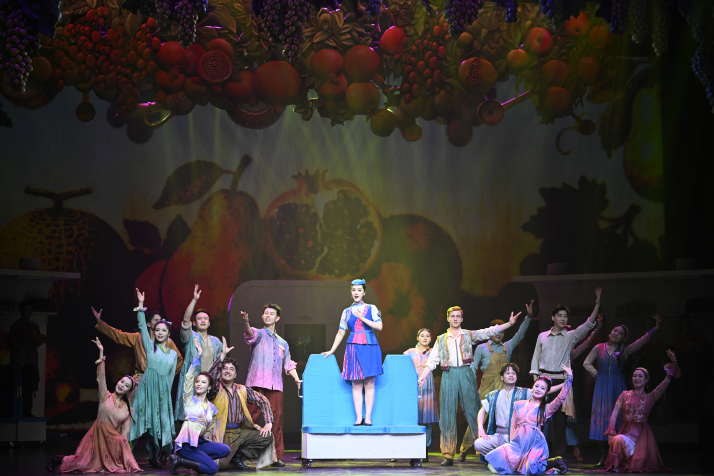 Musical dance drama Happy Golden Train is staged in Beijing on August 24 (CNSPHOTO)
On a slow-moving train winding through south Xinjiang Uygur Autonomous Region, peaches sell out within minutes of each stop. This moving bazaar is a lifeline for local farmers—and it has now inspired a musical dance drama that captivated audiences in the nation's capital. Happy Golden Train, performed at the Seventh National Ethnic Minority Arts Festival in Beijing, brings the real stories of these vendors on trains to the national stage. 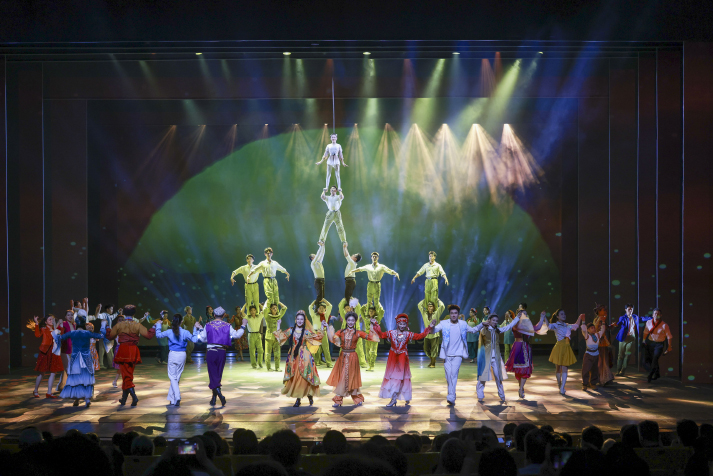 The acrobatic show Tianshan Snow is staged in Beijing on September 8 (VCG)
The moving bazaar As peach season hits its peak, Huojiaabudula Maitiruze and his father head into their orchard in Hetian (Hotan) Prefecture by four each afternoon, plucking ripe fruit and neatly packing them into plastic crates. Early the next morning, they board the train running from Hetian to Urumqi, capital of Xinjiang, selling the peaches to passengers on the train. As travelers board at each stop, the father-and-son team moves through the aisles selling peaches, only to see their inventory vanish soon. "Our peaches are never enough to meet the demand," Huojiaabudula told newspaper Global Times. This onboard market has transformed his livelihood. In years past, he only sold harvests directly from the orchard at rock-bottom wholesale prices to a handful of buyers. Now, selling directly to train passengers commands far better margins, boosting his family's annual income by 70,000-80,000 yuan ($10,000-$12,000). The slow-speed train "Hetian Yulong" operates between Urumqi and Hetian. When service began in June 2011, it broke Hetian Prefecture's historical isolation from the national rail network. Cruising at an average speed under 80 km per hour, the train winds through county after county across southern Xinjiang on a nearly 2,000-km, 32-hour route. Despite the long journey, transit remains extraordinarily accessible: A full hard-seat ticket costs just 165 yuan ($24), while short hops between neighboring stations cost as little as 4 yuan ($0.59). Its passenger cars double as a platform for local farmers to trade fresh produce—earning the train its affectionate moniker, the "moving bazaar." The energy of this rolling market recently took center stage in Happy Golden Train, a musical dance drama performed at the Seventh National Ethnic Minority Arts Festival in Beijing. Held every five years, the festival is China's premier platform showcasing the artistic traditions of its minority communities. Running from August 18 to September 23, the festival features 48 works across 13 theaters, including dance dramas, stage plays, acrobatics, concerts and regional operas. Happy Golden Train was staged from August 24 to 26 as part of the lineup. The drama's screenwriter, Dong Ni, noted that the creative team spent two years conducting field research across Hetian and neighboring counties along the rail route, riding the train repeatedly to collect rich, firsthand stories from local passengers. Every character in the drama is rooted in real life. Among them is Polatihan, the train's chief conductor. A Xinjiang native, Polatihan has served on this line for 14 years. In the early days, he regularly saw farmers squeezed into carriages with heavy baskets and sacks, making the long journey to Kashi's (Kashgar's) night markets to sell their walnuts, dates and pomegranates. For these families, the slow train was a crucial lifeline—a way to turn a year of hard labor into incomes. In 2020, Polatihan proposed a solution: converting a carriage into a dedicated marketplace. Launched as a regular operation in 2021, the train bazaar now hosts vendors from nearly 200 participating farming households. The initiative generated over 650,000 yuan ($96,906) in agricultural sales in 2025 alone, benefiting thousands of rural families along the route. Its success also spawned a companion e-commerce platform. Through this slow-speed train, Xinjiang's local produce now reaches wider markets, delivering fresh regional goods to consumers nationwide. The drama incorporates real-life events gathered during field research, including a dramatic livestock rescue. When a severe blizzard threatened local herds, officials organized an emergency train evacuation that saved hundreds of thousands of cattle and sheep. Today, seasonal livestock transport by rail has become an annual event across the region. Artistically, the drama seamlessly incorporates Xinjiang's distinct intangible cultural heritage. After analyzing extensive historical archives, composer Xu Hao fused traditional Muqam musical motifs with contemporary orchestral techniques. A classical Uygur art form masterfully integrating music, song, dance, literature and drama, Muqam was inscribed by UNESCO as a Masterpiece of the Oral and Intangible Heritage of Humanity in 2005. The opening sequence blends a train whistle's echo with classic Muqam melodies, immediately transporting the audience to the heart of the borderlands. National treasure preservation Building on this deep artistic connection, the festival's program featured a second major work dedicated to the Muqam heritage: an opera chronicling the life of Wan Tongshu, the visionary musician who worked alongside local artists to rescue the endangered Twelve Muqam. Considered the grandest and most structured pillar of the tradition, the Twelve Muqam comprises twelve large-scale suites that serve as the bedrock of Uygur classical music. In 1951, 28-year-old Wan—then a young scholar at the Central Conservatory of Music in Beijing—was tasked with an urgent mission: travel to Xinjiang and save the Twelve Muqam before it vanished forever. Passed down orally for over four centuries without written notation, the complex masterwork survived through a single master over 70 years old. Recognizing the urgency, Wan came to Xinjiang with his wife and their infant daughter. He spent over two months recording the aging master and developing an original notation system. After nearly five years of painstaking transcription, the Twelve Muqam was formally preserved in print for the first time. Produced by the Xinjiang Art Theater, the new opera, scheduled to be staged in Beijing on September 20-21, brings this historic rescue to life. Marking Xinjiang's first production to fuse traditional Muqam with modern AI technology and digital media, the performance utilizes holographic projections to transcend time and space—honoring the quiet heroism that safeguarded a national treasure. 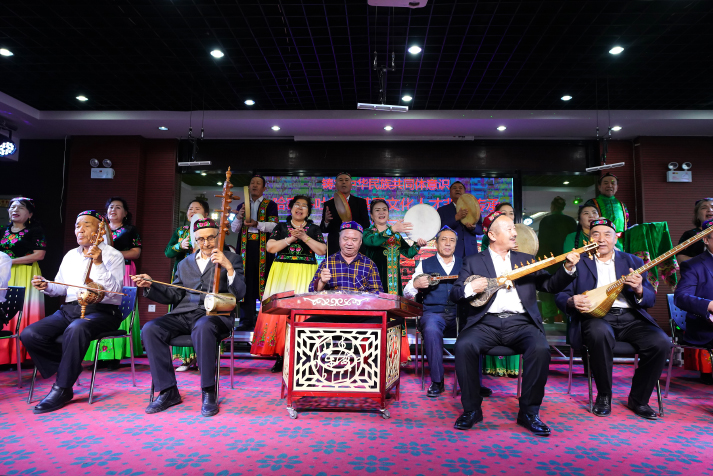 Muqam inheritors perform a singing and instrumental piece in Hami on December 16, 2025 (VCG)
Cross-regional bond Beyond music and opera, Xinjiang's artistic narrative at the festival extended to Tianshan Snow, an acrobatic show jointly staged by performers from Shanghai and Xinjiang. Presented in Beijing on September 7 and 8, it marks China's first acrobatic drama themed on the national paired assistance program. Under the program, developed provinces are paired up with less-developed regions like Xinjiang, to provide financial, technical, and cultural support for coordinated development. The narrative centers on the decades-long bond between acrobats from both Shanghai and Xinjiang, unfolding a 70-year panorama of cross-regional solidarity through breathtaking stagecraft. To refine the production, the creative team completed nine rounds of revisions and undertook multiple field trips across Xinjiang to ground the story in real-life experiences. Since its 2023 premiere, the show has logged nearly 100 performances nationwide, including two extensive tours across the Tianshan Mountains, reaching over 2 million viewers online and offline. "Performing at the Seventh National Ethnic Minority Arts Festival is meaningful," said Liang Hongjun, head of the Shanghai Acrobatic Troupe. "Rooted in true stories of mutual support between Shanghai and Xinjiang, the connections built through Tianshan Snow have paved the way for deeper, ongoing collaborations between our troupe and Xinjiang's local performing groups." On the holographic stage of Beijing's theaters, Xinjiang's stories are traveling farther than ever before. Whether through the rhythm of a train whistle, the haunting melody of Muqam, or the daring feats of acrobats, the performances remind us that art—like the slow train itself—is a bridge connecting lives, cultures and histories. Comments to yuanyuan@cicgamericas.com |
|
||||||||||||||||||||||||||||
|