|
| Xinjiang Today |
| Records revisited | |
|
|
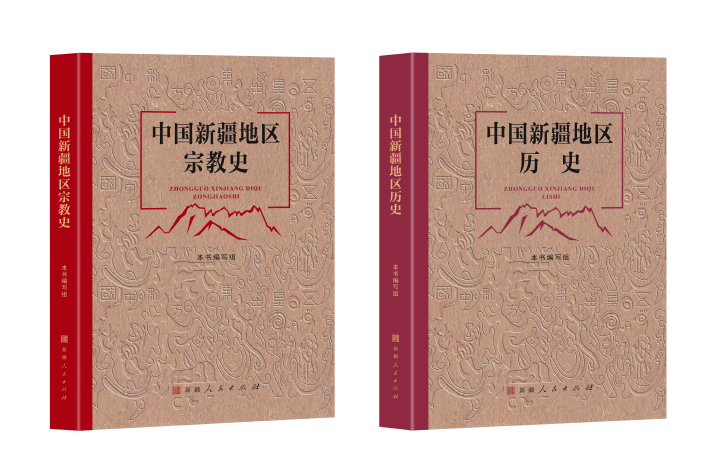 The covers of The History of China's Xinjiang Region and The Religious History in China's Xinjiang Region (COURTESY PHOTO)
As early as the pre-Qin period (pre-221 B.C.), the area of present‑day Xinjiang Uygur Autonomous Region was already conducting extensive cultural exchanges with the Central Plains, a vast area covering the lower and middle reaches of the Yellow River, considered the heartland of ancient China. Cultures in this region have borne the marks of China's diverse and unified civilization from the very beginning. More than 2,100 years ago, Chinese envoy Zhang Qian set out from Chang'an, known as Xi'an today, on a diplomatic mission to the Western Regions, or xiyu, which includes today's Xinjiang. His expedition laid the foundation for the ancient Silk Road, a route that connected China with Central Asia and Europe.
In 60 B.C., the Western Han Dynasty (202 B.C.-A.D. 25) established the Western Regions Frontier Command, which was the first time the Central Government exercised effective administrative jurisdiction over Xinjiang. From that point on, every Chinese dynasty regarded the Western Regions as part of its territory and maintained governance over the area. Over centuries, the peoples of the Western Regions and the rest of China together built the country's territory, culture and shared identity. That long history is now the subject of two new books The History of China's Xinjiang Region and The Religious History in China's Xinjiang Region, released on September 2 in Beijing by the Xinjiang People's Publishing House. They are the most comprehensive books on the region's history produced by Chinese scholars to date. The editorial team said the books aim to present the historical development and religious evolution of the region, drawing on archaeological discoveries and historical records. They also seek to address misrepresentations about Xinjiang's history that have circulated abroad and to provide the public with reliable and accurate historical knowledge. 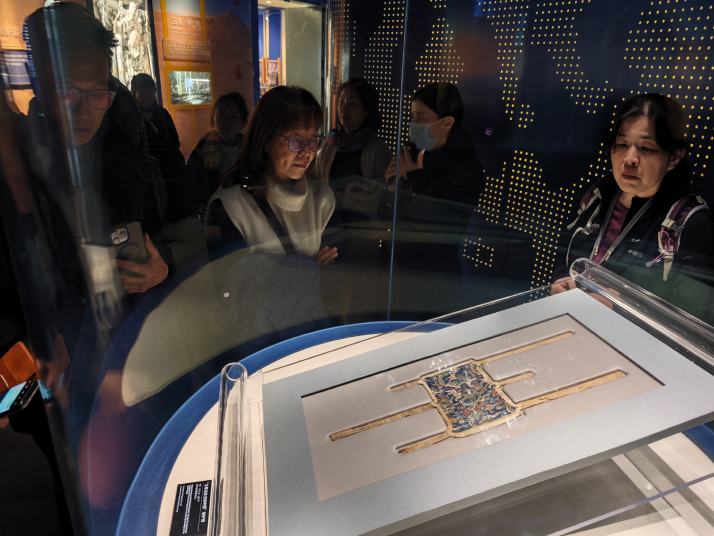 A brocade armguard dating back to the Han Dynasty (206 B.C.-A.D. 220) with the inscription "Five stars rising in the east benefit the Central Plains" on display at the Museum of Xinjiang Uygur Autonomous Region in Urumqi on November 9, 2025 (LU YAN) What the books offer The two books draw on archaeological findings and historical records to trace the region's development from ancient times to the present. The History of China's Xinjiang Region is China's first full‑span general history of the region with a rigorous, complete editorial structure. It traces the region's development, with a focus on the modern era, documenting how successive Chinese dynasties administered the area. After the Western Han Dynasty established the Western Regions Frontier Command, the Tang Dynasty (618-907) successively established the Grand Anxi Frontier Command and the Grand Beiting Frontier Command, high-level military posts, placing the region under a full‑fledged frontier governance system. The Qing Dynasty (1644-1911) established the post of Yili (Ili) General and adopted a mechanism combining military and political administration, consolidating border defense in the northwest. In 1884, it established the Western Regions as a province. In 1912, as a response to the Revolution of 1911, Xinjiang became a province of the Republic of China (1912-49). "However turbulent events were in the Western Regions across history, the region ultimately came under unified governance of China's central authorities. This is the defining pattern of Xinjiang's historical development," Tian Weijiang, Co-Editor in Chief of the book and former Vice President of the Xinjiang Academy of Social Sciences, told Xinjiang Today. The Religious History in China's Xinjiang Region examines the coexistence of multiple faiths in the region over time. It documents the spread of Buddhism, Taoism, Manichaeism, Islam and many others through Xinjiang at different periods. "In Xinjiang, no ethnic group adheres to a single religion, nor has any ethnic community maintained unchanged religious beliefs throughout history," said Yu Shangping, Co-Editor in Chief of the book and Vice President of the Xinjiang Academy of Social Sciences. In the narrative framework of Western religious history, church‑state relations are often reduced to a binary opposition between theocracy and the separation of church and state. The book offers an approach rooted in China's long history—zheng zhu jiao cong, or state primacy over religion. "China's traditional church‑state relationship follows the principle of zheng zhu jiao cong, meaning religion submits to and serves state power," Yu said. This, he noted, is the most defining feature of the relationship between religion and the political superstructure in China. Beginning with the central government's administration of the Western Regions in the Western Han, religious administration was a part of China's frontier governance system. Successive imperial authorities established dedicated institutions and refined policies for religious management, enabling religions to support imperial rule and educate local communities. During the Tang Dynasty, the imperial court decreed the establishment of state‑run Buddhist and Taoist temples nationwide. Through systems including allowing monks to serve as government officials and issuing ordination certificates and monastic registrations, Buddhism and Taoism in Xinjiang were brought under effective regulation. Rulers of the Yuan and Ming dynasties (1271-1644) established religious administrative bodies of varying ranks and scopes for different faiths to tighten oversight over religious affairs across the Western Regions. In the Qing Dynasty and the Republic of China period, central authorities strengthened the governance of religions in Xinjiang through national legal frameworks. "Throughout this course of history, religious governance formed an integral part of the central authorities' frontier administration. Eras in which the central power maintained strength and effective oversight over religious affairs in Xinjiang were generally peaceful, stable and prosperous, and religions coexisted and interacted," Yu said. Historical evidence shows that robust religious governance and ensuring harmonious relations among religions are effective at preserving stability and prosperity across Xinjiang, Yu added.
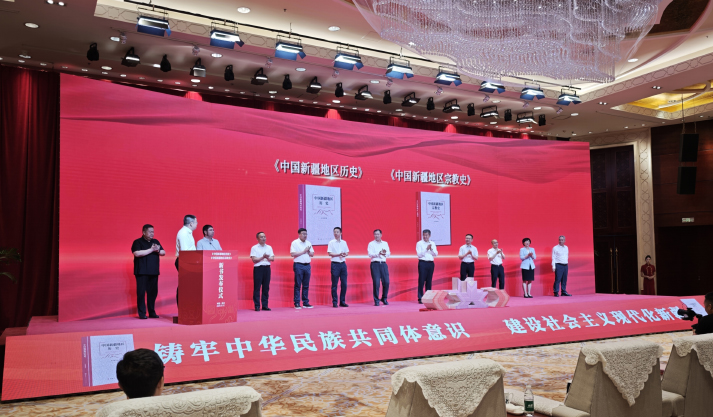 The book launch of The History of China’s Xinjiang Region and The Religious History in China's Xinjiang Region (LU YAN)
The significance The release of these two books carries both academic and political weight. For some time, hostile forces at home and abroad have grossly distorted, fabricated and tampered with Xinjiang's history, exaggerated cultural differences, and promoted ethnic estrangement and hatred. Their aim is to disrupt the ideological sphere in Xinjiang and confuse public opinion, Wang Jianxin, head of the Publicity Department of the Communist Party of China Xinjiang Uygur Autonomous Regional Committee, said at the book release. "Drawing comprehensively on archaeological evidence, cultural relics, historical documents and academic findings, the two books lay out well‑grounded facts about Xinjiang's history, ethnicity, culture and religion, and forcefully refute fallacies and disinformation concerning Xinjiang," Wang added. Wang Yao, Director of the Department of Xinjiang Studies at the Institute of Ethnology and Anthropology, Chinese Academy of Social Sciences, said that on-the-ground work in Xinjiang has often moved ahead of theoretical exploration. Although notable progress has already been made in many areas, there has been a relative lack of systematic review and synthesis of practical experience. The publication of these two books serves both as a historical review of governance achievements in Xinjiang in the new era and as a timely addition to the limited pool of educational materials on Xinjiang's history and religions. "They will provide strong guidance and play an indispensable role in primary, secondary and higher education, museum education and other forms of public learning," Wang Yao said. Comments to luyan@cicgamericas.com |
|
||||||||||||||||||||||||||||
|