
|
| Xinjiang Today |
| The refrigeration revolution | |
|
|
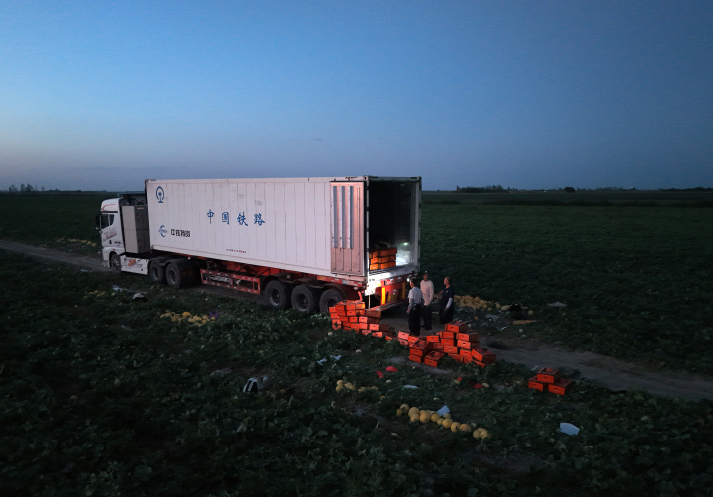 A refrigerated container truck is loaded in a field in Urumqi on July 17 (VCG)
For centuries, Xinjiang's distance from the rest of China meant that only its dried fruits such as raisins could reach distant markets in any meaningful quantity, while fresh melons and grapes remained prohibitively expensive for most households owing to high transportation costs. With limited sales in other markets, even premium Hami melons, a group of melon varieties native to Xinjiang that are named for the city of Hami and known for their sweet and refreshing taste, were sold at extremely low prices at local bazaars.
Today, cold chain logistics has brought revolutionary benefits to both producers and consumers. Hami melons, traceable via QR codes and graded through a 28-indicator digital sorting system, can fetch as much as 180 yuan ($26.8) a piece in up-scale supermarkets in cities including Shanghai and Shenzhen in Guangdong Province. 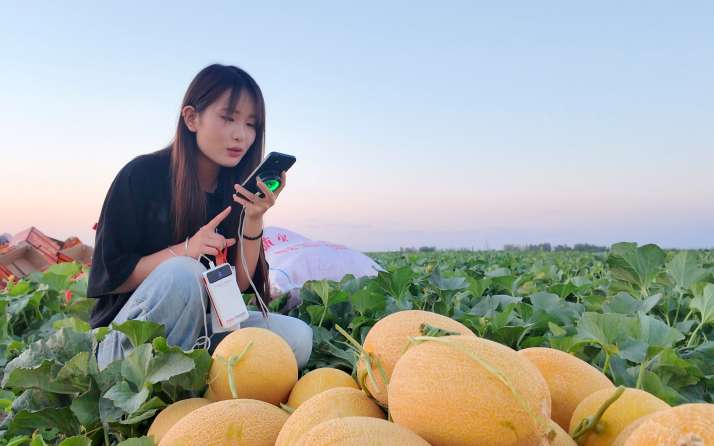 A social media influencer sells Hami melons via livestreaming in Hami on July 17 (VCG)
Natural endowments Blessed with abundant sunshine and sharp day-night temperature differences, Xinjiang produces high-quality fruit valued for its sweetness and texture, creating unique competitive edges in global agricultural trade. Bolstered by solid industrial progress and standardized cultivation, Xinjiang's fresh fruit exports have posted sustained growth in both volume and value in recent years. Official figures from the General Administration of Customs show that Xinjiang exported 320,000 tons of fruit worth 4.2 billion yuan ($619 million) in 2025, up 33 percent and 44 percent year on year, respectively. As a major gateway for Xinjiang's farm exports to Central Asia and wider Eurasian markets, the Huoerguosi (Khorgos or Horgos) land port in Yili (Ili) Kazak Autonomous Prefecture has seen a substantial rise in outbound fresh produce trade. Local customs data show that 413,000 tons of fruits and vegetables were shipped from the port between January and July, a 28.1-percent year-on-year rise. Xinjiang's premium fruit is gaining a foothold in far-flung markets. Kashi (Kashgar) cherries arrived in Hong Kong Special Administrative Region for the first time in June. In July, a 342-kg consignment of Kashi netted melons also made their debut in the market via full cold-chain air freight from Urumqi Tianshan International Airport. Kashi Customs opened a dedicated green channel for agricultural and food exports, and offered customized enterprise support, adopting immediate declaration, prompt inspection, fast certification and efficient release to preserve freshness and achieve speedy delivery. Even newer varieties such as Jiashi plums (xinmei), with a national geographical indication brand value exceeding 3.8 billion yuan ($566 million), now reach Southeast Asian markets via cold-chain routes. 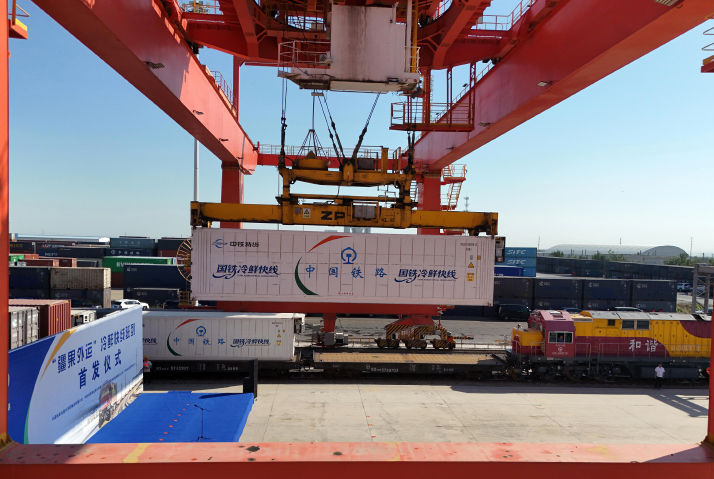 A container crane hoists a container off of a cold-fresh express train in Urumqi on July 17 (VCG)
Cold-chain upgrade Previously, the outbound transportation of fresh produce from Xinjiang relied heavily on road transport that involved repeated trans‑shipments. Consequently, long transit times often resulted in delayed arrivals for consumers in other parts of China and international markets. A turning point came when China State Railway Group, the national railway operator, launched a cold-fresh express service specifically to transport fruit from Xinjiang this summer. In July and August, cold-fresh express trains from Urumqi and Aksu slashed transit times to Xi'an in Shaanxi Province and Jiaxing in Zhejiang Province from five days to just 36 hours. The service deploys refrigerated containers with precise temperature control and round-the-clock intelligent monitoring. Local railway operators provide end-to-end delivery and bring refrigerated containers directly to orchards for on-site loading to retain maximum freshness. Improvements to Xinjiang's multi-modal cross-border cold-chain logistics network have further opened overseas routes. Launched on September 24, 2024, a cold-chain freight train service from Urumqi to Bangkok, Thailand, was put into operation, creating a reliable long-distance rail corridor for Xinjiang fruit to reach Southeast Asian markets. Its inaugural trip carried more than 463 tons of local table grapes in refrigerated containers, departing from the Urumqi International Land Port Area and arriving in Bangkok via Mohan Port on China's border with Laos. The innovative "farm-side consolidation and cold-chain freight train" model enables whole-process temperature monitoring, lowering cargo damage and ensuring timely delivery for long-distance fresh fruit trade. Institutional innovation at border ports has smoothed export passages. Huoerguosi runs a special green channel for China-Kazakhstan agricultural trade, featuring 24-hour clearance, online phytosanitary (plant health and disease control) certificates and priority inspection and release for perishable farm produce, shortening port dwell time and trimming transit expenses. Coupled with dedicated air cargo routes for high-value items such as figs and premium fresh prunes, Xinjiang has formed a three-dimensional cold-chain logistics network: Road links serve nearby markets, railways handle large-volume long-haul transport and air freight delivers high-end fresh produce. In August 2025, a dedicated air cargo service for fruit and vegetable trade was launched between Urumqi and Dubai in the United Arab Emirates. Before that, Xinjiang's fresh produce bound for the Middle East relied mainly on sea, land and rail connections, entailing long transit times and freshness challenges. "Fruits and vegetables from Xinjiang can now reach Dubai directly in about six hours," Zhu Shiqiang, Chairman of Xinjiang Fruit Industry Group, told Xinhua News Agency. Wang Kexiang, technical head at the Hami Melon Industry Chain Platform Service Center in Hami, manages a 67-hectare double-cropping greenhouse operation in the city's Huayuan Township. On the night of August 15, he led farmers in a late-night harvest, with the melons being rushed to Chongqing Municipality by refrigerated trucks. "Premium melons must meet strict quality standards. We harvest at night to avoid daytime heat, locking in sweetness and flavor and aiding the cold-chain transport," he told Xinjiang Daily. Connectivity and beyond Upgraded domestic and cross-border cold-chain logistics represent more than progress in Xinjiang's foreign trade infrastructure. They offer an example of turning ecological and agricultural strengths into economic gains and shared benefits of China's opening up. Standardized workflows, including hand-picking, automatic sorting, pre-cooling and constant-temperature packaging, have been widely adopted in Tulufan (Turpan), Aksu, Kashi and other major fruit-producing regions. Urumqi Customs is continuously refining regulatory services, implementing full-chain supervision covering orchard registration, standardized harvesting, packaging and traceability. It also offers targeted guidance on international phytosanitary rules and packaging requirements to help Xinjiang's fresh fruit meet market access standards across Eurasia and in other markets. Nonetheless, challenges persist, and targeted solutions have become vital to sustaining growth. For perishable goods, every hour matters. "Previously, customs officers would spend half a day commuting from their office to our warehouse for inspections," a Hami melon cooperative manager told China News Service. "Today, thanks to a smartphone app, the whole inspection is completed in under 30 minutes. This allows goods to be loaded and shipped on the same day, significantly reducing costs while preserving freshness." Hami Customs' new remote inspection system completed its first cross-border melon clearance via high-definition video link in only 24 minutes. The new system cuts the time required by more than 80 percent and reduces storage and logistics costs by roughly 1,000 yuan ($149) per shipment. As one customs official put it, the system "essentially moves the inspection counter right into the packaging facility, with no physical visits, lower costs and zero waiting." Xinjiang's fresh fruit is now far less bound by the limits of shelf life or distance. The cold-chain network that makes this possible is still expanding, with more routes, faster clearances and smarter monitoring. Already, the network has proven that even the most perishable goods can travel the ancient Silk Road routes at modern speed, carrying sweetness and flavor in one direction and opportunities and higher incomes in the other. Comments to mamm@cicgamericas.com |
|
||||||||||||||||||||||||||||
|