
|
| Xinjiang Today |
| Echoes of Chawuhu culture | |
|
|
 Bronze knives excavated from the Chawuhu Cemetery in Hejing County, on display at the Xinjiang Museum in Urumqi, on September 3, 2025 (VCG)
At the southern foot of the Tianshan Mountains in Hejing County, Bayingol Mongolian Autonomous Prefecture, lies a ravine mouth called Chawuhu. Here, the alluvial terraces are exposed, strewn with gravel and stones, yet beneath this seemingly desolate surface rests the largest prehistoric clan cemetery discovered so far in Xinjiang—the Chawuhu Cemetery.
The tombs are densely distributed, neatly arranged, distinct in character and grand in scale. Since archaeologists first uncovered this site in 1983, a splendid civilization spanning the late Bronze Age to the early Iron Age has come to light, and in archaeological terms it has been named the Chawuhu culture. Based on current archaeological evidence, the Chawuhu culture flourished over 3,000 years ago, lasting roughly 600 years (from around 1000 to 400 B.C.) and spanning the Western Zhou Dynasty (1046-771 B.C.) through the Spring and Autumn (770-476 B.C.) and Warring States (475-221 B.C.) periods. It reflects the historical process of the ancient peoples at the southern foot of the Tianshan Mountains, from clan-based communal living to diverse cultural integration. 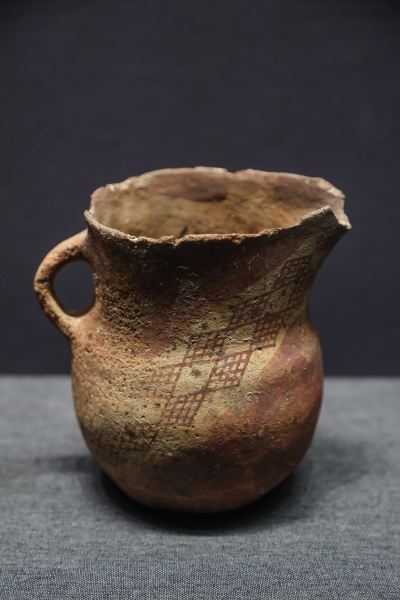 A single-handled spouted painted pottery jar excavated from the Chawuhu Cemetery in Hejing County, on display at the Xinjiang Museum in Urumqi, on September 3, 2025 (VCG)
Chronological framework Based on radiocarbon dating and archaeological typological analysis, the absolute dates of the Chawuhu culture span from before the 10th century B.C. to the late 5th century B.C. or even later. Radiating outward from the Chawuhu ravine mouth, its sphere of influence extended north to the southern foot of the Tianshan Mountains, south to Qiemo County on the southeastern edge of the Taklimakan Desert, east from Hejing and west to Wensu County, with its core area of activity in the Yanqi Basin and surrounding regions. In addition to the Chawuhu Cemetery, its cultural complex also includes a series of important sites such as the Qunbake (Qunbak) Cemetery in Luntai County, the Kezier (Kizil) Reservoir Cemetery in Baicheng County and the Zhagunluke (Zagunluk) Cemetery in Qiemo. Historians generally divide the Chawuhu culture into three developmental stages. The early period (ca. 1000-800 B.C.), represented by the No.5 cemetery of the complex, was characterized by the emergence of stone-enclosed graves, the predominance of primary single burials, the widespread use of plain pottery and the initial appearance of bronze artifacts. The middle period (ca. 800-500 B.C.)—the cultural peak—was centered on the No.1 and No.4 cemeteries. It was marked by the prevalence of multiple secondary burials, the peak of painted pottery production and a balanced mix of animal husbandry and agriculture. The late period featured an increase in stone-mound tombs, the appearance and gradual spread of iron implements, larger joint burials of up to 20 to 30 individuals and stronger cultural influences from the eastern and northern steppe zones. The most distinctive marker of the Chawuhu culture lies in its unique and well-regulated tomb structure—the vertical stone-chamber tomb. On the terraces within a 5-km radius of the Chawuhu ravine mouth, over 2,000 tombs were arranged in orderly rows, dense yet not chaotic, indicating a clan society with a tight social organizational structure. On the surface, most tombs were encircled by large pebbles forming curved triangular, circular or oval enclosures, which later evolved into inverted-funnel-shaped mounds. The burial chambers were vertical pits dug downward, with walls built of block stones, and the mouths were usually covered with large stone slabs or logs. Some tombs feature a short, shallow sloping passage on the southern side—possibly a ritual path believed to guide the soul of the deceased. Unlike the primary burials commonly found elsewhere in Xinjiang, the Chawuhu culture practiced multiple secondary burials. After a period of time following a relative's death, the deceased's decayed bones were collected and reburied together with other deceased clan members in the same stone chamber, arranged in layers with bones scattered and intermingled. Each tomb chamber often contained burials of several to as many as 20 or 30 individuals, men, women, young and old alike, reflecting a strong bloodline cohesion and a clan identity of "sharing life and death together." In addition, there were also some primary burials in extended supine or flexed side positions, with the heads uniformly oriented toward the west or northwest—a ritual orientation that likely expressed a cosmological longing for the direction of sunset or the mythical ancestral homeland. At the edges of the main stone-chamber tombs, small child satellite burial pits are often found, along with sacrificial pits containing horse heads, cattle heads and hoof bones. Within the cemetery area, special sacrificial altars have also been discovered, paved with stones of five different colors—likely symbolizing cosmic directions or elemental forces, reflecting the prevalent mountain worship and primitive shamanistic beliefs of the time. This layout of human-animal co-sacrifice and the interment of both adults and children in the same ritual space paint a vivid picture of the prehistoric spiritual world. 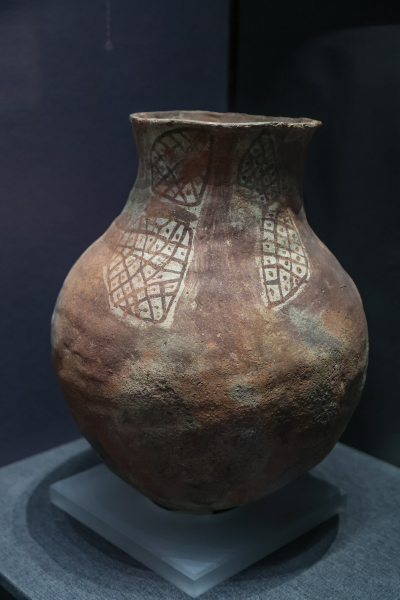 The Cultivated Field and Grapevine Motif Painted Pottery Jar excavated from the Chawuhu Cemetery in Hejing County, on display at the Xinjiang Museum in Urumqi, on September 3, 2025 (VCG)
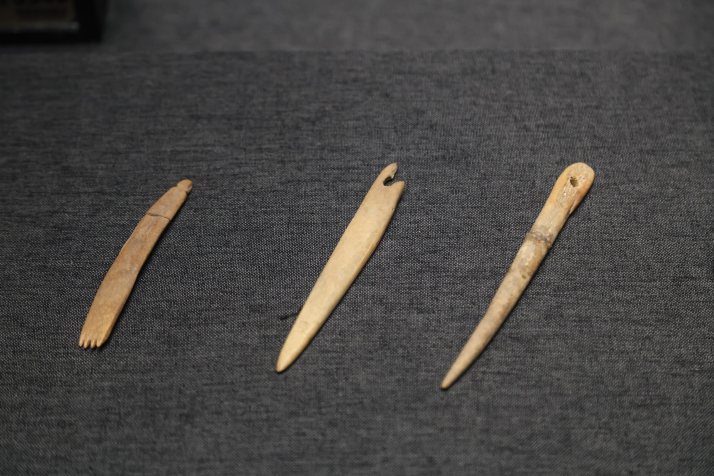
Diverse artifacts Among the over 5,000 artifacts unearthed from the cemeteries, pottery accounts for the lion's share. The unique vessel shapes and brilliant decorative patterns form the very soul of the Chawuhu culture. The most typical pottery form is the single-handled spouted jar. One side of the body is fitted with a flat, wide or cylindrical spout, while the opposite side bears a single or double handle, and the base is mostly flat. The design of the spouted vessel likely originated from imitation of leather or wooden containers, adapting to the daily needs of consuming dairy products and beverages, and it stands as an iconic symbol of prehistoric culture at the southern foot of the Tianshan Mountains. Painted pottery accounts for over 12 percent of the Chawuhu assemblage, boasting a highly distinctive style. The pottery is mostly sand-tempered red or reddish-brown ware, covered with a yellowish-white or pinkish slip and then painted with ochre-red or black pigments. The decorative patterns are dominated by geometric designs—lozenge patterns, grid patterns, triangles, checkerboard patterns, vertical stripes and variant meander patterns interwoven with one another. Among them, the Cultivated Field and Grapevine Motif Painted Pottery Jar unearthed in 1987 is particularly striking. Combining grid patterns symbolizing furrowed fields with curved grapevine tendrils, it is one of the earliest painted pottery pieces in China to merge agricultural and grape motifs. This artifact provides solid evidence that the Chawuhu people had already begun cultivating grapes and practicing horticulture as early as the pre-Qin period (prior to 221 B.C.), long before Han Dynasty (206 B.C.-A.D. 220) envoy Zhang Qian's missions to the Western Regions, known as Xinjiang today. This discovery overturns the long-held assumption that grape cultivation in the Western Regions only began in the Han era. Bronze artifacts are the second largest category, including knives, awls, needles, spears, arrowheads, horse bits, rings and bowls, yet farm tools are rarely found, suggesting the central role of animal husbandry. In the late Chawuhu period, iron artifacts quietly made their appearance. Although most of the excavated iron cauldron fragments, iron awls and iron rings are heavily corroded, they signify the onset of the early Iron Age. In addition, stone artifacts such as grinding slabs and spindle whorls, bone artifacts like hairpins and arrowheads, wooden objects such as trays and spoons, and fine fragments of woolen textiles piece together a settled society with advanced handicraft industries including pottery making, metallurgy, wool spinning and woodworking. 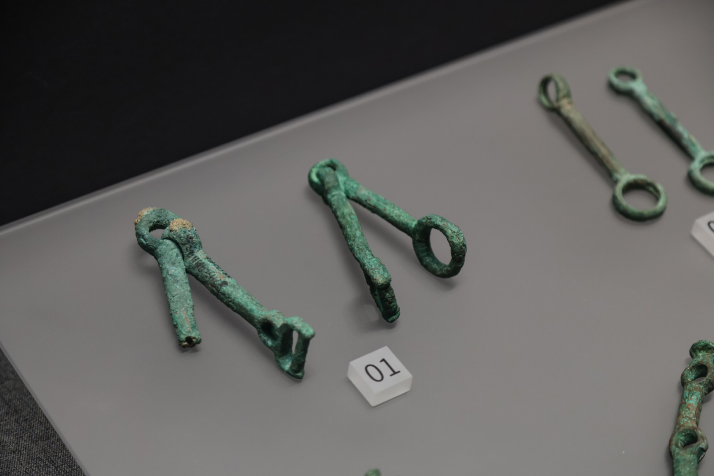 Bronze horse bits excavated from the Chawuhu Cemetery in Hejing County, on display at the Xinjiang Museum in Urumqi, on September 3, 2025 (VCG)
An interwoven picture For a long time, the scholarly stereotype of prehistoric Xinjiang's economy was one of pure nomadism—moving in pursuit of water and pasture. However, isotopic analyses of human bones, plant starch grain testing, and archaeological remains from the Chawuhu culture reveal a composite subsistence pattern that combined farming and herding, with both sedentary settlement and mobility coexisting. The tombs contain abundant sheep, horse and cattle bones as grave goods, and even special horse-head and cattle-head pits. Trace element analysis of human bones indicates that meat constituted a significant portion of the diet. The discovery of bronze horse bits and cheek pieces proves that horses were used not only for meat but also for riding, hauling and warfare. Flocks of sheep provided the mainstay of wool, hides and dairy products. The Chawuhu people most likely practiced mountain grassland pastoralism characterized by seasonal transhumance. Starch grains of foxtail millet, barley and wheat detected on the inner walls of pottery vessels, along with the discovery of grinding slabs and stones, confirm that they cultivated drought-resistant millet and wheat—crops of Western origin—in the riverine oasis zones at the southern foot of the Tianshan Mountains. The agricultural and grapevine motifs on the pottery jars are direct material evidence of horticulture. This model—with herding providing meat, animal power and dairy, and farming supplying carbohydrates and stable reserves—greatly enhanced the community's resilience against risks. More importantly, the large-scale family joint burials, combined with disparities in the quantity of grave goods—some tombs containing only one or two pottery vessels while others contain dozens, along with the coexistence of bronze and pottery weapons—suggest that wealth differentiation and initial social stratification had already emerged within the clan. A social structure anchored by elders or chiefs was likely taking shape. Today, the Chawuhu Cemetery is a key cultural heritage site under state protection. Standing on the terrace at the Chawuhu ravine mouth and looking into the distance, the snowy peaks of the Tianshan Mountains are piercingly cold, and the wind through the ravines sounds like a whispering tale. Though the stone enclosures built of pebbles are now weathered and mottled, they still guard the traces of a 3,000-year-old civilization. They tell us that long before Zhang Qian opened the route to the Western Regions in 139 B.C., a brilliant people had already thrived at the southern foot of the Tianshan Mountains, who bridged the East and the West. They practiced both farming and herding, dwelled in stone chambers and created painted pottery. As vital members of the broader family of the Chinese nation, their culture remains a weighty and unique piece of the mosaic that constitutes the diverse yet integrated pattern of Chinese civilization. Comments to lanxinzhen@cicgamericas.com |
|
||||||||||||||||||||||||||||
|