
|
| Xinjiang Today |
| An August encounter with Hetian | |
|
|
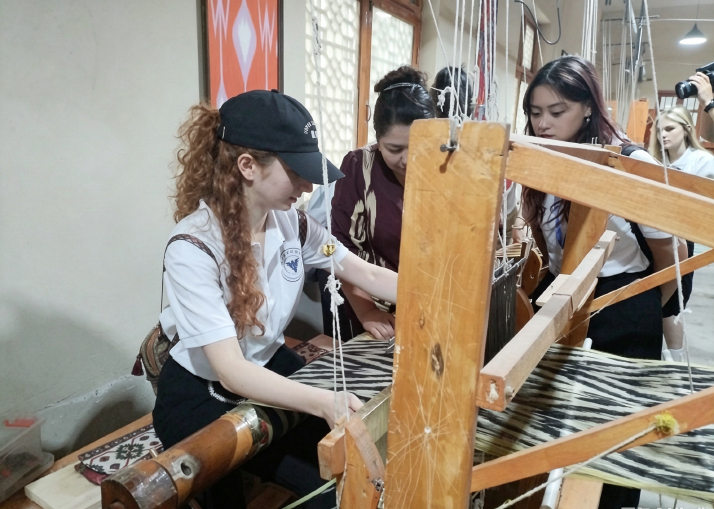 International students from Zhejiang University experience the weaving of Atlas silk on August 9 (XIANG YUTING)
Late on the summer night of August 6, drums and horns rose over Yotkan Ancient City in Hetian (Hotan).
As the cry "Open the city!" rang out, the ancient city seemed to awaken from history. There was no stage and no fixed seating; the story of the Kingdom of Khotan (232 B.C.- A.D. 1006) unfolded through streets, courtyards and squares. Among the crowd that night were 21 international students from Zhejiang University, from 18 countries. When the actors playing the king and queen walked through the audience, history and the present briefly shared the same space. Khotan, the name of Hetian in ancient times, was an important oasis on the southern route of the Silk Road. Today's Yotkan Ancient City is a cultural and tourism complex reconstructed on the basis of archaeological findings from the underground ruins of Yotkan, an important site of ancient Khotan. The name "Yotkan" is said to carry a local meaning of "the land of kings." Archaeological discoveries from beneath have yielded numerous artifacts bearing witness to exchanges and interactions among different civilizations. It is against this historical backdrop that The Music of All Lands Resounds in Khotan, an immersive outdoor production inspired by the history and culture of ancient Khotan, has found its home here. For these international students who traveled through Xinjiang from August 4 to 10, it is one of the most unforgettable nights of the journey. "Of my whole journey through Xinjiang, what impressed me most was the night in Yotkan Ancient City," Alice Kuhn Ozawa from Canada said. The performance ended, but the exchanges it portrayed did not—they live on in Hetian's jade, silk and carpets, where people from different directions once met and created something new. 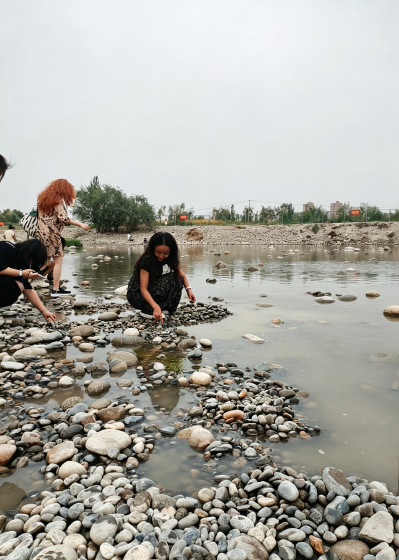 International students from Zhejiang University search for Hetian jade at a jade site in Hetian on August 6 (XIANG YUTING)
Jade's long journey On August 6, at the Hetian Jade Museum, French student Lucie Marie Godallier began to understand why Chinese people value jade so highly. "I used to think it was just a beautiful stone," she said. Hetian jade is mainly found in the Kunlun Mountains. As early as the Neolithic Age, people at the foot of the mountains had begun using it. Over time, jade traveled eastward to the Central Plains, the heartland of ancient China that covers the middle and lower reaches of the Yellow River, forming an ancient route later known as the Jade Road—one that predated the Silk Road. Jade later came to stand for virtue, ritual and spiritual ideals. It linked people and places separated by mountains and distance, opening Hetian to the wider world early in its history. "Now I like it too," Godallier said with a smile. Lin Joan, from Austria, was particularly struck by jade's presence. In her view, behind every piece of jade carefully carved and polished by artisans lies a long tradition. Besides, from solemn ritual objects and personal ornaments to treasures collected by aristocrats and everyday objects carrying wishes for good fortune, people continue to give jade new meanings. 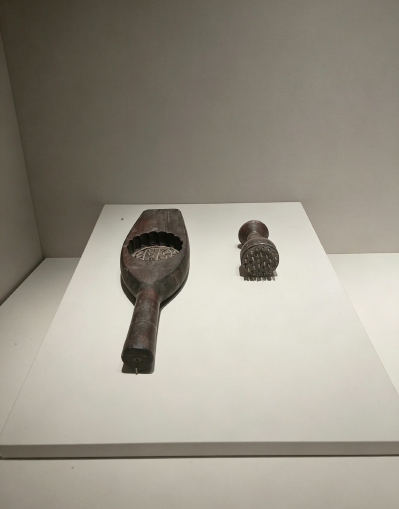 A mooncake mold in the Hetian Museum on August 6 (XIANG YUTING)
Encounters in silk On August 9, in a workshop in Jiya Township, the rhythmic sound of a wooden loom filled the room. Silk threads, prepared through the traditional process of resist-dyeing the warp, were arranged on the loom. As the weaver's hands moved back and forth, colors that had once seemed separate gradually intertwined, and vivid, flowing patterns began to emerge. The international students gathered around the loom. Some recorded the process on their phones. Others leaned in to ask questions. A few, guided by the artisans, tried weaving a small section of fabric themselves. For someone encountering the making of Atlas silk for the first time, it is difficult to imagine that the brilliantly colored fabric before their eyes began as bundles of delicate threads. China was among the earliest places in the world to develop mulberry cultivation, sericulture and silk production. A long-standing legend about how sericulture reached ancient Khotan was recorded by the Tang Dynasty (618-907) monk Xuanzang in The Great Tang Records on the Western Regions. According to the story, Khotan once had no mulberry trees or silkworms. Seeking to acquire the technology, the king requested a marriage alliance with a dynasty in the Central Plains. A princess who traveled west to marry him is said to have hidden mulberry seeds and silkworm eggs inside her headdress, bringing them across the frontier and into the oasis. The legend may not reveal every detail of history. But it indicates that, through contact between people, sericulture made its way to Khotan, took root there and eventually continued its journey outward. Yet the local silk-making techniques did not simply reproduce the styles of the Central Plains. Over the centuries, sericulture and silk production blended with local weaving traditions, dyeing techniques and aesthetic preferences. Artisans developed a distinctive method of resist-dyeing the warp threads before weaving them into cloth, creating Atlas silk with its flowing patterns and intense colors. The traces of such cultural creation are not found only in light, flowing silk. In Hetian, handmade carpets—dense and heavy—also preserve the marks of exchanges along the Silk Road. During their trip, the students also visited the Nakexiwan Carpet Factory, where flowers, leaves and geometric patterns spread across carpets in vivid colors. While preserving local cultural traditions, carpet-making also absorbed artistic influences from different regions. And they remain deeply embedded in local life. Weaving skills continue to be passed down from generation to generation, while patterns evolve with changing tastes. In 2008, the Uygur carpet-weaving tradition was included on China's national list of intangible cultural heritage. Today, traditional weaving techniques are still practiced at the Nakexiwan Carpet Factory, and carpets from Hetian continue to travel far beyond the oasis where they were made. 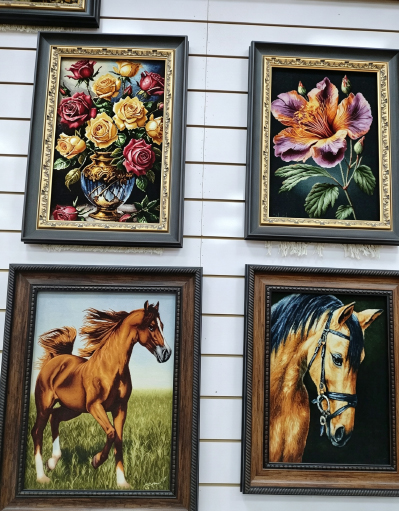 Carpet ornaments featuring different patterns on display at the Nakexiwan Carpet Factory in Hetian on August 9 (XIANG YUTING)
Where roads converge Two seemingly ordinary objects in the Hetian Museum make those exchanges even more tangible: a block of salt and a wooden mooncake mold. For people today, salt is an everyday necessity. But modern resource surveys show that Hetian does not produce edible salt. During the Han and Jin dynasties (206 B.C.-A.D. 420), the salt needed by people living here had to be brought in as a commodity from elsewhere. A small block of salt thus became evidence of trade and exchange across geographical boundaries. The wooden mooncake mold has four Chinese characters carved into its center: "Cantonese-style egg yolk." Dough filled with ingredients would be pressed into the mold, shaped and then baked in an oven. Discovered in Hetian, the mold recorded another kind of movement: as people traveled and communities interacted, festival traditions from the Central Plains made their way here, while belt hooks, bronze mirrors, longevity locks, porcelain and tea drinking also became part of local life. Handled cups from Central and West Asia also added new colors to the region's material culture. Before coming to Xinjiang, Zoe Y Kit Lit, from New Zealand, had worried about something. And the trip changed her view. "I used to think that, as in many parts of the world, some groups that are not numerically dominant would gradually lose their languages, cultures and customs through integration," she said. But in Xinjiang, she saw something different: Uygur, Kazak and other ethnic cultures were being protected and passed down. It led her to rethink what "integration" could mean. Integration does not necessarily mean one culture replacing another. Nor does it require everyone to become the same. Different cultures can retain their own languages, traditions and ways of life while building connections and mutual understanding through long-term interaction. For Myanmar student Nang Seng Hom, the journey raised another question: What does cross‑cultural communication really mean? Myanmar is world‑famous for its jadeite, while Hetian's nephrite enjoys equal renown. That parallel gave her a sense of familiarity in a place far from home. "As international students, we are, in a way, doing cross-cultural communication without even realizing it," she said. "And this trip to Xinjiang showed me one way it can happen. It is not about simply telling you about my culture. It is about seeing each other in the same place." "It is a place of convergence—where mountains meet deserts, oases meet wilderness, and different ethnic groups, cultures and stories come together," she added. Avendano Chin Liaying Rebecca, from Panama, noticed one such connection. Panama and Xinjiang differ greatly in climate, architecture and ethnic composition. Yet in her interactions with local people, she found something that reminded her of Latin America: Whether welcoming guests or simply enjoying themselves, people like to sing and dance. For her, those moments became some of the most memorable of the journey. Comments to xiangyuting@cicgamericas.com |
|
||||||||||||||||||||||||||||
|