
|
| Xinjiang Today |
| Stepping in and rethinking | |
|
|
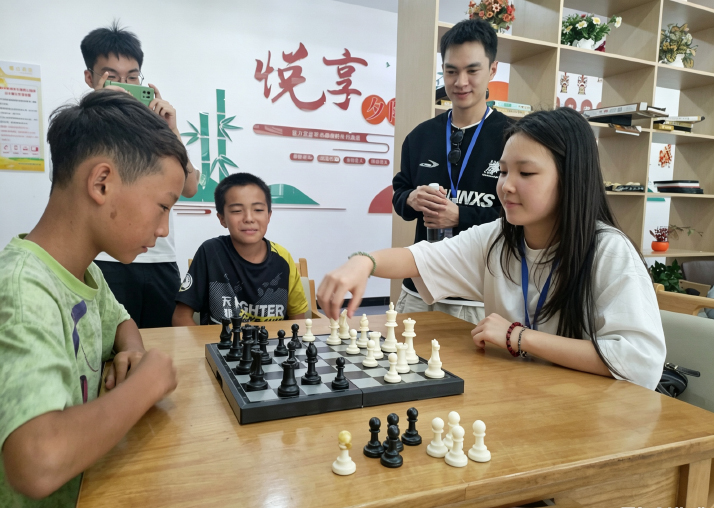 Umetbekova Aijamal Cholponovna plays chess with a boy at the Service Center of the Donghu Community in Kashi (Kashgar) on August 17 (XIANG YUTING)
From August 12 to 18, 17 international students from Peking University, representing 14 countries, joined a study tour titled Understanding Contemporary China, Perceiving Open Xinjiang. Over seven days, they traveled from Hami to Kashi (Kashgar), visiting industrial parks, businesses, villages, trade fairs and urban communities—trying to understand a place they had previously known mostly through books and media reports. Yet they seemed to take away more than just a deeper knowledge of Xinjiang. More importantly, they began to reconsider a larger question: How should people come to know Xinjiang—and the world at large? 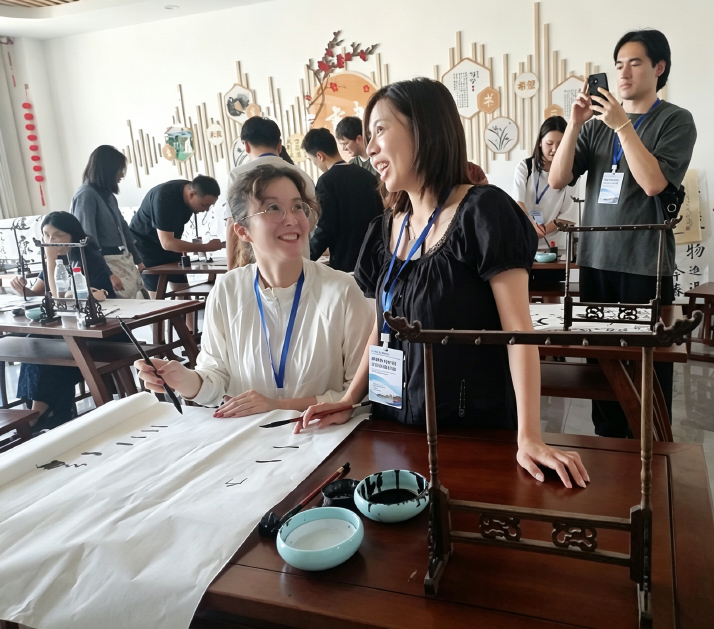 Baillargeon Lea practices Chinese calligraphy at the Service Center of the Donghu Community on August 17 (XIANG YUTING)
The Xinjiang they thought they knew Before the trip, the students were not totally unfamiliar with the region. For Phan Long Nhat, from Viet Nam, his knowledge was vivid: high mountains, grasslands, deserts and vast landscapes. Kailil Abdel Quoddouse, from Morocco, recalled attaching certain labels to Xinjiang before the trip. "These labels came from news reports and fragmented information," he said. Other students also arrived carrying similar preconceptions. But once they saw the region for themselves, they found reality far more complex than any label, photograph or statistics could convey. The tour began in Hami. Before visiting the city, the students' first impression may well have been a slice of Hami melon at breakfast—juicy, fragrant and lingeringly sweet. At the Hami Melon Fresh Fruit Industry Chain Platform Service Center, they were introduced to a complete industrial system encompassing germplasm research and cultivation, certification, warehousing, logistics, processing and sales. After four years, the platform has grown to comprise five centers dedicated respectively to improving seed varieties, setting standards, brand promotion, cold-chain logistics and settlement; three platforms for domestic sales, international barter trade and supply-chain finance; an industrial cluster; and an incubator. When Umetbekova Aijamal Cholponovna, from Kyrgyzstan, first tasted a Hami melon, her reaction was simple: "Delicious." Seeing the agricultural technology and modern industries behind it, she came to perceive an intricate industrial system, not just a fruit. This was what Kailil later called "working out the small, tangible numbers." Where does a melon come from? How is it grown better, graded, transported and sold? And how can more ordinary people benefit from the industry? Once such concrete questions come into view, "development" is no longer an abstract word. 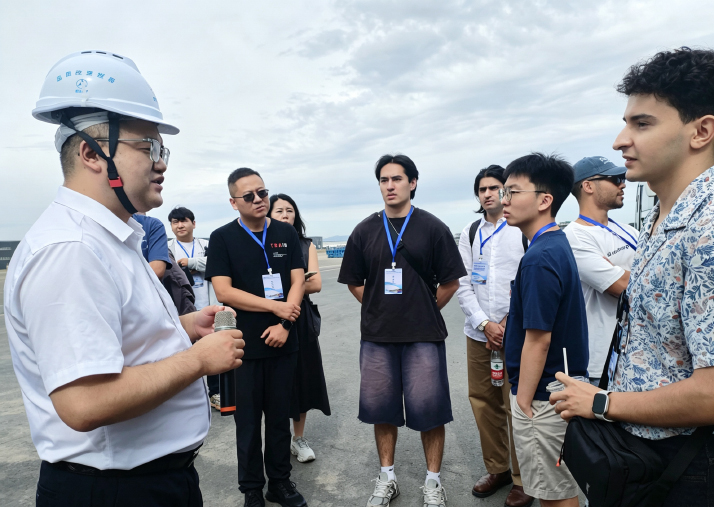 Members of a Peking University international student delegation at the Sanenergy Gigawatt-level Smart Wind Power Equipment Manufacturing Industrial Park on August 14 (XIANG YUTING)
What the details revealed If a Hami melon shows that a place's development lives in everyday details, the thriving wind energy sector in Balikun (Barkol) Kazak Autonomous County reveals another side of Xinjiang. Nhat's image of Xinjiang had been shaped largely by mountains, grasslands and deserts. In Balikun, he found that its abundant natural resources were fueling modern industries. The Sanenergy Gigawatt-level Smart Wind Power Equipment Manufacturing Industrial Park is a major local new-energy project. It represents an investment of 9 billion yuan ($1.34 billion) across wind power equipment manufacturing, energy storage and wind-powered hydrogen and ammonia; its main turbine base became operational in November 2023. Here the wind is no longer just part of its natural character; harnessed for energy, it links manufacturing, technology and the local economy. After seeing clean energy equipment up close, the students found yet another side of Xinjiang—its outward reach—in Kashi. The 16th Kashi Central & South Asia Commodity Fair ran from August 14 to 18, with Uzbekistan as guest country of honor and Guangdong as guest province of honor. Companies and representatives from 44 countries and regions gathered for trade, investment and cooperation opportunities. Launched in 2005, the fair has become a vital platform linking China with Central and South Asian markets. Leveraging this role, Kashi has shifted from a local trade hub to a gateway opening up to the wider world. In the students' eyes, a picture of Xinjiang took shape: a region devoted to home-grown development and serving as an open window on the world. 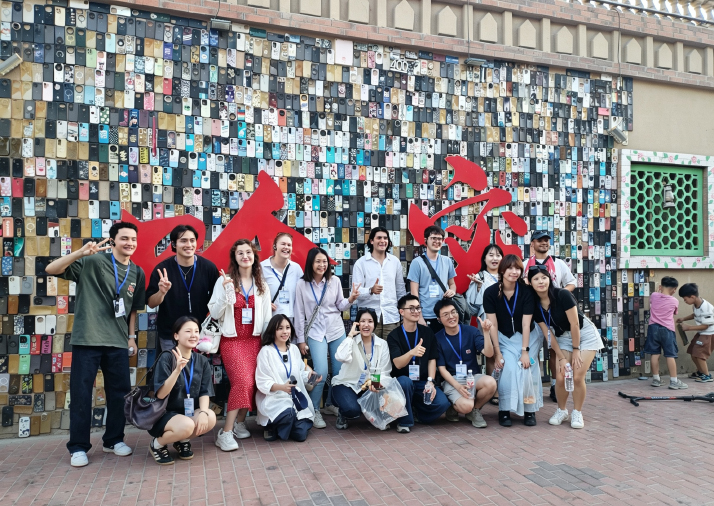 International students from Peking University pose for a group photo in Aletun Ancient Street in Hami on August 14 (XIANG YUTING)
An immersive experience of community life As the journey moved from Hami to Kashi, the students kept observing and exploring Xinjiang. Yet what quietly changed the course of their journey was a seemingly unremarkable stop: the Donghu Community in Kashi. Entering the community's Service Center, they passed a game room where residents of diverse age groups played cards and chess on an ordinary afternoon. Still, one student whispered to a companion: "Could the people inside be 'actors?'" Such doubts had arisen more than once during the journey, and the skepticism was understandable. Most of the students were pursuing master's degrees in fields ranging from international relations and law to business and computer science. Accustomed to reading, analyzing and questioning, they were not inclined to set aside their doubts after a few visits. But what happened next turned them from observers into participants. At first the students gathered to watch two boys play chess. One quickly gained a decisive lead and the game ended without suspense. Umetbekova then sat down and challenged the winner. After nearly 20 minutes, with each side left with just two pieces, Umetbekova said, "It's a draw." Onlookers also seemed ready to applaud the friendly "happy ending." But the boy said nothing. He pressed his lips together and looked up at Umetbekova—shy, yet unmistakably firm. Umetbekova understood. Instead of saying "It's a draw" again, she asked, "Do you accept a draw?" The boy remained silent. His eyes returned to the board, and he kept thinking. The game went on. In the end, the boy won. Only then did the applause begin. No one had arranged for the child to win as part of a performance. Nor did the staff need to prove anything to the students. Once they had sat down at the board, there was no longer any need to explain what was real. The students also tried Chinese calligraphy, drumming and basketball. Scenes they had only watched became experiences they joined. By the time they left, no one was asking whether the people in the game room had been "actors." How to share real stories For Kailil, the most unforgettable moments were precisely those never on the itinerary. Seeing children play soccer in Kashi's ancient city, he said their laughter recalled his own childhood. "It felt like coming home." That feeling has inspired him to rethink how to introduce Xinjiang to others. As a student of Chinese language education, he believes that empty words carry little weight. He chooses a different approach. He said he will present Xinjiang through small, tangible details: How many links does an industrial chain connect? How does a company work with farmers? How many mundane matters does a community handle daily? Zheng Jingyi, from Singapore, reached a similar conclusion. Previously accustomed to understanding a region through policies, data and broad concepts from books, she grew aware that a place's true character lies in concrete details. It lies in a conversation with a child, an interaction with an ordinary resident, the cooperation between farmers and businesses. For Baillargeon Lea, from Canada, the trip made one thing clear: True understanding comes not from books alone, but from one real encounter after another. She said she found the Hami she saw more vivid and full of life than the one in books. At the start of the trip, the students set out from different sources—photographs, books, news reports, data and concepts. Seven days later, they took home a Hami melon's fragrance, a piece of handmade pottery, a miniature musical instrument, a scarf from an international fair and the memory of losing a chess game to a local boy. These things could hardly differ more, yet together they formed the Xinjiang they had come to know. More importantly, the students realized that understanding a place does not mean simply finding a single answer to define it—because Xinjiang is not a single story. Perhaps that is the journey's most valuable lesson: Sometimes the best way to understand the world is not to hear someone else's answer, but to step inside it and become part of the story. Comments to xiangyuting@cicgamericas.com |
|
||||||||||||||||||||||||||||
|