
|
| Xinjiang Today |
| The sound of a region | |
|
|
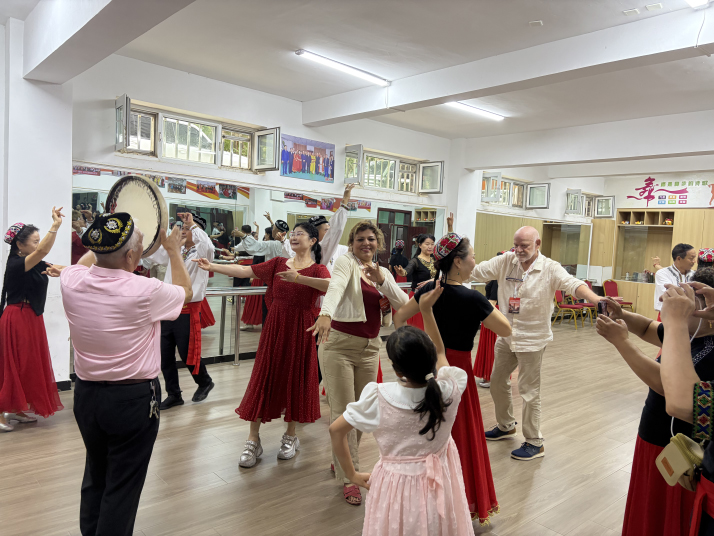 Visitors dance with residents of the Tuanjie Community at the community center in Kuerle (Korla) on August 13 (ZHANG YAGE)
In the 1950s, a young musician from Tianjin Municipality made a journey that would define the rest of his life. His name was Wan Tongshu. His mission was to save the Twelve Muqam, an ancient and complex musical tradition of the Uygur people, from disappearing forever.
He faced bitter cold, isolation and personal tragedy. At one point, he lost his son to pneumonia as he was too busy with work to get timely treatment for the baby. He transcribed, recorded and documented Muqam, ensuring that this intricate art form with roots stretching from ancient China's Western Regions to Central Asia and beyond would survive for future generations. Later, his story was told on the silver screen. The film Wan Tongshu, produced by the Tianshan Film Studio, brings his life and legacy to audiences across China. Through Wan's story, the film showcased how Xinjiang's cultures are being preserved, celebrated, and shared with the world. His story deeply touched a delegation of 13 professors from 10 countries, who visited Xinjiang from August 10 to 17, traveling to Urumqi, Kuerle (Korla) and Aksu, among other cities in the region. They toured film studios and heritage museums, walked through ancient alleys and smart farms, and sat down with local communities. They witnessed how Xinjiang preserves its traditions while embracing innovation. 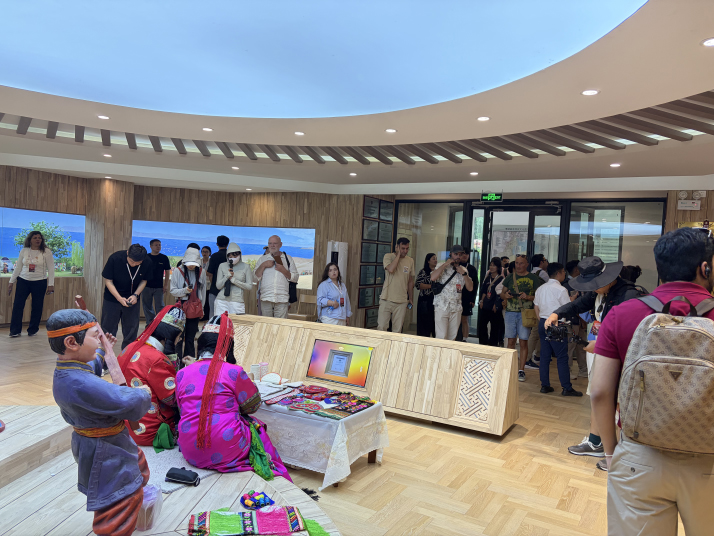 A visit to the Bohu County Intangible Cultural Heritage Preservation and Transmission Center in Bayingol Mongolian Autonomous Prefecture on August 13 (ZHANG YAGE) Preserved cultures On the first day of their itinerary, they gathered at the Tianshan Film Studio to watch Wan Tongshu and tour the facilities that have produced some of China's most celebrated films about ethnic group cultures. As Muhammad Arif Khan from Pakistan, who works as an associate professor at Jilin International Studies University in northeast China, observed, Muqam has a resonance that transcends borders. "Muqam is very important in as far as the Xinjiang history is concerned," Khan told Xinjiang Today. "Wan Tongshu came from Tianjin to Xinjiang in the 1950s and he dedicated his lifetime to preserving Muqam. He overcame difficulties. He lost his son because of the very cold weather in Xinjiang at that time, but he tried his best to preserve Muqam." Khan noted that Muqam is not only popular in Central Asia but also in South Asia. "In Pakistan and India, we call it 'qawwali,'" he said. "It's like a different dialect but having the same roots. This story can resonate strongly with our people." The film, Khan said, has a crucial role to play in shaping how the world sees China. "The movie will play a very crucial role as far as the soft image of China is concerned," he added, "because this movie tells us about the government effort to restore and preserve Muqam and the history of ethnic groups in China." "I think people should come to Xinjiang, they should come to Urumqi and see, witness what's happening in Xinjiang. How the Central Government in Beijing is taking care of the ethnic minorities, not only in terms of culture but economics, political status and livelihood standards. They come and they receive from their own eyes and then they will draw a meaningful conclusion," Khan added. "The movie was very real and touching, and the scenes actually took me back to the 1950s when I was born and saw the changes of my family. The film factory has done a great job recreating the past," Daniel Sluse, Dean of the Royal Academy of Fine Arts in Liege, Belgium, told Xinjiang Today. "I believe the movie would appeal to international audiences in many ways. It is about love, family, dedication and friendship." The studio behind the film is itself a living monument. Established in 1959 as one of 16 state-run film studios approved by the State Council, the highest state administrative organ, the Tianshan Film Studio has produced over 130 films and more than 30 television series over its 67-year history. Ten of its films and three of its television dramas have won the "Five One Project" Award, one of China's highest honors for cultural works. The studio has also sent some of its films to five continents, screened in dozens of countries, allowing Xinjiang's stories to become an important window through which the world sees China. Of its 113 staff members, 90 are technical professionals, making up roughly 80 percent of the workforce; and 52 are from ethnic minority groups. The preservation of culture is not limited to music. In the Xinjiang Uygur Autonomous Region Intangible Cultural Heritage Museum, which opened its doors in 2024, visitors can see the breadth of the region's traditions. The museum, covering 13,088 square meters, is organized into four basic exhibition halls, covering themes like festivals, daily life, wedding customs, and intangible heritage from other provinces, alongside five thematic galleries. Since its trial opening in September 2025, the museum has received nearly 100,000 visitors. It regularly invites inheritors to perform and interact with visitors, bringing the traditions to life. "Culture means more than preserving heritage. It acts as a bridge connecting people across generations. Cultural events, education, exchanges and intangible-heritage conservation enrich people's spiritual life and showcase the region's rich diversity," Shiderina Gaukhar, a professor at Turan University in Kazakhstan, told Xinjiang Today. Xinjiang has also established dedicated cultural preservation centers in areas where ethnic minorities are concentrated, ensuring that the traditions of individual ethnic groups are protected at the community level. In Bayingol Mongolian Autonomous Prefecture, which is home to a large Mongolian community, the Bohu County Intangible Cultural Heritage Preservation and Transmission Center in the prefecture serves as a living repository of Mongolian cultural heritage. The center, which opened in 2010, focuses on the traditions of the Mongolian community. It displays traditional Mongolian costumes, embroidery, products, the Saurden dance, Tuvinian short-tune folk songs and the techniques of making and playing the Tovshuur, a traditional Mongolian stringed instrument. The center has been a key site for preserving the region's four national-level intangible cultural heritage items of Mongolian people. Diego Arbildo Prieto, Coordinator of International Relations at the Faculty of Technological Management and Innovations at ITMO University in Russia, said after visiting the center that what impressed him most was how the local people connect their culture with nature. "What impressed me most was how this center preserves not just techniques, but a way of thinking—the deep connection between culture and nature," Prieto said. "For instance, unlike the chemical-based approach common in Western medicine, the Mongolian traditions here integrate culture, plants and healing in a remarkably natural way. I think it's very important to understand, listen to and respect this wisdom." Veysel Bozan, a professor at Ankara University's Faculty of Communication in Türkiye, said that he was struck by the region's religious and cultural diversity. "I didn't expect to find such richness here—mosques alongside old temples and different ethnic groups living together," he said. What impressed him even more was how these cultures remain alive. "In many parts of the world, minority cultures become assimilated over time. But here, they are still going strong. The folk culture is still living. People maintain their own practices, their own religions and they are protected in doing so." 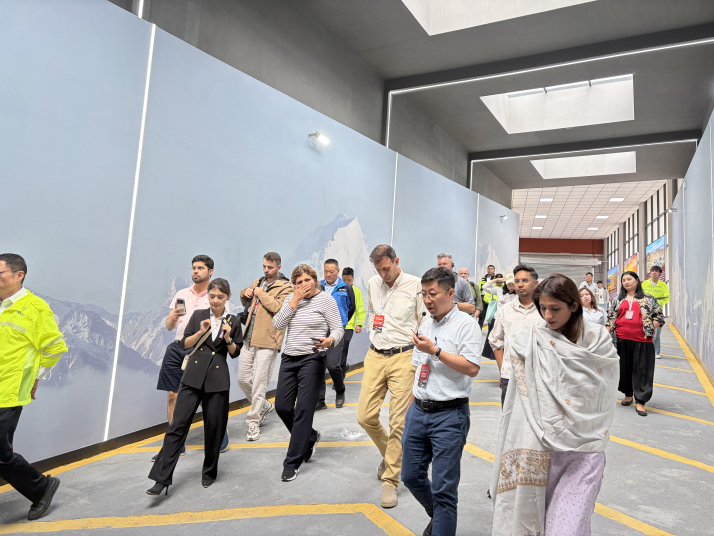 International visitors at an exhibition near the Tianshan Shengli Tunnel in Urumqi on August 12 (ZHANG YAGE)
Strengthened unity From the living traditions of music, dance and medicine, the delegation's journey turned toward a deeper layer of Xinjiang's story—its ancient roots in Chinese civilization. In the city of Luntai, the Western Regions Frontier Command Museum stands as a testimony to a history that stretches back over two millennia. The Western Regions Frontier Command, established by the Han Dynasty (206 B.C.-A.D. 220) in 60 B.C., was the first central government office to govern the Western Regions (covering Xinjiang Uygur Autonomous Region). Its establishment formally incorporated this vast territory into China's administrative system. The museum, which opened to the public on May 18, 2025, covers 10,000 square meters. Its permanent exhibition is organized into seven sections that trace the establishment of the Western Regions Frontier Command and the effective governance of Xinjiang by central authorities since the Han Dynasty. For Zoon Ahmed Khan, a researcher at the Center for International Security and Strategy of Tsinghua University and the Center for China and Globalization in Beijing, the museum offered a powerful reminder of how cooperation between central authorities and regional populations has historically led to prosperity. "There was abundant historical evidence that whenever they (the Western Regions and the Central Government) worked together, the Western Regions flourished," she said. "And I think that's what matters. Like any historic civilization, there are periods when different groups might not be eye to eye. But we see that in the case of Xinjiang, especially when the Central Government and the people of Xinjiang were on the same page, they always found ways to cooperate." She also noted how museums like this one are helping bridge the gap between eastern and western parts of modern China. "Until recently, there wasn't a lot of opportunity for people from eastern parts of China to come to the western parts," she said. "They know the history, they know the Silk Road. But increasingly, these cultures within Xinjiang are becoming more familiar for people in east China. When they come to the museum, they can learn more deeply about the history and how collective it has always been." Thelikada Kankanamge Asela Prabath Kumara from Sri Lanka, a postdoctoral researcher at East China Normal University, captured the sentiment of many visitors when he stood on the ancient ground. "Today, standing here, I truly feel the weight of history," he told Xinjiang Today. "A place so far from the Central Plains was incorporated into the central governance system over 2,000 years ago. That in itself is an extraordinary chapter of history." 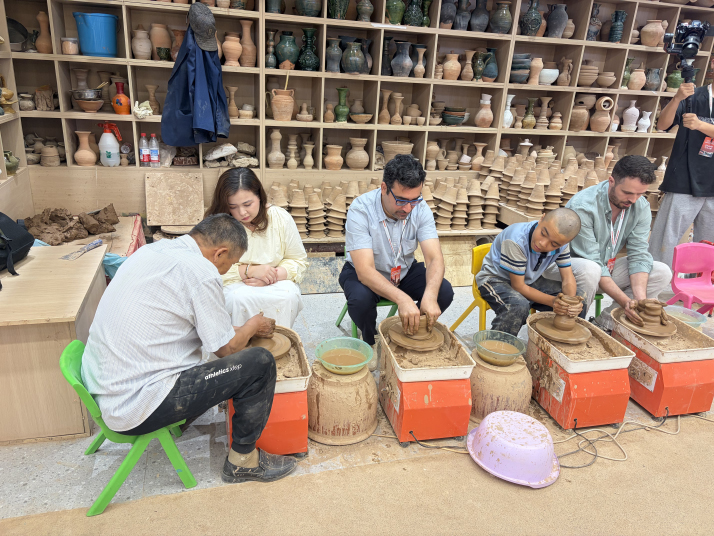 International tourists make pottery under the guidance of Uygur craftsmen in Kuche on August 15 (ZHANG YAGE)
Innovative frontiers In addition to culture and history, the delegation also witnessed how Xinjiang is blending traditional knowledge with modern innovation, giving rise to specialty industries and new consumption scenarios. At the Uygur Medicine Hospital in Urumqi, the delegation visited a Traditional Chinese Medicine Culture Education Base, which opened in 2025. The facility is divided into four exhibition halls covering the core concepts of Traditional Chinese Medicine, the history of medical exchanges along the Silk Road, Uygur medical theories, and the hospital's seven decades of development. The base also offers hands-on activities including wellness education, herbal workshops and traditional exercise classes. For Mohsen Ebrahimi, an associate professor of plant genetics and breeding at the University of Tehran, the visit resonated deeply with his own cultural background. "In Persian, we have a saying that there is a remedy in every plant," he shared. "China and Iran share a long history of using medicinal plants for healing. I believe traditional medicine can complement Western medicine, because chemical treatments often have side effects, while plant-based remedies are generally safer and have been used for centuries." Ebrahimi also saw great potential for collaboration. "Xinjiang has a vast and diverse environment with many endemic plant species. There is a huge opportunity for research and cooperation—exchanging plants, comparing their effects on diseases like diabetes and cancer, and developing new drugs based on natural ingredients." The delegation traveled to Kuerle to visit a Cloud Farm demonstration base, a 497-hectare smart agriculture project that exemplifies China's rural revitalization efforts. Rural revitalization is a strategy introduced in 2017 to modernize agriculture, improve rural living standards, strengthen governance, and promote sustainable development in rural areas. The Cloud Farm project consolidated over 110 fragmented plots into five standardized fields, integrating AI-powered water and fertilizer systems, precision irrigation, and advanced mulching techniques to address the water scarcity that plagues south Xinjiang's arid regions. The results have been remarkable. Water usage per hectare dropped from 12,000 to 4,200 cubic meters, a 65-percent reduction, while fertilizer efficiency increased by 30 percent. Cotton yields rose from 5.25 to 7.8 tons per hectare, a 48.6-percent increase. The farm also serves as a public classroom, training over 20,000 farmers annually and turning them from passive recipients into active adopters of smart farming techniques. Prieto was impressed by the scale and sophistication of the operation. "This is a good example to show the world that China is offering more than products—it's offering services and technology," he said. "The AI irrigation system, the drones, the digital management are all very advanced." He also commented on the broader implications of China's technological advancement. "China is entering to set standards and rules that companies and countries around the world will follow. That's why many people see China as a model to follow. In the next three to five years, I think China's role in global AI governance will become even more important." Arif Khan noted the implications for his home country. "We saw very advanced technology applied in the cotton field—drones, drip irrigation, digital systems managing miles of fields," he said. "These technologies and management methods are now being shared with Pakistan through the Belt and Road Initiative. I believe China and Pakistan have great potential for collaboration in smart agriculture and infrastructure." The delegation also saw how tourism is transforming local communities. At Bosten Lake, the largest inland freshwater lake in Xinjiang, what was once a modest fishing village has been developed into a thriving 5A-level (or the highest level) scenic attraction. The lake now features water parks, ferry cruises, recreational facilities, and signature events including fishing festivals, winter fishing with giant nets, and ice sailing competitions. The lake's water quality has improved, supporting both ecological conservation and tourism. Zoon Ahmed Khan described the transformation as remarkable. "The government's efforts protected the environment as well as created economic opportunities and gave people a better quality of life," she said. "You could see families relaxing, people enjoying the beach, and the fish being protected. It talks about the many efforts the Chinese Government has made to improve the lives of people in Xinjiang." In Kuche (Kuqa), the delegation walked through the Kuche Ancient Alley, a 1.2-km lane in the heart of Kuche's old city center that preserves the street patterns 100 years ago. Home to 12 century-old trees and 10 ancient residences, the alley was revitalized through a "micro-renovation" approach that preserved its historic character while introducing 55 new businesses. In 2025, it received 2 million visitors and generated 210 million yuan ($31 million) in tourism revenue. "I talked to many families who are living in the alley and running their business with the vast number of tourists at peak season. It's great to see that they don't need to move to other areas, nor relinquish their old ancestral house to make a living," she added. Beyond the revitalized alleyways and tourist destinations, the delegation also stepped into ordinary communities to observe how daily life is lived and supported at the grassroots level. In Kuerle's Tuanjie Community, a 1,500-square-meter service center embodies a philosophy of "one room, multiple uses." The facility offers a cafeteria for seniors, a reading area, calligraphy and painting rooms, a wellness center with moxibustion therapy, dance studios, table tennis rooms, and outdoor spaces including a cultural square and basketball court, all provided free to local residents. For Somayeh Taheri, Assistant to the Dean of the College of Science at the University of Tehran's Central Laboratory, from Iran, the visit offered a glimpse into how governance translates into everyday care. "What I observed today was very fantastic," she told Xinjiang Today. "There were facilities for dancing, calligraphy, sports, and massage instruments that I tried, it was very good. They also have services for elderly people, exactly what communities need. When people get older, they need a calm place where they can gather easily and find friends to spend time with." Taheri was particularly struck by the fact that all these services are provided free of charge. "The community government is doing great," she said. "You can see it in the river, the bridges, the businesses—all of it affects people's daily life. This is the best way for older people to release their energy, especially through dancing and sports. I really enjoyed dancing with them." "When you go to the service center and walk by the river, you get to see the real aspect of the local people. You can talk with them, and it's very real," Taheri added. "Last night we were out very late and it was quiet. The people were so nice. I didn't expect this place to be so green, so beautiful, so organized." Comments to zhangyage@cicgamericas.com |
|
||||||||||||||||||||||||||||
|