|
| Governance |
| A window into China's governance and development | |
|
|
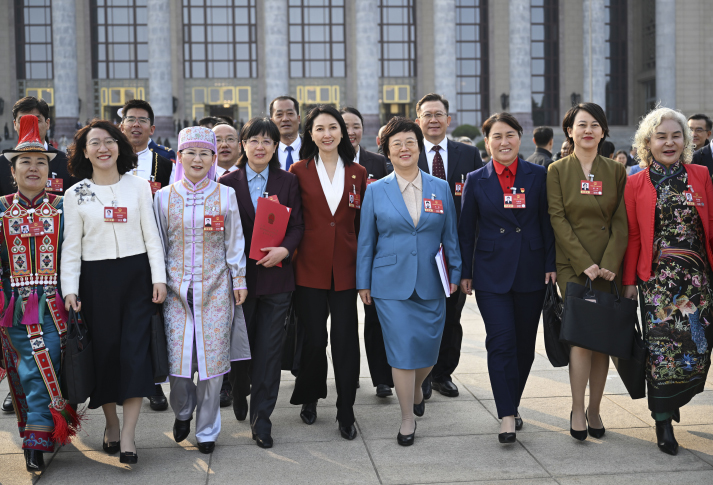 Deputies leave the Great Hall of the People after the closing meeting of the Fourth Session of the 14th National People’s Congress in Beijing on March 12 (XINHUA)
Each March, Beijing becomes the center of China's most important annual political gatherings, known as the Two Sessions. In 2026, the meetings formally consisted of the Fourth Session of the 14th National People's Congress (NPC) and the Fourth Session of the 14th National Committee of the Chinese People's Political Consultative Conference (CPPCC). The CPPCC National Committee session opened on March 4, followed by the NPC session on March 5. For scholars and observers of China, this event offers one of the clearest windows into how the country governs itself, evaluates its progress and sets priorities for the future. In many ways, it is China's annual moment of national reflection and strategic planning. Focusing on national development For many outside observers, the most familiar image of these meetings is a brief television moment when delegates applaud as leaders enter the Great Hall of the People. Yet that widely circulated scene captures only a small fraction of what the meetings represent. The NPC is China's highest state organ of power, responsible for legislation and major national decisions. The CPPCC National Committee functions as the country's top political advisory body and is a distinctive feature of China's system of multiparty cooperation and political consultation under the leadership of the Communist Party of China (CPC). Through consultation and deliberation, the two institutions together help translate national priorities into concrete policy direction. Representation at the Two Sessions spans every level of Chinese governance and society. Deputies and members come from the Central Government, provincial administrations, municipalities, counties and grassroots communities. They represent sectors ranging from manufacturing and agriculture to technology, healthcare, education, culture and ethnic groups. Their participation ensures that perspectives from across China's vast and diverse society are brought into national policymaking. Beyond the plenary meetings in the Great Hall of the People, the Two Sessions involve numerous group discussions and consultations. Delegations review government reports, debate draft legislation, and present proposals drawn from their local constituencies. Senior leaders including President Xi Jinping also participate in these discussions, exchanging views directly with representatives from different sectors and regions. Contrary to the stereotype that these are purely ceremonial gatherings, the sessions frequently involve substantive policy debate and refinement. Delegates are encouraged to offer constructive criticism, practical insights and alternative approaches aimed at improving governance. The 2026 meetings carried particular significance because this year is the beginning of China's 15th Five-Year Plan (2026-30) period. The Five-Year Plan framework has guided China's development for more than 70 years. Through this system of long-term planning combined with phased implementation, China has overseen one of the most rapid economic and social transformations in modern history. The new planning cycle therefore represents not only continuity but also adaptation to a changing global environment. The government work report delivered by Premier Li Qiang at the NPC session's opening meeting offers a detailed blueprint for the country's next stage of development. The report reflects a governance philosophy that emphasizes careful planning combined with disciplined implementation. Rather than addressing policy challenges in isolation, China's approach links economic development, social stability, legal reform, national security and modernization into an integrated framework. One major theme of this year's government work report is resilience in an uncertain world. Financial supervision and early warning mechanisms are being strengthened to detect and prevent systemic risks. Policymakers are placing increasing emphasis on risk management, recognizing that stability is a necessary condition for sustained development. Public safety and social stability are also key priorities. The government is expanding monitoring systems for meteorological, hydrological and geological hazards while improving disaster prevention and emergency response capabilities. Major infrastructure initiatives, including modern water management networks and flood control systems, demonstrate how long-term planning translates into concrete projects that strengthen national resilience. Governance reform and the rule of law are another important focus. The report stresses the need to advance law-based administration and ensure that government agencies operate strictly within the framework of the Constitution and the law. Administrative efficiency is also being enhanced through digital government platforms and streamlined procedures designed to improve public services and create a more efficient business environment. Equally important is the principle that development must ultimately serve the people. Policies addressing healthcare, education, housing and elderly care aim to ensure that economic progress translates into tangible improvements in people's daily lives. This emphasis on people-centered development remains a defining feature of China's modernization strategy. The 2026 Two Sessions also revealed how China is reshaping its economic model for the next stage of growth. For many years, infrastructure investment and real estate development were major drivers of expansion. Today the focus is shifting toward strengthening the real economy through innovation and advanced manufacturing. Several strategic industries have been identified as priorities for the coming years. These include integrated circuits and semiconductor technologies, aerospace engineering, biopharmaceutical innovation, intelligent robotics, advanced energy storage, and the emerging low altitude economy (airborne economic activities below 1,000 meters—Ed.) based on drone systems and aerial logistics. Each of these sectors represents a frontier of technological capability and an important driver of future economic competitiveness. At the same time, policymakers are placing greater emphasis on investing in people. High-quality development depends not only on physical infrastructure but also on stronger social foundations. Expanding access to education, improving healthcare systems, strengthening elderly care services and enhancing public services are therefore becoming central components of national policy. AI is another area receiving growing attention. The rise of the intelligent economy will integrate AI technologies into manufacturing, services and everyday work environments. Policymakers increasingly see AI not merely as a technological tool but as a catalyst for productivity gains and industrial transformation. China's diplomatic priorities While domestic development remains the central focus of the Two Sessions, the international community also closely watches China's foreign policy direction. During the meetings, Foreign Minister Wang Yi, who also serves as a member of the Political Bureau of the CPC Central Committee, held a widely attended press conference addressing China's diplomatic priorities. A central theme of Wang's remarks was the importance of head-of-state diplomacy led by President Xi. In an increasingly uncertain world, leadership-level engagement is seen as providing stability and continuity in international relations. In the coming year, China will host several major diplomatic events, including the Asia-Pacific Economic Cooperation (APEC) Economic Leaders' Meeting in Shenzhen and the second China-Arab States Summit. Wang also addressed relations with major powers. China-Russia relations, he noted, remain stable and characterized by strategic independence and mutual trust. On China-U.S. relations, Wang emphasized that the two countries cannot change each other but can choose how they interact. Mutual respect, peaceful coexistence and win-win cooperation remain the principles that China believes should guide the relationship. China's commitment to multilateralism was another major theme. Wang reaffirmed the central role of the United Nations in global governance and emphasized the importance of international cooperation in addressing shared challenges. China also continues to deepen partnerships with countries across the Global South, particularly in Africa and Latin America. Taken together, the discussions during the Two Sessions illustrate a distinctive feature of China's governance model. Long-term planning, broad consultation and practical implementation are combined in a system designed to guide national development over extended time horizons. For international readers seeking to understand China, the Two Sessions are more than a political event. They provide a valuable glimpse into how a country of over 1.4 billion people organizes its priorities, manages complexity and charts a path toward modernization in a rapidly changing world. BR The author is president of the America China Public Affairs Institute (AmericaChina). He is a fellow of the Foreign Policy Association, and an advisor to the George H. W. Bush Foundation for U.S.-China Relations Copyedited by G.P. Wilson Comments to dingying@cicgamericas.com |
|
||||||||||||||||||||||||||||
|