
|
| Voice |
| How Beijing is reimagining urban innovation | |
|
|
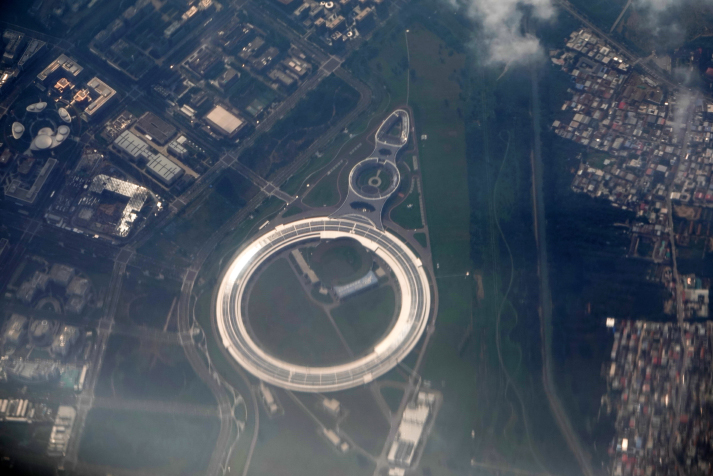 China’s High Energy Photon Source in Huairou Science City in Huairou District, Beijing, on August 30, 2025 (CNSPHOTO)
For decades, Beijing's technological and educational power has been concentrated in Zhongguancun, the city's emblematic "Science City." Often dubbed China's Silicon Valley, Zhongguancun has anchored the capital's innovation ecosystem since the nation's reform and opening-up era began in 1978. But Beijing is no longer content with a single innovation core. Over the past decade, guided by the Beijing Urban Master Plan (2016-35), the city has embarked on an ambitious restructuring—expanding from a single-center model toward a polycentric system designed to spread science, technology and talent across its metropolitan area. The goal is to create a networked engine of innovation rather than a single geographic symbol. From one to four This transformation revolves around a new configuration: Huairou Science City, Beijing Future Science Park and Zhongguancun Science City, along with the Demonstration Area for Innovation-Based Industrial Clusters, which includes parts of Beijing's southeastern and northeastern districts. Together, they form a coordinated innovation ecosystem intended to deepen collaboration between advanced research, industrial application and commercialization. Huairou Science City in the north, anchored by the Chinese Academy of Sciences, is building national laboratories and major scientific instruments dedicated to frontier research. Beijing Future Science Park, meanwhile, focuses on applied innovation—energy, advanced manufacturing and intelligent technology. Zhongguancun remains the capital's entrepreneurial heart, strengthening its full-chain ecosystem from basic research to hi-tech industry incubation. The demonstration area acts as an industrial accelerator, turning scientific discoveries from the "three science cities" into market-ready technologies. The concept may sound bureaucratically neat, but its implications are profound: Instead of chasing innovation inward toward the city's center, Beijing is pushing it outward—toward new towns, smaller districts and underdeveloped peripheries long left out of the digital economy. At the forefront of this shift are Beijing's leading universities. Peking University and Tsinghua University have begun extending their research bases into the capital's northern outskirts. Peking University is building a new Yanyuan Campus and an Industry-Education-Research Center in Machikou Town; Tsinghua has established a State Key Laboratory base in nearby Nankou Town. These initiatives are reshaping how educational, scientific and municipal institutions interact. By moving talent and resources beyond the urban core, Beijing hopes to cultivate innovation clusters that combine the intellectual density of universities with the spatial freedom of peripheral zones—echoing successful experiments in Seoul, Tokyo and Silicon Valley's suburbs. Scientist towns Nankou and Machikou, both in Changping District in the northwest, offer vivid examples of this peripheral renaissance. Once modest industrial areas, they are now evolving into vibrant hubs for high-end technology and research. Nankou is planning a "scientist town," complete with modern laboratories and research housing, while Machikou is transforming into a "science town" centered on medical technology and smart manufacturing. This shift is not confined to laboratories. Infrastructure is being rebuilt to serve an influx of professionals: advanced medical centers, international schools, ecological restoration projects and new residential communities. Corridors like the G6 Science and Technology Innovation Corridor, named after the Beijing-Lhasa Expressway (G6), now connect these areas with the broader Three Science Cities and One Demonstration Area, reinforcing physical and intellectual connectivity. The philosophy behind this approach is clear—to let talent lead spatial change. By expanding research and educational institutions outward, Beijing is cultivating growth where it has been least expected: in the quiet towns that ring the capital. A blueprint for the future Critics might question whether this diffusion can genuinely rival Zhongguancun's historic concentration of talent and resources. Reproducing "another Zhongguancun" is neither possible nor desirable. What Beijing is truly building is not a replica, but an ecosystem—a diversified network of innovation clusters linked by shared infrastructure, coordinated development policies and a commitment to high-quality urban living. If successful, this model may redefine how mega-cities approach technological development. Instead of overcrowded centers that hoard talent and capital, Beijing is experimenting with a distributed model of innovation, where knowledge, industry and education radiate outward to create a resilient, multi-centered metropolis. Innovation is not just about inventions; it's also about institutional imagination. Beijing's effort to redistribute its scientific and educational resources reflects a broader shift in urban governance—one that values coordination, inclusivity and long-term ecological balance. Building such a network requires more than new campuses and laboratories. It demands reforms in land use, transportation planning and public services to ensure that scientific excellence is matched by livable urban environments. In this sense, the Three Science Cities and One Demonstration Area initiative is as much a social experiment as a technological one. Beijing's wager is bold: That by turning education and research into engines of spatial renewal, it can drive high-quality growth across its metropolitan fringe and ultimately strengthen its position as a global innovation capital. It's a vision that extends beyond urban planning—a statement of confidence in China's capacity to reimagine the geography of knowledge itself. BR Li Guoping is head of the Beijing Development Institute, Peking University. Sun Yiyuan is an assistant researcher with the School of Government, Peking University Copyedited by Elsbeth van Paridon Comments to yuanyuan@cicgamericas.com |
|
||||||||||||||||||||||||||||
|