|
| China |
| Weaving the future of silk | |
|
|
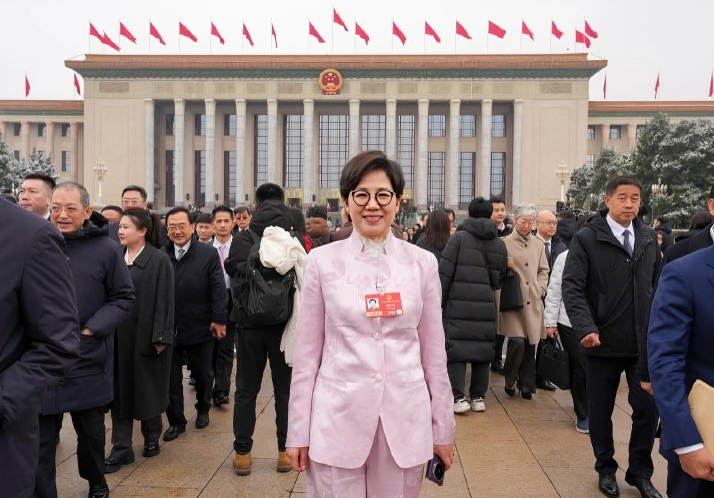 Tu Hongyan, a deputy to the 14th National People’s Congress, China’s top legislature, and chairwoman of Wensli Group on March 5 (COURTESY PHOTO)
As China begins implementing its 15th Five-Year Plan (2026-30), revving up innovation and green ambitions, Tu Hongyan, a deputy to the 14th National People's Congress, the top legislature, and Chairwoman of Wensli Group, recently sat down with Beijing Review reporters Xu Bei and Shang Zhouhao, sharing her insights on creative silk products, the transformation of traditional industries and the green development of the silk sector. Founded in 1975, the company has grown into a modern industry group focusing on silk products while also covering areas such as biotechnology and financial management. As a veteran entrepreneur, Tu has been a part of the development of the company and the silk industry at large. Edited excerpts of the interview follow: Beijing Review: China is promoting the development of new quality productive forces. Wensli has used AI to reduce its design cycle from 15 days to two hours. What do new quality productive forces mean for a traditional industry like silk? Tu Hongyan: New quality productive forces do not mean abandoning tradition. Instead, they upgrade traditional industries through technology, culture and sustainability. For silk, this means using AI to drive design innovation, applying green technologies such as waterless dyeing to transform manufacturing, and expanding cross-sector collaborations such as artist partnerships. At the same time, combining traditional aesthetics with digital consumption scenarios can open new markets. (Waterless dyeing refers to textile printing and dyeing technologies that use little or no water, which helps reduce wastewater and environmental impact—Ed.) This transformation is not only about improving efficiency but also redefining value—allowing silk, with its thousand-year history, to move from something worn on the body to something integrated into everyday life and personal expression. Your company developed GBART, a waterless digital printing and dyeing technology that produces almost no pollution. Could this technology bring about green standards for the entire textile industry in China and even around the world? GBART has already achieved near-zero wastewater discharge and has the potential to set a benchmark for green manufacturing. To scale its application further, three steps are essential. First, standardization—developing national or industry standards for green textile printing and dyeing, and carbon-footprint certification for AI-assisted processes. Second, policy support, including subsidies for equipment upgrades and green finance programs. Third, international collaboration through platforms such as joint laboratories under the Belt and Road Initiative and global exhibitions. (The Belt and Road Initiative is a China-proposed framework to boost connectivity along and beyond the ancient Silk Road routes—Ed.) The biggest challenges are limited coordination across departments and the high cost for small and medium-sized companies to adopt new technologies. National demonstration projects could help reduce those barriers. Wensli has been led by generations of women. Looking ahead, what should the company's next generation inherit and what should they change? The most important core asset to inherit is a respect for silk culture and Wensli's core philosophy of harmony between heaven, earth and humanity. What must evolve is the strategic mindset—embracing digitalization, globalization and sustainable development. My hope for the next generation is not simply to maintain the family business. They should tell China's story with a global vision, use technology to revitalize traditional culture and develop time-honored brands. They must be inheritors of culture, innovators in technology and partners in global cooperation. 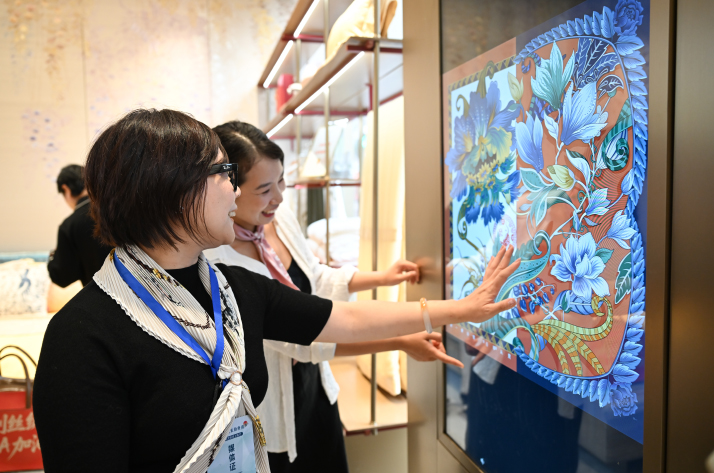 An AI-powered application developed by Wensli for customized silk scarf design (VCG)
You have worked to make silk culture feel younger. What is the "soul" that silk products should keep, and what should be left behind? The soul lies in the spirit of Eastern aesthetics—subtlety, elegance and the philosophy of harmony between humanity and nature, as well as the refined beauty of silk itself. What should be left behind are outdated ways of presenting tradition that are disconnected from modern life. For example, our customers can design their own silk scarves through AI by scanning a code, with the finished products ready in minutes. This is not about abandoning tradition but about bringing it into modern design while engaging consumers in the creative process. Wensli's silk products have been given as state gifts from China on many diplomatic occasions. What is the biggest challenge in designing such gifts and in presenting Chinese culture to the world? The challenge is not in designing patterns or symbols, but in conveying the lifestyle and philosophy behind Eastern aesthetics. In the coming years, we plan to create more cultural experience scenarios, strengthen product standards to build consumer confidence and develop AI-based platforms that allow global consumers to participate in co-creating designs inspired by Eastern aesthetics. We plan to expand exports of our waterless dyeing equipment and introduce AI customization terminals in overseas flagship stores. As a female entrepreneur, how do you view the discussion about women balancing work and family? Balancing career and family should not be seen as a question only for women. It is a question society must address together. True balance means allowing women to make different choices at different stages of life with adequate social support. Policies such as expanded childcare services, flexible work arrangements and gender equality indicators in corporate ESG standards can help. (ESG stands for environmental, social and governance, a framework used to evaluate a company's sustainability and social responsibility—Ed.) When those conditions exist, women will no longer be asked how they balance work and family—they will simply focus on creating value. What word best describes your mission at the start of this new development stage in China? Empowerment. I focus on two priorities. One is to help traditional industries build stronger brands and become younger and more fashion-oriented, and use culture to boost domestic consumption. The other is to promote greener and smarter production to support the upgrading of traditional industries and the development of new quality productive forces. For me, empowerment is both a method and a mission. By fostering new quality productive forces, we can create a better innovation environment and more room for traditional industries to transform and grow. BR Copyedited by Elsbeth van Paridon Comments to xubei@cicgamericas.com |
|
||||||||||||||||||||||||||||
|