|
| Governance |
| A governance model focused on results | |
|
|
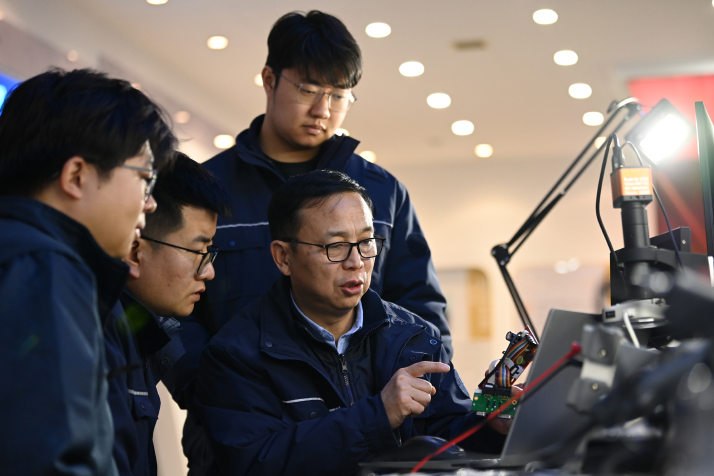 Bullet train technician Dong Hongtao (right), a deputy to the 14th National People’s Congress (NPC), and colleagues examine and maintain a bullet train at a maintenance depot of China Railway Xi’an Group Co. Ltd. in Xi’an, Shaanxi Province, on January 14 (XINHUA)
What does it take to improve people's lives? In many political systems, this question is primarily contested through emotionally charged debates between opposing camps. The Two Sessions, the most important annual political event in China held in early March, present a different understanding of politics. Experts, delegates and representatives from across society bring together experiences from industry, research and everyday life, and share a common objective: improving the living conditions of the people. Getting things done The intellectual roots of this approach reach back to the revolutionary phase of Chinese politics. In 1937, Mao Zedong published his essay On Practice. In it, he formulated an epistemological idea that later shaped the political methodology of the People's Republic of China. Knowledge does not arise from theory alone but from active engagement with the material world. People act, accumulate experience, reflect on it and develop understanding. That understanding then feeds into new action. For Mao, this formed a dialectical cycle between practice and knowledge. From this thinking also emerged the so-called Mass Line. Political leadership should not operate separately from society. Instead, ideas, experiences and problems from the population are collected, analyzed and translated into political programs. The results then return to society, where they are implemented and tested in practice. Politics thus becomes a continuous learning process between state and society. After 1978, Deng Xiaoping revived this methodological principle and applied it to economic development. Under the guiding idea of "seeking truth from facts," China launched its reform and opening-up policies. Reforms were often first tested locally, then evaluated, and only later implemented nationwide. Officials studied successful pilot regions and international developments. This experimental approach laid the groundwork for the Four Modernizations and China's economic rise in the following decades. Today, President Xi Jinping consciously continues this tradition. In numerous speeches, he stresses the importance of field research and direct engagement with the population. Political decisions, he argues, should not be made only in conference rooms. Officials are encouraged to visit factories, research institutes, rural areas and urban communities to understand problems firsthand. These investigations form an important basis for policies and reforms. Politics thus appears less as rigid planning and more as a continuous process of learning, testing and adaptation. 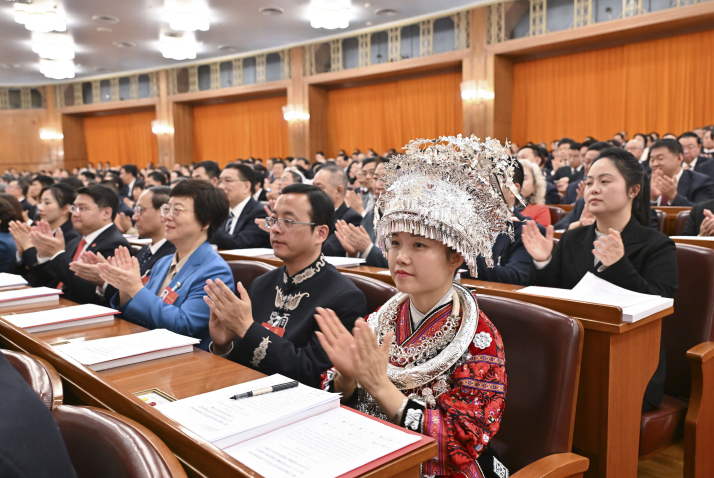 Deputies attend the closing meeting of this year’s NPC session in the Great Hall of the People in Beijing on March 12 (XINHUA)
Concrete action and material growth At this year's Two Sessions, President Xi highlighted a concept currently shaping China's economic policy debate: new quality productive forces. The idea refers to an economic model increasingly driven by innovation, technological breakthroughs and higher value creation. President Xi outlined four key tasks in achieving new breakthroughs, opening new development paths, expanding new horizons and securing tangible results. Together, these principles aim to accelerate China's transition toward becoming an innovation-driven economy. A central instrument is the 15th Five-Year Plan (2026-30). The plan includes 109 strategic projects across six core sectors. Twenty-eight of these focus on new quality productive forces, including investments in AI, quantum computing, next-generation semiconductors and the creation of national research laboratories. Universities and industries are expected to deepen cooperation, while pilot zones test applications of generative AI in manufacturing. Infrastructure and energy form another priority. Twenty-three projects focus on smart power grids, the expansion of the high-speed rail network and technologies related to green hydrogen. Ecological transformation is another major field, with 18 projects, such as river restoration. Social development is addressed through 25 projects aimed at improving educational access, expanding medical services in rural regions, and building modern care and welfare systems. Additional initiatives seek to strengthen long-term food and energy security through sustainable agriculture, new seed technologies and expanded domestic energy resources. China's official growth target has been set at around 4.5 to 5 percent, while planning retains flexibility to respond to global economic shifts. International cooperation and global governance For international partners, this approach signals stability and long-term predictability. Cooperation in green technology, infrastructure and research can rely on relatively consistent policy frameworks. Diplomatically, China again emphasized socialist values during the Two Sessions: At a press conference, Foreign Minister Wang Yi said China continues to extend its hand for cooperation and favors dialogue, mutual respect and a stable international order. Wang noted that 2026 could become an important year for relations between China and the United States. Both sides, he argued, should carefully prepare channels of exchange and manage differences with calm and rationality. He also emphasized the importance of global governance based on cooperation rather than confrontation. China, he said, supports an international order guided by the idea of "a community with a shared future for humanity," a concept China promotes as a central principle of its foreign policy. Addressing other regions, Wang argued that violence cannot resolve conflicts in the Middle East and warned against a return to international politics based on the law of the strongest. Regarding Europe, he called for expanded economic cooperation and urged policymakers to move beyond protectionist reflexes. Grassroots democracy in China The Two Sessions bring together two central institutions of China's political system. The National People's Congress (NPC) and the Chinese People's Political Consultative Conference (CPPCC) National Committee. The NPC is the country's highest legislative body, while the CPPCC National Committee functions as a forum for bringing together representatives from many social sectors. Many proposals originate from direct observations in local communities. Delegates travel to regions, speak with residents and analyze local projects. Proposals are debated, revised and eventually translated into policy initiatives. Between May and June 2025, more than 3.11 million online suggestions were submitted by citizens. These contributions were reviewed, discussed in expert hearings, and in some cases examined through field studies. Delegates then proposed revisions, many of which were incorporated into official programs. The result is a planning process strongly oriented toward practical implementation. The 2026 Two Sessions once again illustrate a central feature of Chinese governance. Political decisions are not viewed only as debate but as part of a practical development process. The philosophical foundation was articulated by Mao in his theory of practice. Today, President Xi continues this tradition, linking it with technological modernization and long-term strategic planning. As a result, laws, programs and development strategies do not emerge solely from abstract theory. They evolve from feedback within society, local experiences and empirical analysis. Politics becomes visible through infrastructure projects, technological innovation and social improvements. The Two Sessions therefore illustrate a political model in which decisions are not merely debated but systematically implemented and tested. In the end, what matters is not the debate itself, but its impact in reality. BR The author is a promoter of China-Germany exchange in the fields of business, academia and politics. He is pursuing a Ph.D. at Peking University's New Media Research Institute Copyedited by G.P. Wilson Comments to dingying@cicgamericas.com |
|
||||||||||||||||||||||||||||
|