
|
| Xinjiang Today |
| The oasis outreach | |
|
|
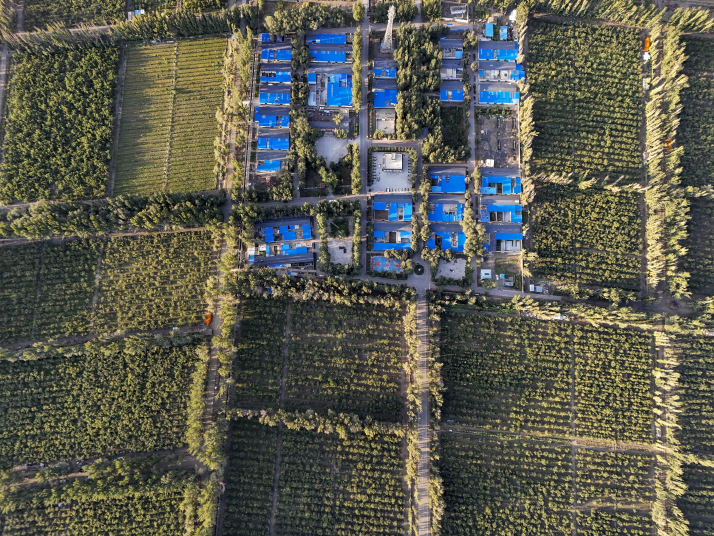 A drone photo shows Shuangfeng Town in Shihezi City on September 4, 2024 (XINHUA)
The conference hall at the library of Shihezi University was filled with delegates from across Asia, Africa, and South America on the afternoon of August 31. They had arrived to take part in a five-day event designed to let the world see for itself how Xinjiang Production and Construction Corps (XPCC), a development-focused organization with roots in the military, based in Shihezi City, has transformed barren deserts into a patchwork of farmland and cities over the past seven decades.
Themed Sharing the Opportunities, Connecting the World, the event was co-organized by China International Communications Group (CICG) and the Publicity Department of the Communist Party of China XPCC Committee. Through facilitating in-person visits and cultural exchanges, and producing a series of vlogs, the organizers aimed to help the world understand the XPCC and its role in implementing China's strategy to promote large-scale development in the western region. 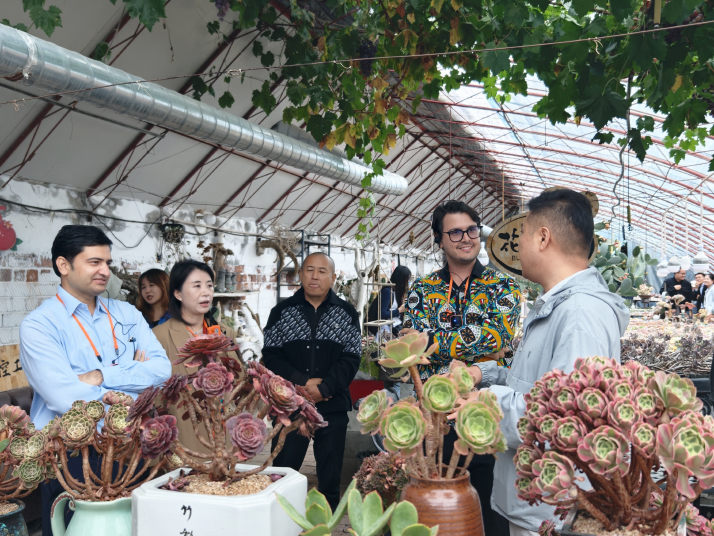 Journalists visit a cultivation base at Xishan Farm, operated by the Xinjiang Production and Construction Corps, to gain insights into the development of the suburban economy in Shihezi City on September 2 (COURTESY PHOTO)
A frontier hub in the making The XPCC occupies a unique place in China's political and economic landscape. Founded in 1954, it was tasked with securing the country's northwestern border and developing the region's vast but inhospitable territory. Today, it oversees 13 cities, scores of farms and factories, and a population of several million. The XPCC has become a linchpin of the Belt and Road Initiative. "We have established regular trade mechanisms with 211 countries and regions," Zhou Zhenfan, Deputy Secretary General of the Communist Party of China XPCC Committee, said at the event. He cited trade statistics to back up the claim: The XPCC's foreign trade volume reached 116.86 billion yuan ($17.4 billion) in 2025, a year-on-year increase of 28.5 percent. Infrastructure has been a key priority, Zhou said. The XPCC has co-constructed 29 civil airports, 23,700 km of highways, and 9,500 km of railways, which now link the region to the rest of China and neighboring countries. "We are building an integrated transportation hub connecting Asia and Europe," he added. If the XPCC has a global calling card, it is agriculture—specifically, the water-saving technologies it has developed to cultivate crops in one of the world's driest regions. Li Jingbin, Vice President of Shihezi University, delivered a detailed presentation on the XPCC's agricultural advances: membrane drip irrigation, integrated water-fertilizer systems which have been introduced in 18 countries and regions, precision seeding, and full mechanization. The results of these advancements are striking by any measure. Cotton yields have climbed from 330 kg per hectare in 1979 to 2,379 kg per hectare today. The XPCC's agricultural mechanization rate now stands at 95.8 percent, with some production processes nearly entirely automated. These technologies have traveled well beyond China's borders, Li noted. Shihezi University has established an agricultural demonstration park in Uzbekistan that uses the XPCC's drip irrigation technology, boosting local crop yields by 20-40 percent. Thousands of Chinese-made seeders, cotton harvesters, and processing machines have been exported to Central and South Asia. "Food security is a global challenge," Li said. "It requires collective action and shared knowledge." Another theme that ran through the event was environmental restoration, a subject that organizers clearly view as both a practical achievement and a powerful narrative. The XPCC has spent decades combating desertification, planting shelterbelts, and rehabilitating degraded land. The most ambitious project is the "green belt" around the Taklimakan Desert, a 3,046-km ring of trees and shrubs completed in November 2024. Last year, the project was named by a Chinese academic panel as one of the world's top 10 engineering achievements. Zhong Dawei, a former designer from China's east coast, first visited Xinjiang in 2020 on a road trip. "The amazing scenery impressed us," he said. He and his family moved to the region, and he now works in the corridor between the Taklimakan and Kumtag deserts, planting trees to prevent the two vast deserts from merging. "We have widened the gap from three km to 20," he said. "Every generation builds on the work of the last." Michael Meadows, former president of the International Geographical Union and an academician of the European Academy of Sciences, has visited Xinjiang twice. He noted the Tarim River ecological water conveyance project, which has replenished water to dried-up riverbeds and revived wetlands, demonstrates the power of sustained effort in the rehabilitation of ecosystems. He said that the experience in Xinjiang proves that long-term investment and adaptive management can yield substantial results. But the work is not finished. 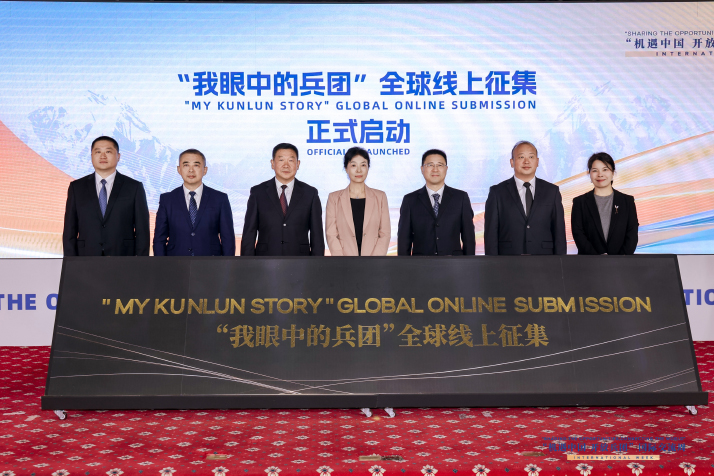 The launch of "My Kunlun Story" Global Online Submission at the opening ceremony of the Sharing the Opportunities, Connecting the World International Week in Shihezi City on August 31 (COURTESY PHOTO)
Telling the story For all the optimism on display, the event also drew attention to a deeper challenge facing the XPCC: How to communicate the region's story to an international audience that often approaches Xinjiang with skepticism. Event organizers worked on the assumption that the best response is not more official statements but more exposure—direct, personal, and ideally, viral. Two initiatives were launched at the opening ceremony to put that strategy into action: an International Youth Short Video Creation Camp, in which creators from Russia, Türkiye, Malaysia and elsewhere will travel to XPCC cities to document what they see; and the "My Kunlun Story" Global Online Submission, which invites submissions of videos, photographs and posters from around the world. Whether this strategy will lead to progress remains to be seen. But the participants who spoke at the event seemed genuinely engaged, and the content they produce over the coming days will soon reach their own audiences. Chloe Kwok Wei Yan, a Malaysian content creator and Ph.D. candidate, offered practical advice on cross-cultural storytelling. She described what she called the "Cross-Cultural Onion Framework," in which the creator must first grab attention with vivid imagery, then layer in human details and local color, and finally peel back to reveal the deeper meaning: The XPCC's true stories of transformation, resilience and cultural heritage. Zachary Lundquist, an American journalist with CICG, offered an international perspective. The XPCC's story, he said, should be told because it speaks to a universal human aspiration for a better life. He urged international audiences to visit and see for themselves. The event's most memorable moments may have come during a roundtable conversation with four individuals whose experiences in the XPCC diverged widely but converged around a shared theme: What it means to live and work in this region. "The XPCC's story is essentially a human story of how a community transformed a harsh desert environment into a thriving oasis through determination, innovation and collective effort," said Wang Xinling, General Manager of CICG's Xufang International Media. From August 31 through September 4, the international visitors traveled through XPCC cities and rural areas, filming, photographing and interviewing. They saw the green belts, the irrigated fields, the new factories and the old museums. They met farmers, entrepreneurs and students. They will share what they see with the outside world. "We hope the world to see an open, confident and inclusive XPCC," Li Yafang, Associate Editor in Chief of CICG, said in her opening address. Comments to linan@cicgamericas.com |
|
||||||||||||||||||||||||||||
|