
|
| Xinjiang Today |
| One man and his farm | |
|
|
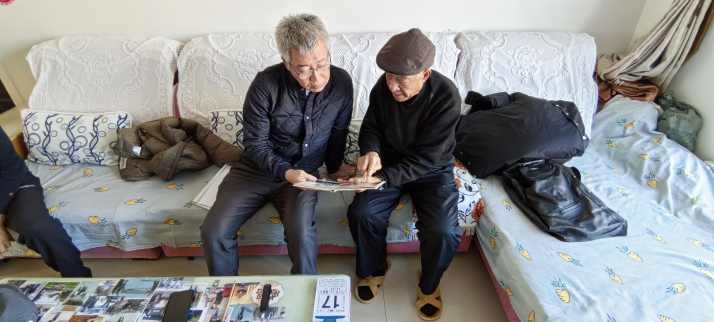 Wang Gongmin (right) and Qian Zhen look through old photos at Wang's home on January 17, 2025 (GAO XINWEI)
At 88, Wang Gongmin still has the hands of a man who built something from nothing—calloused, strong and steady.
He lives on the edge of the Gobi Desert, in a small house at Fuhai No.1 Farm. On a snowy January day in 2025, he sat in his living room and told stories from seven decades ago. His memory was sharp, and his voice firm. He did not talk about himself. So his son brought out a pile of yellowed certificates. They revealed a lifetime of quiet heroism: walking some 60 km through snow to deliver mail, climbing telephone poles in blizzards, raising a neighbor's child and saving a woman's life with his own blood. This is the story of an ordinary man who built an extraordinary legacy. It is also the story of modern Xinjiang. The great trek In 1959, at age 22, Wang answered Beijing's call to develop the far western borderlands. He left his family in coastal Jiangsu Province and arrived at Habahe Farm in Habahe County, deep in the Altay Mountains. At the time, local herders could not grow enough grain. New settlers like Wang helped change that. But after just one year, the mission shifted. Wang and about 200 other families moved again—this time to Fuhai County, a barren stretch of salt flats and scrub some 170 km from Habahe. There were no trucks. They split logs, fitted them with iron strips and made sleds. The convoy stretched for miles across the frozen Gobi. When hungry, they broke frozen flatbread with an axe and warmed it against their chests. When thirsty, they ate snow. After days of trekking, they finally reached what would become Fuhai No.1 Farm. The land was worse than before—alkaline, waterless and hostile. But Wang and the others dug canals by hand, planted alfalfa to restore the soil, and dug channels to divert water. By the end of the first year, they had sown more than 666 hectares. They were no longer outsiders, but pioneers. 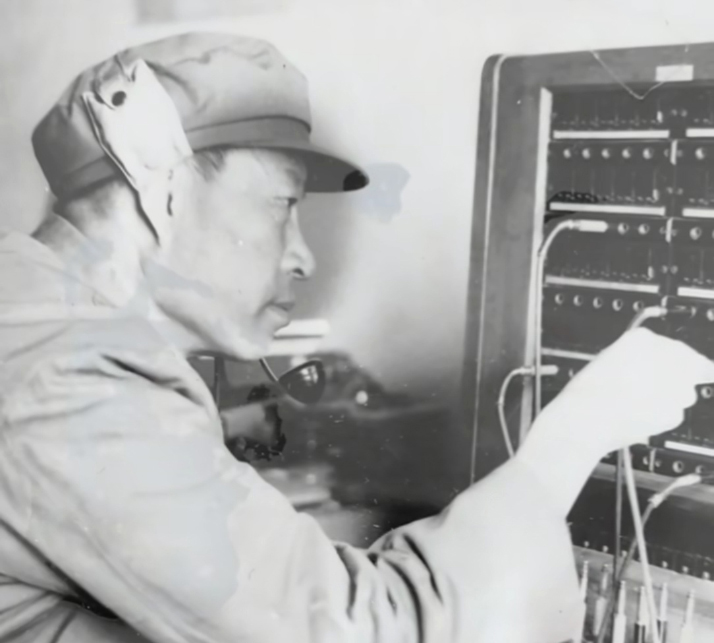 Wang Gongmin at work in the 1980s (COURTESY PHOTO)
Connecting the void In the early 1960s, Fuhai No.1 Farm was nearly cut off from the world, for it had no telephone or local post office. Letters and news came only if someone walked to a distant post office to get them. Wang became that someone. Twice a week, he would walk more than 70 km round-trip to the Fuhai County post office. He carried back heavy sacks of letters, sorted them by lamplight and delivered every single one on foot. In those days, a letter from Shanghai or Jiangsu was the only thread connecting a settler to their past. Wang understood that. He never missed a delivery, not even in rain or snow. Later, the farm got a hand-crank telephone. But there were no lines. So Wang became a lineman. He dug holes, cut timber for poles and climbed them with homemade hooks. He strung wire across the wilderness until the farm could finally hear the voices of the outside world. For decades, whenever a storm knocked down a line, Wang climbed back up. Liang Bo, a former deputy head of the Fuhai No.1 Farm recalled: "Wang never backed down from hard work. He was always serious and responsible." 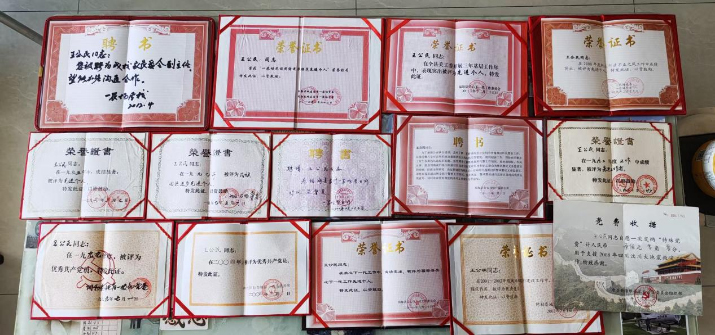 Some of Wang Gongmin's honorary certificates (GAO XINWEI)
A community built on kindness But what truly defines Wang is not what he built, but who he helped. In the 1970s, a boy named Han Qiang lived next door. He was malnourished, short and thin. Han loved to draw as a child, but his family could not afford paper, pencils or paints. Wang asked the farm office for blank paper and bought the art supplies with his own money. Han grew up to become a professor at Xinjiang University. He never forgot the man who fed him and bought him his first art supplies. Then there was Li Jing, a coworker who needed a blood transfusion after surgery. In the 1970s, there was no blood bank on the frontier. Wang went door to door, testing neighbors until he found a match. He saved her life. After Li moved back to her native Sichuan Province, Wang helped collect her salary and mailed it to her every month, making a 50-km roundtrip each time, and he continued this for more than a decade. Wang's farm has always been a tapestry of ethnic groups: Han, Kazak, Uygur and Hui. Wang speaks fluent Kazak. When his Hui friend Ya Xi moved away but left behind his 80-year-old mother who was reluctant to leave her home, Wang visited her daily. He even installed a phone so she could call him anytime. Another story stays with those who know him. A Uygur worker named Sulaihan was so poor that her children wore rags. One New Year, Wang's wife bought fabric with money she had saved for a long time to make a jacket for their own son. But when she saw Sulaihan's son shivering in torn clothes, she sat down with her boy and asked, "What if we give the fabric to him?" The boy agreed. They hired a tailor, made the jacket and delivered it. Sulaihan wept. After retiring, Wang threw himself into community work. Fair and respected, he was invited by the local police and others to serve as an unpaid supervisor. He guided troubled teenagers that even their parents could not handle. And when a massive earthquake hit Wenchuan in Sichuan in 2008, he was the first to donate and motivated others to do the same. 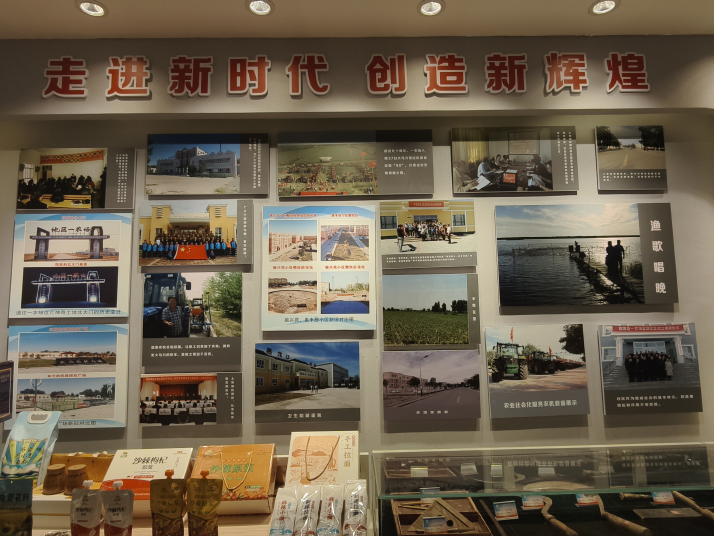 A display board at the Fuhai No.1 Farm history museum showcasing the farm's recent developments (HAN XUEYAO)
A farm transformed In 2026, Fuhai No.1 Farm turns 70. It is no longer a dusty outpost. Today, on its 12,000 hectares of land grow wheat, corn, sunflowers, melons and even crayfish. A small tourism town now welcomes 3,000 visitors a year. The old hand-crank phones are gone. Tractors use satellite navigation to plant seeds with precision. The farm produces organic black wheat, salt-lake fish and jujube honey sold under its own brand. A major change came in 2018, when the farm secured legal rights to its land. This gave it incentive to upgrade to large-scale modern farming. In 2022, the farm was restructured and officially registered as a state-owned investment company, marking its transformation from a traditional farm into a modern enterprise. Then in 2023, the farm launched a cooperative model: The company paid for seeds, fertilizer, irrigation and water, while farmers did the planting. This model reduced risks for individual farmers and improved efficiency. With the company covering the major costs, more farmers were willing to participate. As a result, both crop yields and the farm's overall revenue continued to grow. Land revenue jumped from 7 million yuan ($1 million) in 2020 to 55 million yuan ($8 million) in 2024. But the foundation was laid by people like Wang. Xinjiang's reclamation system now includes 170 state-owned farms. They no longer just grow grain. They guard food security, lead agricultural innovation, build ecological barriers and help keep the border stable. Wang's life is not written in grand speeches or monuments, but in the furrows of a land that once yielded nothing. He came with a sled and stayed through seven decades of wind and dust. Today, the farm hums with machines and data, but its roots are still sunk in the grit of those who refused to leave. Wang never sought recognition. He simply believed that a place worth building was worth staying for. And in that quiet conviction, he helped turn a wilderness into a home. That is not just one man's story. That is how frontiers become communities, and how ordinary lives become the bedrock of change. Comments to luyan@cicgamericas.com |
|
||||||||||||||||||||||||||||
|