
|
| Xinjiang Today |
| Model youth | |
|
|
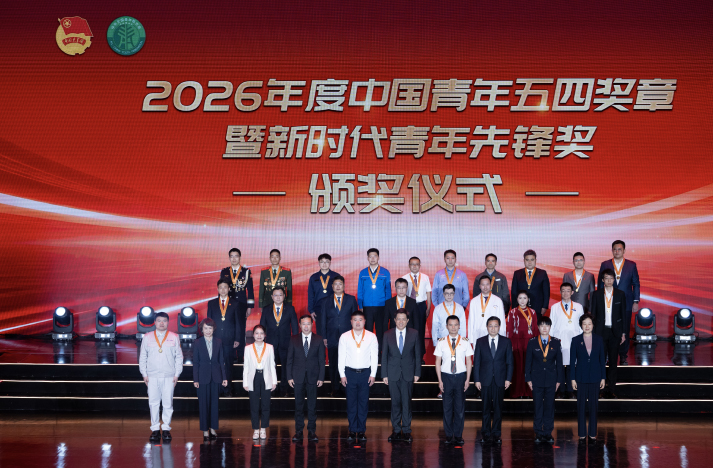 Individual recipients of the 2026 China Youth May Fourth Medal pose for a group photo during the award ceremony in Beijing on April 27 (XINHUA)
In Beijing on April 27, Xinjiang native Guzailinuer Abula received a 2026 China Youth May Fourth Medal, the country's top award that recognizes outstanding young figures. This year, 29 individuals and 30 organizations received China Youth May Fourth Medal in recognition of their remarkable contributions to sectors including scientific research, rural revitalization, green economy development and public services. 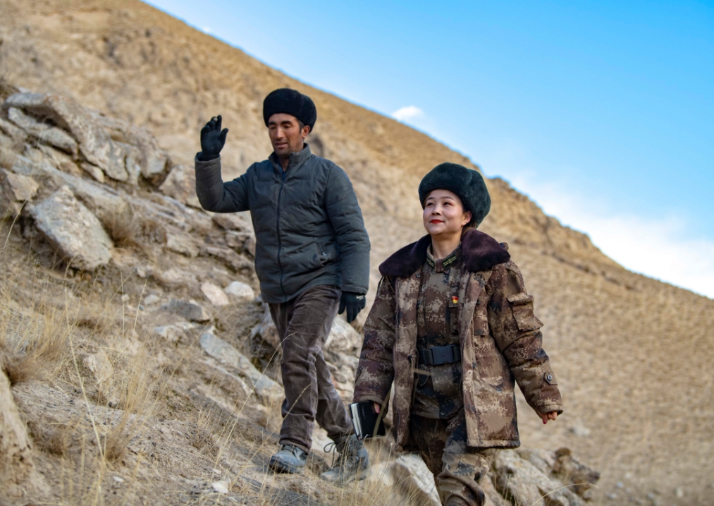 Guzailinuer Abula (right), a border patrol guard, visits a local herder in Tumushuke City of Kashi Prefecture in December 2020 (XINHUA)
Where heart takes root Guzailinuer has her feet planted deep in the soil of her hometown. Born in 1996, this medal recipient grew up at the foot of the Kunlun Mountains in Xinjiang. Her grandfather and father were both border patrol guards. In 2018, after graduating from a university in Shihezi City of Xinjiang with a nursing degree, she chose to return to her hometown instead of finding a job at a hospital or clinic in the city. She joined a border patrol team in Tumushuke City. Located at an altitude of nearly 4,000 meters, it is also one of the most remote outposts in the region. Life on the border is harsh: Oxygen levels are less than 60 percent of those on the plains, ultraviolet intensity is three times higher than on the plains, and winter temperatures drop as low as minus 30 degrees Celsius. Border guard work includes patrolling the border area to ensure the safety of the frontier. Over the past eight years, Guzailinuer and her patrol team have traveled nearly 30,000 km during their patrols. Guzailinuer refers to her tanned skin and rough hands as "medals from the plateau." As a nurse, she carries a medical kit on every patrol. She treats sick herders, delivers medicine and builds health records to help seniors, children and families in need. Guzailinuer has a habit of carrying a small notebook with her at all times. In it, she meticulously records the difficulties and pressing needs of the community. She and her fellow patrol team members have also set up mutual aid groups. They help senior residents who live alone—carrying water for them, feeding their livestock, and sweeping their houses. They tutor left-behind children with their homework, and assist herders with seasonal grazing migration, shearing sheep and repairing houses. When asked if she had ever thought about leaving, Guzailinuer gave a shy smile and said, "When I first started patrolling the border, I suffered from really bad altitude sickness, and I honestly did think about giving up. But then I thought of the stories my grandfather used to tell, the days I spent patrolling the border with my father, and all the hardships we've shared with the herders. That's when I knew this place is our home, and we will protect it, always." 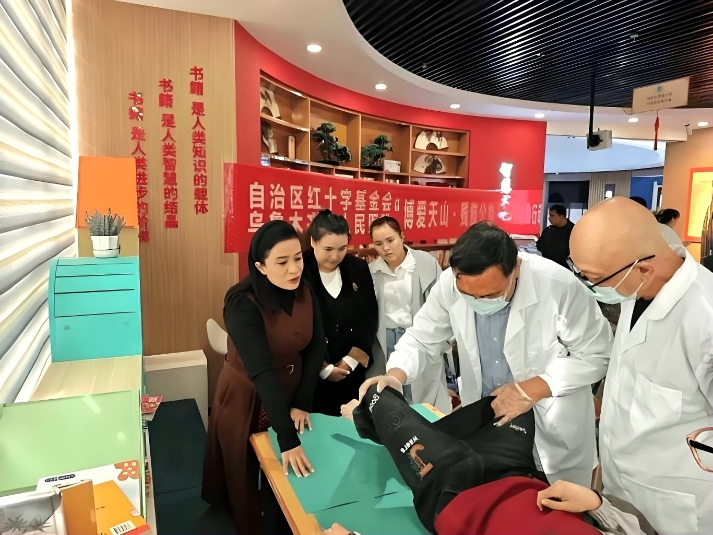 Ayinuer Halike (left) works with doctors during a health screening program at Mother's Home, a private, non-profit service center for children with cerebral palsy she founded in Kashi (Kashgar), in October 2025 (FILE)
Setting an example The China Youth May Fourth Medal is the highest honor for Chinese youths—those aged 14 to 40, which is granted by the Central Committee of the Communist Young League and All-China Youth Federation. The nation began awarding the medals in 1997. The two organizations have also granted 677 individuals titles of New Era Youth Pioneer of 2025 for their good moral characters and noble value pursuit. These honored youths have served in positions, mostly at the grassroots level, in sectors including scientific research, cultural promotion, journalism and communication, rural revitalization (which aims to narrow the urban-rural gap), social services and healthcare. Ayinuer Halike, a lawyer who has dedicated herself to public welfare, was among the 677 individuals. She is the founder of Mother's Home, a free rehabilitation center in Kashi (Kashgar) for children with cerebral palsy. To date, she has helped over 1,500 children receive free care and training, while also working as a lawyer and political advisor to advocate for legal protection and better government support for children with disability. Ayinuer's journey into public welfare began with family love. Her younger sister was born with cerebral palsy. By the age of 13, she still could not speak or walk, let alone take care of herself. As the eldest daughter, Ayinuer grew up sharing the responsibility of looking after her sister. She remembered that her mother couldn't work or go out much because she had to care for her disabled daughter. "When will my sister be able to manage on her own? Then our mom wouldn't have to be so busy and tired all the time." This question never left Ayinuer's mind. In 2011, after graduating from university, Ayinuer returned to Kashi and became a village official in Tawuguzi Village. While visiting households in the area, she discovered that the township alone had more than 200 people living with cerebral palsy. Every time she met a child with the condition, she would give them a hug. In 2013, Ayinuer learned about the story of Anqi Home, a cerebral palsy rehabilitation center in Nanning, Guangxi Zhuang Autonomous Region. She reached out to its founder, Wang Fang, a mother who also had a child with cerebral palsy. That same year, Ayinuer traveled to Guangxi three times to learn more about rehabilitation techniques. After returning home, she put the exercises into practice with her sister every day. Six months later, her sister managed to stand up—shaky and unsteady, but she was on her feet. That small breakthrough became the source of Ayinuer's confidence to keep going. In January 2014, Ayinuer founded Mother's Home, a private, non-profit service center for children with cerebral palsy, the first of its kind in Kashi to offer free rehabilitation training to children aged 3 to 14. In 2015, she made the resolute decision to quit her job and devote herself fully to public welfare. Ayinuer's kind deeds and charitable work have received support from the government and several sectors of society. She has also raised funds through platforms such as Tencent Charity to ensure the long-term operation of the center. She also hopes to draw on her Nanning experience by incorporating rehabilitation, education and training to help the children better integrate into society. In 2023, she became a member of the Xinjiang Uygur Autonomous Regional Committee of the Chinese People's Political Consultative Conference (CPPCC), the top political advisory body. Since taking office, she has submitted more than 70 reports on public opinions and policy suggestions. She never misses an opportunity to make her voice heard. And her efforts have paid off. In early 2025, the regional authorities announced that the subsidy for basic rehabilitation training for children with disabilities aged 0-6 would be raised from 12,000-14,000 yuan ($1,769-2,063) to 17,200-19,200 yuan ($2,535-2,830) per child per year. The news filled Ayinuer with both joy and pride. In 2025, with the support of the regional committee of the CPPCC and related government departments, Ayinuer helped facilitate 137 children traveling to Guangzhou in Guangdong Province and the Xinjiang capital of Urumqi to receive free surgery and rehabilitation. "Even if I can help only one child, I cannot afford to stop," she concluded. Comments to luyan@cicgamericas.com |
|
||||||||||||||||||||||||||||
|