
|
| Xinjiang Today |
| Walking south Xinjiang: history, development and daily stability | |
|
|
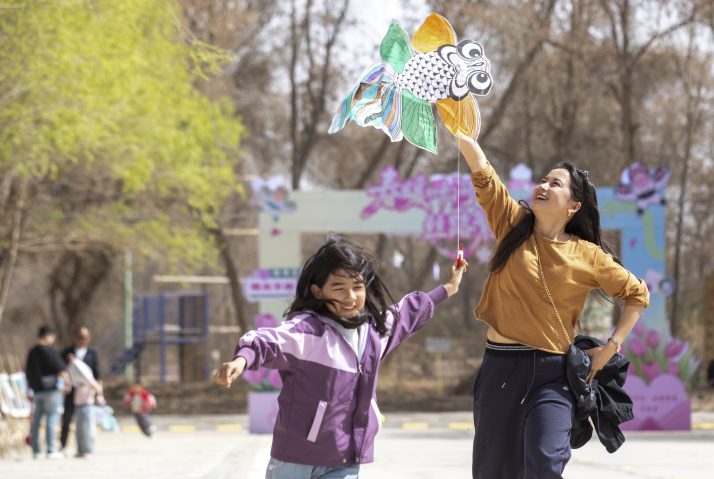 Visitors fly a kite at the Golden Desert Poplar Scenic Area in Zepu County on April 4 (XINHUA)
This piece introduces two women, neither of Chinese origin, whose perspectives were fundamentally reshaped through their experiences in Xinjiang. Their journey took them across cities, communities and parks where ancient trade routes, diverse traditions and modern development meet. From museums and markets to everyday encounters with local residents, they encountered a Xinjiang that is deeply rooted in its past while actively embracing new opportunities.
Their stories, like many others gathered here, are not abstract observations but vivid personal accounts formed through conversation and connection. By engaging with local communities, they saw how longstanding traditions are not simply remnants of history but living practices woven into contemporary life. Their experiences also suggest that understanding a place like Xinjiang cannot come from headlines or statistics alone. It grows through human connection—through listening, observing and seeing firsthand how people live, work and look toward the future. Through their eyes, Xinjiang appears as a region where history and aspiration coexist, and where genuine interaction offers a clearer path to understanding its people and its evolving future. 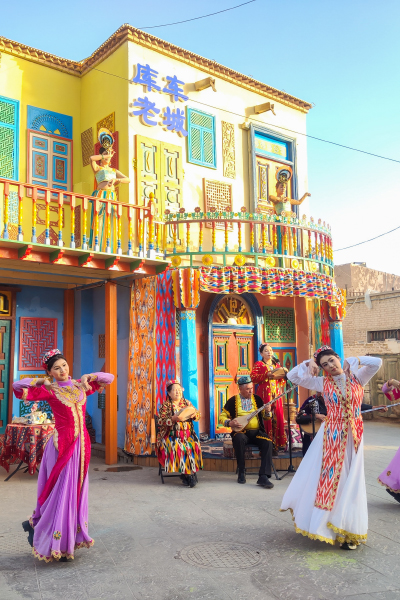 Performers give a show at Flower Hat Lane in Kuche (Kucha or Kuqa) on November 10, 2025 (XINHUA)
Nouran Ahmed Helmy Ahmed Youse, a content creator from Egypt Before I ever set foot in Xinjiang, my understanding of it lived in the same place as most distant perceptions: somewhere between news fragments, secondhand impressions and vague imagination. Even my husband, born and raised in China, would shake his head when the topic came up. Xinjiang, he told me, is so vast that its area can rival that of sovereign countries. If many Chinese people may not fully know the story of every region, he said, what chance did foreigners have of seeing Xinjiang clearly from across the ocean? Then we arrived, and the distance between imagination and reality collapsed. Xinjiang did not feel like a blank space on a map. It was a living place, steeped in history and full of texture. I encountered a land shaped by more than a thousand years of memory, where culture is not displayed like an exhibit but carried forward in sound, craft and daily life. The Uygur Muqam, a traditional musical art form, struck me as gentle and melodious, its stringed instruments sounding like time itself, an artistic treasure etched into the rhythm of the region. What surprised me most was the sheer force of Xinjiang's contrasts. Here, vast golden deserts stretch toward the horizon, and not far away towering snow-capped mountains gleam under Sun, their slopes cloaked in verdant forests. It is not a simple landscape. It is a powerful juxtaposition, one that challenges any one-dimensional narrative you may have built from far away. In Kashi (Kashgar), an ancient city in south Xinjiang, the sense of time changes. Strolling its streets, I felt the pace slow, as if history had its own gravity here. The staggered ochre buildings carry an old charm, and the streets and alleys crisscross in a way that keeps offering new surprises. At the Khan Bazaar market, life was loud in the best way: merchants calling out, tourists laughing and movement everywhere. Even the air was like a report in itself; crispy baked buns, the mellow wheat fragrance of hand-pulled noodles, and the rich scent of stewed chicken. Xinjiang, in that moment, wasn't an abstract concept. It was taste, sound and crowd energy, an economy of everyday life, thriving in public view. And it wasn't only the sights and flavors that stayed with me. It was the people. Walking all the way throughout Kashi, what impressed me most was the residents' enthusiasm. Strangers greeted us with sincere smiles and warm greetings. "No trace of stiffness at all," as I wrote later, still surprised by how natural the warmth seemed. Their simplicity and kindness dispelled the fatigue of travel like sunshine. It is one thing to admire scenery. It is another to feel welcomed inside it. That openness, the human kind, was echoed in the way tradition and modern life sit side by side. In Shufu County's Xinjiang Ethnic Musical Instrument Village, I watched craftsmen at work and sensed genuine admiration for the ingenuity at their fingertips. The instruments they make are not just products; they are cultural inheritance made visible. Then, in places like the Silk Road Mountain Resort, I saw something else: modern leisure activities where ancient charm and contemporary comfort blend seamlessly. That blend matters. It suggests a region not frozen in time, but moving forward without discarding what makes it itself. Even nature here tells a story of resilience. At the N39 Desert Scenic Area, located exactly along the 39th parallel on the southwestern edge of the Taklimakan Desert, China's largest desert, stepping onto soft grains of sand and facing the desert's majesty, I understood why Xinjiang's landscapes carry such symbolic weight. In Jinhuyang National Forest Park, the poplars, hardy trees taking root in the Gobi Desert and thriving against odds, felt like a living metaphor for tenacity. And at the Xinjiang Ancient Ecological Park, seeing wild horses and sensing what I can only describe as the heroic spirit of the Silk Road, I saw firsthand how strongly history still shapes the present. By the end of the journey, one sentence kept returning to me: Xinjiang has never been a thin, lifeless text in books. It is a magnificent, vibrant picture, full of warmth, color and vitality. The vastness of China is not only measured in territory, but in how each region carries its own distinct charm. Xinjiang, to my eyes, stands among the most splendid. I arrived with imagination. I left with memory, precise, sensory and human. And that difference is exactly why Xinjiang deserves to be seen not from a distance, but firsthand. 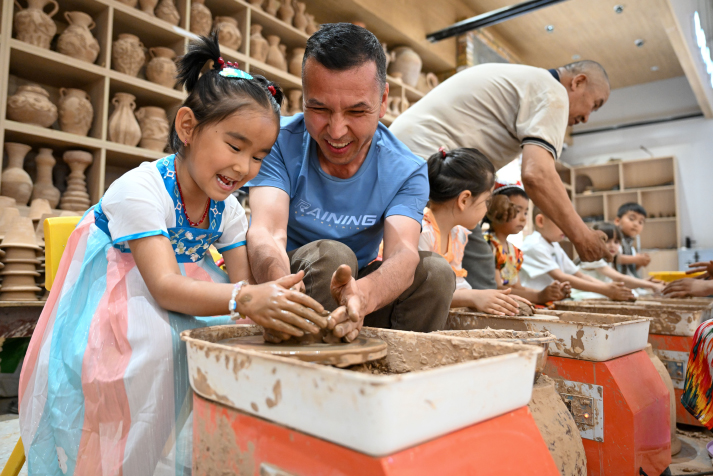 Children experience clay pottery making under the instruction of local craftsmen at the Kuche Intangible Cultural Heritage Workshop in Kuche on May 12 (XINHUA)
Daniele Mattioli, an Italian photographer currently living in Shanghai Traveling from Shanghai to Kashi, the change was instant. After years on China's eastern coast, surrounded by speed, glass and constant motion, Kashi felt slower and deeper. Here, history is not something you hunt for. It is simply there, in the streets, in the buildings and in the faces of the people. That contrast alone says something important: Xinjiang is often talked about from a distance, but it is understood best at walking pace. I did not stay long in Kashi, yet even a short visit was enough to grasp its role. In the old city, narrow alleys fold into clay-colored houses, wooden doors and courtyards hidden from the street. Life moves at a human rhythm—shops are open, people talk and children play. It serves less as a final destination and more as a doorway, preparing you for the wider land of south Xinjiang, where culture, geography and development meet in ways outsiders rarely imagine. Leaving Kashi, I continued south by road. As the city slipped behind me, the landscape opened. The route runs between cultivated land and dry terrain, following what I can only describe as the logic of water and survival, an order shaped over centuries. Traveling this way makes one thing clear: Life here is fragile and keeping it going requires planning, discipline and steady work with the land. That reality became vivid in Maigaiti (Makit) County. The focus was not on monuments or headline-making sights, but on the idea of the oasis itself. Everything here speaks of balance and protection; the fields, irrigation channels and lines of trees are laid out with purpose. It is the kind of scene that quietly challenges stereotypes. This is not a place drifting on the edge of the desert; it is a place actively holding its ground. One of the most impressive moments of my journey was visiting the vast expanse of the windbreak and sand-control forest. Its scale is difficult to believe. Long rows of trees stretch across the land, planted to stop sand, soften wind and protect farms and villages. The forest is quiet, but it is full of meaning. It is not decoration, it is infrastructure. And in that word, "infrastructure," you hear something bigger than engineering—you hear ambition, persistence and a commitment to long-term stability. Nearby, I reached the N39 Desert Scenic Area, where the land opens directly onto the desert. Standing there, I felt very small. The desert does not feel empty; it feels powerful and endless. This is the beginning of the Tarim Basin and the Taklimakan Desert, an immense space that has shaped movement, trade and imagination for thousands of years. The Taklimakan Desert spans around 300,000 square km. For centuries, people have lived around its edges, relying on oasis systems fed by water from distant mountains. Seeing it with my own eyes helped me understand why the Silk Road followed fragile green lines. Here, history was guided by geography. What struck me throughout south Xinjiang was how strongly the region is looking toward the future. Alongside tradition and landscape, there is visible work underway to build a modern region, through infrastructure, logistics, renewable energy and environmental technology. These are not abstract policy phrases when you are on the road watching construction, networks and systems taking shape. They are the building blocks of livelihoods. There is also a reality outsiders should be honest about: Xinjiang carries a strong emphasis on security and stability, shaped by counter-terrorism priorities. As a visitor, you can sense that order is treated as a foundation, not an afterthought. Whatever one's wider opinions, it is hard to miss the practical intention: to keep daily life steady, public spaces functioning, and communities able to focus on work, travel and the ordinary routines that make cultural coexistence possible. My journey ended in Zepu County, where the future-focused approach came into sharp relief. Large ecological projects aim to recreate and protect oasis environments through tree planting, water management and soil recovery, efforts designed to make the land productive and stable again, while opening space for eco-tourism and long-term settlement. Zepu is a place where ancient ideas of the oasis are being reimagined with modern tools. Traveling through south Xinjiang was not about checking places off a list. It was about moving through space and witnessing how history, nature and human effort connect. Kashi opened the door, the road explained the land and the desert set the scale. What stayed with me most was the sense of a region in transition, rooted in deep history, yet clearly working toward a future built on innovation, sustainability, openness and a shared commitment to stability. Comments to zhaowei@cicgamericas.com |
|
||||||||||||||||||||||||||||
|