
|
| Xinjiang Today |
| A bridge of hearts | |
|
|
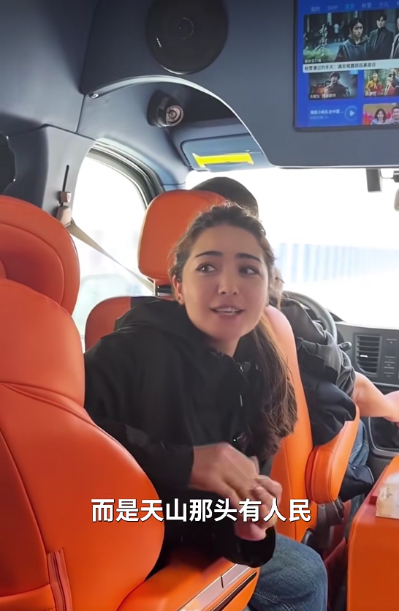 Dilinur Tursunjan introduces the Tianshan Shengli Tunnel to visitors (SCREENSHOT)
Standing outside a meeting room in Beijing, Dilinur Tursunjan, a tour guide from Xinjiang, took a deep breath. When the door opened, she saw Zhou Zheng—the man whose face she had seen countless times in news reports and documentaries. He is general manager of the Xinjiang Wumi Expressway Project and one of the chief overseers of the Tianshan Shengli Tunnel in Xinjiang. Her eyes welled up. "I finally get the chance to meet you," she said, her voice tight. Zhou smiled and patted her shoulder. Beside him stood Wang Heqi, the project manager who had secretly wiped away tears the day the tunnel broke through. Dilinur thought of the many tours she had led through that tunnel—the smooth asphalt, the bright lights, a journey of barely 20 minutes. In her distinctive way, she would tell visitors: "It's not that piercing the Tianshan Mountains is easy. It's that on the other side of the mountains, there are people." That sentence once made her an online sensation. But standing before the people who had turned those words into reality, she felt every syllable carried real weight. 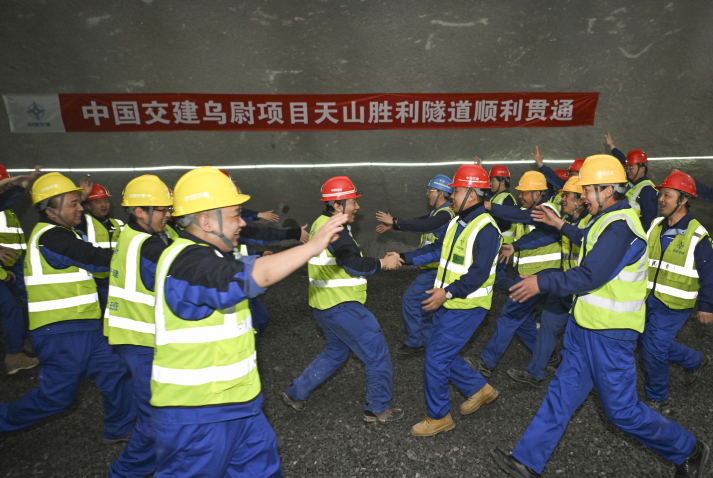 The Tianshan Shengli Tunnel, the world's longest expressway tunnel, was completed on December 30, 2024. This image shows the completion ceremony inside the tunnel on that day (XINHUA)
Crossing the mountains "For me, and for generations of people living on both sides of the Tianshan range, crossing those mountains used to be a long and arduous ordeal," she recalled. Dilinur was born in Atushi (Artux), at the southern foot of the Tianshan range. As a child, the northern side seemed incredibly remote to her. After she was admitted into university in Urumqi, she got opportunities to see the other side of the Tianshan Mountains. The journey was 1,500 km—either over 20 hours on a crowded train, during which some passengers stood the whole way, or four bone-rattling hours by bus traveling on dangerous winding roads, with risks such as falling rocks and blizzards. After graduating in 2022, she became a local tour guide. She loves telling real Xinjiang stories—about customs, history and her own experiences. Then she learned that a tunnel was to be bored through the mountains. Her first reaction: "But those mountains are immense—how could that ever be possible?" Yet in just 52 months, a miracle occurred—the 22.13-km Tianshan Shengli Tunnel, the world's longest expressway tunnel, was completed. The journey across the range has been shortened to 20 minutes. Dilinur devoured everything she could find about the project. The tunnel had to traverse 16 fault zones—with rocks as hard as iron, and mudstone as soft as bean curd. It was the Mount Everest of tunnel engineering. But what truly shook her was a scene from a CCTV documentary. During the final sprint, the tunnel boring machine (TBM)—"Tianshan Hao"—encountered a geological belt that did not appear on any map. In dry conditions it was rock-hard; with water, it turned into a clay-like paste. Within 20 minutes, the cutterhead was encased and immobile. It took seven months just to clean the mass. When the machine tried again, in just 35 seconds, a surge of debris buried it again. The chief engineer there had only 30 seconds to escape. Even academicians called the conditions extraordinarily complex. The team worked day and night. After 14 months of relentless effort, they finally dragged the TBM out of the quagmire. Dilinur learned that the chief engineer had once said what motivated the team most was the thought that "the people on the other side of the mountains are waiting for this road." That sentence hit her like a beam of light. As a native of south Xinjiang, she would like to pay tribute to the people who have overcome so many difficulties to complete the great project, by telling their stories to tourists traveling through the tunnel. 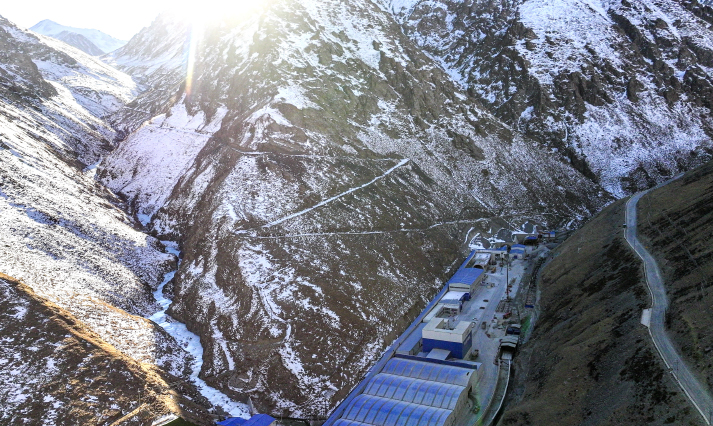 The entrance of the under-construction Tianshan Shengli Tunnel of the Urumqi-Yuli Expressway on December 20, 2024 (XINHUA)
Protecting nature At their meeting in Beijing, Dilinur asked Zhou a question that had long been on her mind. The tunnel entrance is just over 10 km from the Tianshan No.1 Glacier—the source of drinking water for millions. The question is how to keep that water safe for the people? Zhou answered candidly: "Ecological protection was our primary concern." The project built three wastewater treatment plants, recycling treated water for construction use. Excavated debris was turned into roadbed fill and concrete aggregate. Today, wildlife protection signs line the road. Passages have been created under bridges for animals, preserving their migration routes. "Sometimes we encounter red foxes," Zhou said. "We look at each other, and it feels very warm." With the tunnel complete, Zhou has moved on to the next project—the Kuiduku Expressway, which will cut travel time from 14 hours to four, making travel between south and north Xinjiang easier. Embracing a broader horizon Easier transportation has brought more tourists to Xinjiang. Dilinur, who once yearned to travel out of Xinjiang to see the vast world, now is welcoming people flocking to Xinjiang. "When friends from all over China come to my hometown and walk with me through Xinjiang's beautiful landscapes, and when I stand on the great roads our nation has built, connecting my hometown with friends from afar, I feel my feet are planted on the vastest world there is." She said her name, "Dilinur," means "having light in one's heart." Her wish is to share that light, the beauty of her hometown, with as many people as possible. "Xinjiang is full of young people who are sincere, confident, and deeply in love with their hometown," she said. Comments to taozihui@cicgamericas.com |
|
||||||||||||||||||||||||||||
|