
|
| Xinjiang Today |
| A gilded legacy | |
|
|
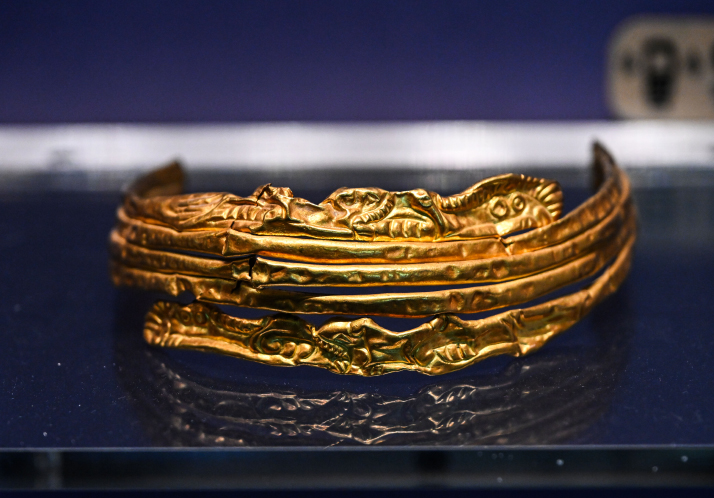 A Han Dynasty gold necklace unearthed from the Gouxi Cemetery at the Jiaohe Ancient City in Tulufan (Turpan), on display on September 24, 2025 (VCG)
Gold has always been more than a precious metal. It is a shimmering record of human movement, power and cultural synthesis. Archaeological evidence reveals that Xinjiang's fascination with gold dated back to the Chemurchek culture, a Bronze Age archaeological culture prevailing from 2500-1800 B.C., making Xinjiang one of the earliest areas in present-day China to craft golden ornaments. During the later centuries, particularly the Han Dynasty (206 B.C.-A.D. 220), gold became a sophisticated language of diplomacy and status, bridging the traditions of the nomadic steppes with the imperial majesty of the Central Plains, the middle and lower reaches of the Yellow River in ancient China, the birthplace of Chinese civilization. 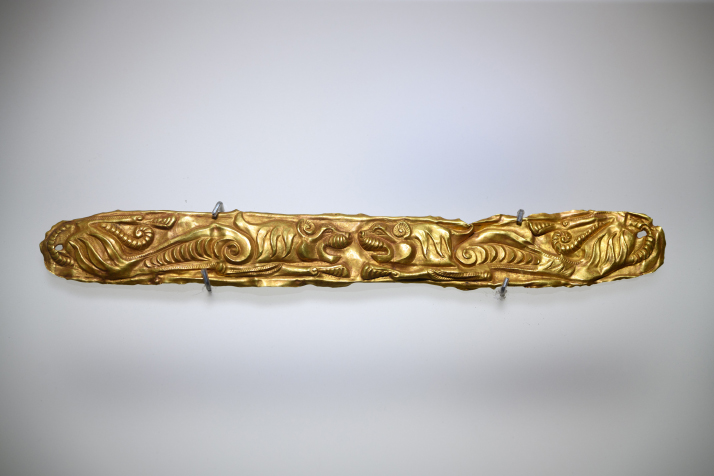 A gold belt ornament with a tiger motif in the collection of the Xinjiang Museum on display at the Splendid Western Regions special exhibition at the Jinsha Site Museum in Chengdu, Sichuan Province, on June 7, 2024 (VCG)
The buckle of power One of the most stunning gold pieces found in Xinjiang is a belt buckle carved with eight dragons inlaid with gems. Unearthed at the Heigeda tomb site in Yanqi (ancient Karashahr) in 1975 and crafted during the Han Dynasty, this horse hoof-shaped buckle is a marvel of ancient metallurgy. Using techniques such as repoussé (hammering from the reverse) and granulation (soldering tiny gold spheres), craftsmen depicted a primary dragon surrounded by seven smaller ones, weaving through a sea of golden filigree clouds. In traditional Chinese culture, the number nine represents the pinnacle of yang (masculine/heavenly) energy and was reserved strictly for the emperor—the Son of Heaven. The buckle with eight dragons identifies its owner as a figure of immense power, likely a local king or high-ranking chieftain, one step below the emperor himself. Historically, Yanqi was a vital hub on the Silk Road; this buckle was almost certainly a Han imperial gift, designed to secure the loyalty of a strategic border ally. 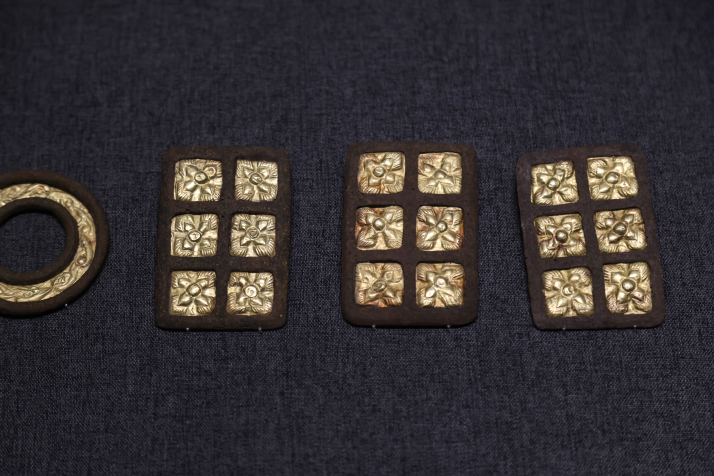 An iron-grid gold belt in the Pre-Qin Period Gallery of the Xinjiang Historical Relics Exhibition at the Xinjiang Museum on September 3, 2025 (VCG)
The iron-grid technique In the northern reaches of Xinjiang, gold reflected a different kind of ingenuity. In 2014, excavations at the Karasu Cemetery in Habahe County revealed a unique "iron-grid" gold belt, a structural feat. Artisans stamped floral patterns onto gold sheets, overlaid them with a protective iron lattice to create a textured, compartmentalized look, and then backed the entire piece with iron and leather for durability. According to Yu Jianjun, a researcher at the Xinjiang Institute of Cultural Relics and Archaeology, the iron-grid gold belt unearthed from the Karasu Cemetery demonstrates a fusion of local technology and cultural influences from the Central Plains. 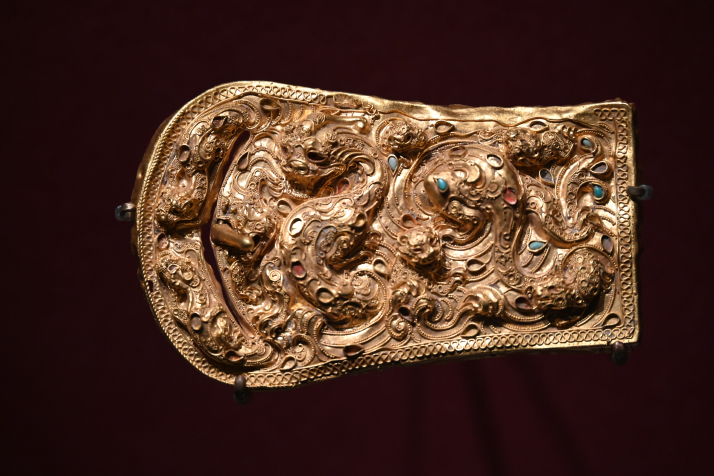 A Han Dynasty gold buckle with eight dragons inlaid with gems at the Xinjiang Museum on February 22 (VCG)
Animal style and power Other finds from Xinjiang pulse with the raw energy of the Eurasian steppes. In the Alagou burials, early Iron Age graves (third to second century B.C.), and the Dongtalede site in the southern Altai Mountains, archaeologists have discovered hundreds of "animal-style" gold appliques featuring snarling tigers, coiled leopards, and animal combat, such as a tiger hunting a deer. In 1977, archaeologists unearthed a trove of gold ornaments from Tomb 30 of the Alagou necropolis. Among the most striking finds is a pair of tiger-motif gold belt plaques, designed to be fastened onto leather. These elongated pieces feature two tigers in mid-roar confrontation, meticulously crafted using the repoussé technique. The Dongtalede Cemetery has yielded a staggering collection of approximately 800 gold funerary objects. Predominantly decorative ornaments, these pieces feature a steppe menagerie: wild boars, snow leopards, deer, tigers, wolves and mountain sheep. A gold necklace discovered in the Goubei burials in the Jiaohe Ancient City, Tulufan (Turpan), is another remarkable find. Composed of four semi-circular, hollowed flat tubes, it is intricately engraved with a high-tension scene of three beasts in a frantic cycle of pursuit and combat. According to Yu, to the nomadic tribes of the Altai and Tianshan mountains, these animals were totems of strength and spiritual intermediaries. For a tribal chieftain, wearing these gold beasts was a way to channel the primal power of the wilderness into their own political authority. A modern renaissance Today, these artifacts, housed in Xinjiang Museum, tell the story of a world that was interconnected long before the modern era. Xinjiang was a vital crossroads on the Silk Road, where the dragon of the East met the beasts of the North. These golden relics are the fingerprints of a civilization that thrived on exchange and a reminder that Xinjiang has always been a place where human ideas blend. To understand why Xinjiang gold looks so delicate, one must understand the "soul" of its craftsmanship: the cumin technique. Though it shares its name with the region's favorite spice, this is actually a master class in ancient metallurgy. A master goldsmith pulls solid gold into filigrees—threads finer than a human hair—and creates microscopic gold beads. These tiny elements are then sprinkled onto the surface, much like a chef seasoning a dish with cumin, and fused to the surface using a high-temperature borax soldering method. The result is a texture so intricate that it captures light from every angle, a tradition that modern Xinjiang jewelers continue to uphold with pride. Gold has shed its image as "grandmother's heirloom." Young Xinjiang designers are blending ancient cumin techniques with contemporary aesthetics, bringing gold into daily wear. Whether it is a pair of earrings shaped like delicate cumin leaves or a bracelet featuring Silk Road motifs, with these pieces young people carry their heritage with a modern edge. From the nomadic chieftains of 1000 B.C. to the modern couples celebrating their weddings today, across 3,000 years gold has remained a shimmering witness to Xinjiang's evolution. The metal's luster reflects the diverse cultures that have hammered, spun and lovingly transformed it into a living legacy. Comments to maxiaowen@cicgamericas.com |
|
||||||||||||||||||||||||||||
|