
|
| Xinjiang Today |
| New tech for old relics | |
|
|
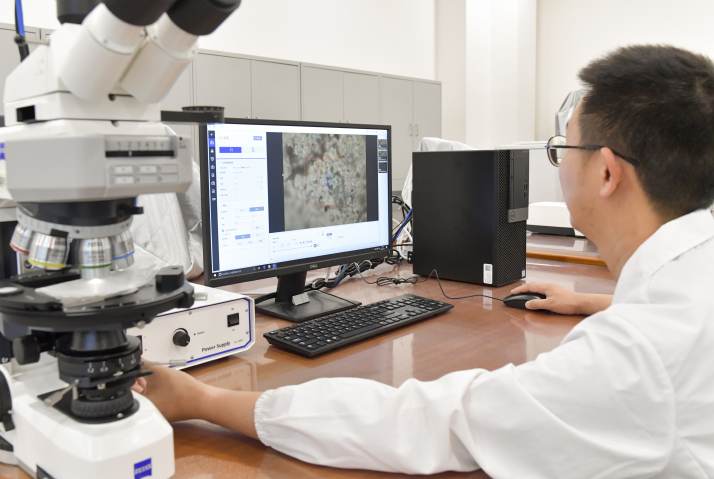 A cultural relics restorer researches and analyzes the material of a cultural relic at the Science and Technology Conservation Center of the Xinjiang Museum in Urumqi on May 16, 2024 (XINHUA)
In Xinjiang Uygur Autonomous Region, archaeology has never been a romantic endeavor. In summer, ground temperatures in the region can soar to 60 degrees Celsius, making you feel like you're being roasted over a fire. In winter, the bitter winds across the Gobi Desert cut like knives at your face. To make matters worse, many sites lie deep in the desert or atop sheer cliffs, with extremely poor accessibility. Once an archaeological team sets up camp, they often stay for months on end, eating and sleeping in tents. But in the past several years, things have begun to change. Special "digital archaeology teams" have entered this land. Their goal is simple: to race against time using technology, preserving the fading traces of civilizations forever in the digital world.  Visitors wear VR devices for an immersive exploration at the Qiuci Wei and Jin Ancient Tomb Site Museum in Kuche (Kuqa or Kucha), Aksu Prefecture, on July 15, 2024 (XINHUA)
Digital painter First constructed in the 3rd century A.D., the Kizil Caves are China's earliest and westernmost large-scale grotto complex. Stretching for several kilometers with 349 grottoes, the remaining some 10,000 pieces of murals record the glory of the ancient Qiuci civilization in Kuche (Kuqa or Kucha), Aksu Prefecture, and witness the eastward spread of Buddhism and the integration of Eastern and Western cultures. However, over the long years, natural erosion and looting have left it scarred: Murals in some grottoes are charred beyond recognition by smoke and fire, while others are cut off and stolen, leaving behind a mess and vaguely recognizable information. More distressing is that from the late 19th to the early 20th century, Western expeditions plundered a large number of exquisite murals from here. Nearly 500 square meters of murals were peeled off, involving 59 grottoes, making many grottoes incomplete and their full features hard to glimpse. These murals are now kept in more than 20 museums and art galleries across eight countries: Germany, Russia, the United Kingdom, the United States, France, Hungary, South Korea and Japan. In 2024, under the guidance of the National Cultural Heritage Administration, the China Cultural Heritage Information and Consulting Center, together with China's tech giant Tencent and other institutions, launched the Tanyuan Plan, an initiative for cultural preservation through digital solutions. It selected grottoes with incomplete murals and smoke-blackened murals of the Kizil Caves as key restoration targets, starting a journey of digital resurrection of cultural relics through technological means. The technical team of the Tanyuan Plan first collected high-definition data of all existing murals in the Kizil Caves to build a complete mural style database, and then used AI large models to learn the lines, colors and pattern rules of these murals. For incomplete murals, the AI "digital painter" first identified the robe patterns of the figures in them and pigment tones of the remaining parts, then combined the characteristics of the figures' shapes in the same grotto and contemporary murals—such as the typical Qiuci costume style, gentle facial expression and posture of holding offerings—to accurately complement the missing facial contours, facial details and arm movements of the figure, and even restore the delicate patterns on the robes and the decorative patterns behind. What's more remarkable is that the AI restoration fully follows the historical original appearance without adding any modern elements. The restored mural is perfectly connected with the surrounding remaining parts, with harmonious colors and smooth lines. For the murals covered with thick smoke stains, the project team used terahertz spectroscopy technology—this special light wave is like a "super perspective eye," which can penetrate the thousand-year-old smoke stains and dust layers without damage, and accurately capture the colors, lines and patterns of the underlying murals. Without touching or cleaning, it makes the hidden thousand-year-old Buddha statues, apsaras and diamond patterns clearly visible, uncovering the dusty artistic code. 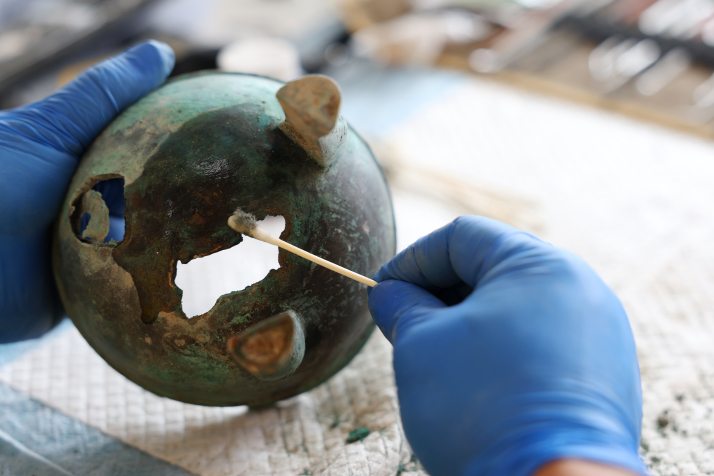 A contestant from the Xinjiang Museum competes in a cultural relics restoration competition in Lanzhou, Gansu Province, on May 22, 2025 (XINHUA)
Archaeology on wheels When we think of the ancient Silk Road, we always picture camel bells, yellow sand and the integration of civilizations spanning thousands of years. But most of these distant histories are hidden in the ruins, ancient tombs and cultural relics in the deserts of Xinjiang. In the past, archaeologists had to work hard to excavate in the wild, then carefully transport the unearthed samples back to laboratories far away for research. This not only took a long time but also risked missing the freshest archaeological information. However, the ancient Silk Road scientific and technological archaeology project jointly launched by Fudan University in Shanghai and Kelamayi (Karamay) City in August last year has completely changed this situation. They "packed" top-level laboratories onto wheels and drove them to the archaeological sites along the ancient Silk Road, gently lifting the veil of history with technology. The core of the project's archaeology is the fleet of three mobile archaeological laboratories, all equipped with "Made in China" equipment. Like three "research centers on wheels," they can complete a series of professional work at desolate archaeological sites without having to travel back and forth. Among them, the two most special vehicles are a molecular archaeology vehicle and a computed tomography (CT) archaeology vehicle, along with a power supply vehicle, which can continuously support archaeological work in deserts without infrastructure. The molecular archaeology vehicle is like a "mobile DNA laboratory," with a clean working space and a full range of testing equipment. After archaeologists excavate samples such as ancient human bones and teeth on-site, they don't need to transport them long distances. Instead, they put on protective clothing and enter the vehicle to directly complete the entire process of sample processing, DNA extraction and sequencing. The sequencing results can also be transmitted in real-time to Fudan University's database for analysis. What used to take several months to get results now takes only about a week to see preliminary answers and a month to complete related tasks, greatly improving archaeological efficiency and allowing timely detection of problems. Through this method, we can clearly understand where the people on the ancient Silk Road came from, how they migrated, and the stories of communication and integration between different ethnic groups. The other CT archaeology vehicle is like giving cultural relics a "non-invasive physical examination." The CT in the vehicle is specially customized for archaeology. Without opening the cultural relics or damaging any remains, it can perform 3D scans on mummies, human bones or complete cultural relics to clearly see their internal structures. For example, when facing ancient mummies, we can understand the physical condition and pathological characteristics of the ancients through CT scanning without damaging the remains; when facing broken bones, we can also restore their complete shape through scanning, helping us restore the living conditions and health levels of the ancients and making the silent cultural relics "speak." Spanning for two months, this scientific and technological archaeology was not only professional and efficient but also very down to earth. The archaeological team opened the experimental process to the public throughout, and even through reality shows, documentaries and other forms, allowed ordinary people to see the real face of archaeological work and understand how technology helps people read history. Comments to luyan@cicgamericas.com |
|
||||||||||||||||||||||||||||
|