
|
| Xinjiang Today |
| The kingdom that vanished | |
|
|
 A sculpture of a Loulan princess at a park in Ruoqiang County, Bayingolin Mongolian Autonomous Prefecture (VCG)
Loulan, a once-flourishing but short-lived kingdom in the Western Regions along the ancient Silk Road, suddenly disappeared from historical records in the 4th century, leaving one of the most enigmatic and enduring mysteries in the history of Xinjiang, and indeed, all of China. Since Swedish explorer Sven Hedin came upon the Loulan Ancient City Ruins in 1900, generations of archaeologists, historians and geographers have traveled into the heart of the Lop Nur region in present-day southeast Xinjiang in search of an explanation for its fall. Yet after more than a century of research, the question of why Loulan vanished remains unresolved. Disappearance from records Located on the western edge of Lop Nur, today a largely dried-up, salt-encrusted lake bed lying between the Taklimakan and Kumtag deserts, Loulan was one of the local regimes in the Western Regions in the Han Dynasty (206 B.C.-A.D. 220). Its position at the meeting point of the Silk Road's northern and southern routes made it an important hub of trade and cultural exchange. Loulan, with little arable land but immense strategic value, was repeatedly contested by the Han Empire and the Xiongnu, a powerful nomadic tribe who were excellent horse riders, according to Han-era records. Loulan shifted its allegiance between the two before eventually coming under Han rule and being renamed Shanshan. After that, references to Loulan grew increasingly rare, until it vanished from the historical records altogether by the Northern Wei period (386-534). One of the greatest difficulties in explaining Loulan's disappearance is the lack of historical sources. Compared with the rich records left by the dynasties of China's Central Plains, the local regimes in the Western Regions received only limited attention in traditional Chinese histories. What survives about Loulan's political system, economy, population and social life is fragmentary at best. Without a clear chronology or reliable accounts of key events, even the date of its disappearance cannot be determined. At most, scattered references suggest that Loulan vanished around the 4th century. 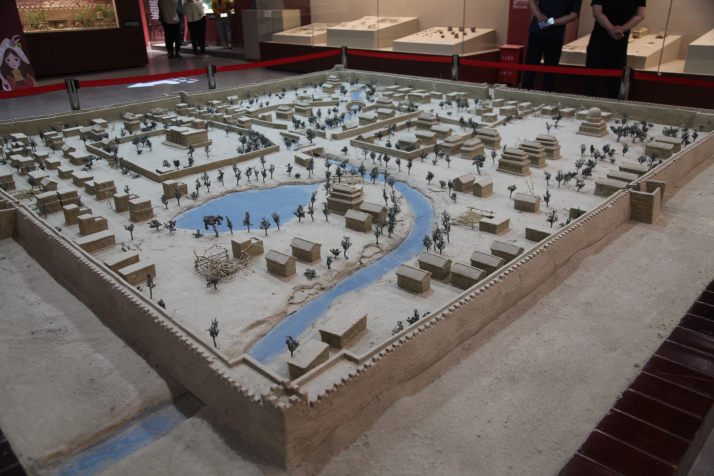 A replica of the Loulan Ancient City at the Loulan Museum in Ruoqiang County (VCG)
Environmental explanations The extreme environment of the Lop Nur region both made Loulan possible and contributed to its downfall. In later centuries, that same environment also hindered attempts to investigate what became of the kingdom. Loulan relied on the branches of the Kongque and Tarim rivers to support life and maintain an oasis amid the desert. But Lop Nur was long known as a "wandering lake." As the climate and river courses changed, the lake repeatedly moved, and Loulan's water supply, crucial to its survival, became erratic. Geological evidence suggests that from the late Eastern Han period (25-220) to the 4th century, northwest China became significantly colder and drier. Falling precipitation and reduced glacial meltwater led to a sharp decline in the flow of rivers and river channels shifted again and again, while Lop Nur contracted dramatically. The consequences for Loulan were profound. As its water supply dwindled, the kingdom's agriculture and the livelihoods of its people came under increasing strain. With limited arable land to begin with, Loulan could no longer sustain stable food production once water sources failed. Desertification and soil salinization accelerated, and the once-fertile oasis gradually gave way to barren land. Even so, reconstructing the exact sequence of these climatic and hydrological changes remains difficult. More than a thousand years of desertification have buried Loulan's ruins beneath sand and badly damaged what remained on the surface. Wind erosion has destroyed much of the geographical and geological evidence that could have shed further light on the process.  A hat unearthed from the Loulan Ancient City Ruins on display at the National Museum of China in Beijing in December 2025 (VCG)
Fragmentary evidence A primary reason the mystery of Loulan's disappearance remains unsolved is that the archaeological evidence is both fragmentary and open to different interpretations. Since the Loulan Ancient City Ruins were first discovered, archaeologists have uncovered wooden slips, documents, coins, silk textiles, pottery and tombs. These finds are invaluable to the study of Loulan, but they are too incomplete to yield a full and continuous picture. The wooden slips and documents found at the site, mainly from the Three Kingdoms and Jin (220-420) periods, contain only scattered references to tuntian, a system in which garrison troops were entrusted with cultivating frontier land, frontier defense and trade. Mentions of "dried-up rivers," "food shortages" and "military unrest" hint at possible explanations, but they do not add up to a clear interpretive framework. Some records suggest that the troops in the Loulan region suffered food shortages as water supplies dwindled, which supports the desiccation hypothesis. At the same time, the discovery of weapons and traces of warfare in certain tombs have led others to argue that Loulan's disappearance may also have been shaped by incursions by nomadic groups such as the Xiongnu and the Xianbei. Furthermore, the cemetery clusters discovered around Lop Nur reveal clear changes in burial styles and grave goods over time. Evidence from certain tombs indicates a sharp population decline, but whether this resulted from plague, famine or warfare remains unclear. Most likely, Loulan vanished as the result of several interlocking forces. A colder, drier climate led to water shortages, ecological decline, lower agricultural yields and a shrinking population. At the same time, changes in Silk Road traffic weakened the kingdom's economic base. Pressure from neighboring nomadic groups only worsened the crisis. In the end, these combined strains appear to have forced the people of Loulan to abandon their homeland and disperse, leaving the ancient kingdom to be gradually buried by the encroaching desert. Even so, in the absence of definitive proof, this multi-factor explanation remains an inference rather than a settled conclusion. Disciplinary disconnect Another reason Loulan's disappearance remains difficult to explain is the lack of effective interdisciplinary collaboration. The problem is not purely historical. It also involves archaeology, geography, climatology, ecology and anthropology, and any convincing explanation requires evidence from all of these fields to be integrated into a comprehensive research framework. However, for over a century, these disciplines have often worked in parallel rather than together. Historians have focused on texts, archaeologists on excavation, and geographers and climatologists on environmental change. Climatologists, for instance, have reconstructed past climate change through ice cores and lake sediments, but they have had difficulty linking those findings to the social and political realities suggested by archaeological evidence from Loulan. Archaeologists, on the other hand, have uncovered signs of sharp population decline, yet they cannot determine the exact timing or mechanisms of water depletion through archaeological evidence alone. This disciplinary disconnect makes it difficult to understand Loulan's decline as a whole. Until environmental, social, economic, political and military evidence can be brought into a single explanatory framework, the mystery is likely to remain unresolved. Loulan's fall was the result of a tragic struggle between a desert civilization and the unforgiving forces of nature, one that also reflects a broader pattern in human history. Research on Loulan has continued for more than a century, and new technologies have transformed the field. Remote sensing, radiocarbon dating and molecular archaeology, among other methods, have given scholars powerful new tools for investigating the ancient kingdom and the circumstances of its disappearance. Satellite remote sensing, for example, has revealed previously unknown paleochannels and traces of ancient oases in the Lop Nur region, adding new support to the water-depletion hypothesis. At the same time, molecular analysis of human remains and of plant and animal specimens recovered from Loulan's tombs has enabled researchers to reconstruct past diets and ecological conditions with far greater precision. The story of Loulan reveals not only the powerful role of the environment in shaping human societies, but also the flourishing and transformation of the Silk Road and the connections between the local regimes in the Western Regions and the dynasties of the Central Plains. It also serves as a reminder of how vulnerable human communities can be to environmental change, and of the importance of protecting our ecosystems and respecting the laws of nature. Perhaps future discoveries and deeper interdisciplinary research will one day bring this ancient mystery closer to resolution. Nonetheless, the story of Loulan will continue to echo through the sands and history, remaining one of the Silk Road's most enduring legends. Comments to lanxinzhen@cicgamericas.com |
|
||||||||||||||||||||||||||||
|