



When Kurban Niyaz opened the Standard Spoken and Written Chinese Language Primary School in 2003, few in his hometown could imagine what it would become. The school, located in Yimamu Township, Wushi County, Aksu Prefecture in Xinjiang Uygur Autonomous Region, is the first private primary school in the region dedicated to intensive instruction in standard Chinese, the national common language.
The township, at the foot of the Tianshan Mountains, is home to fewer than 30,000 people, 99.5 percent of them Uygur. Few residents had ever ventured beyond the township. For many, the world extended no farther than a few fields and flocks of sheep, and the Tuoshigan River, which passed their doorsteps.
Kurban founded the school with his own savings, believing that mastering the national common language could open doors to a wider world and grant local children access to opportunities that are only available through education.
At first, many parents were skeptical. Some questioned whether the focus on standard Chinese was necessary, while others worried it might erode their children’s cultural identity. Kurban visited families individually, sharing his vision and his own experience: In 1982, he became the first university student from his township, studying standard Chinese at Xinjiang University, and later traveled across the country for business.
“They admire my life because I live better than many of them,” he told Beijing Review. “And I tell them it all comes from learning the national common language.”
That first year, 87 students enrolled, paying a modest tuition of 600 yuan ($86) per semester. The sound of children reading aloud has since resounded across the campus.
Shaping lives through education
Kurban’s school transformed students’ daily lives. Many arrived with limited hygiene habits, a reflection of life in remote villages. Teachers guided them to wash, comb their hair and brush their teeth, instilling new routines.
Dietary changes, such as replacing salty breakfasts with healthier options, yielded visible results: Children’s health improved and their faces became brighter and more confident.
The school’s teaching methods were equally transformative. It adopted a model aligned with national standards and introduced textbooks widely adopted across the country, which placed the school at a higher academic benchmark than many other local schools.
Kurban knew from the outset that most local students had little or no knowledge of pinyin, a romanization system that is the basis of standard Chinese pronunciation, before entering primary school. Without that preparation, they would struggle to keep pace with the curriculum.
Therefore, the school was designed to begin with the final year of kindergarten. During this preparatory year, students systematically learn pinyin while also developing essential language skills, classroom discipline and study habits.
“With a solid foundation, first grade would no longer be a problem,” he said.
During the early stages of language learning, he and his teachers use lively and flexible methods to help children adapt. For example, each student receives clappers to chant texts in rhythm, turning rote memorization into playful music. The “click-click” becomes a campus melody, and children often practice at home, naturally internalizing lessons.
“Many students, having mastered the national common language, have become interpreters at home, gradually introducing new ideas and breaking down old barriers within their families,” Kurban said. Parents now recognize the results, and many are eager to send their children to study at the school.
Over the years, thousands of students have graduated with outstanding academic performance, including the first student from Wushi ever admitted to Tsinghua University, one of China’s top higher learning institutions.
For Kurban, this is a work of joy. “Every day brings happiness,” he said. “I’m glad to see students communicating freely in standard Chinese, their habits and living conditions improving, and graduates thriving in Urumqi, capital city of Xinjiang, as well as in Beijing, Shanghai and other major cities.”
“This is the power of education,” he said.
Integrating cultures
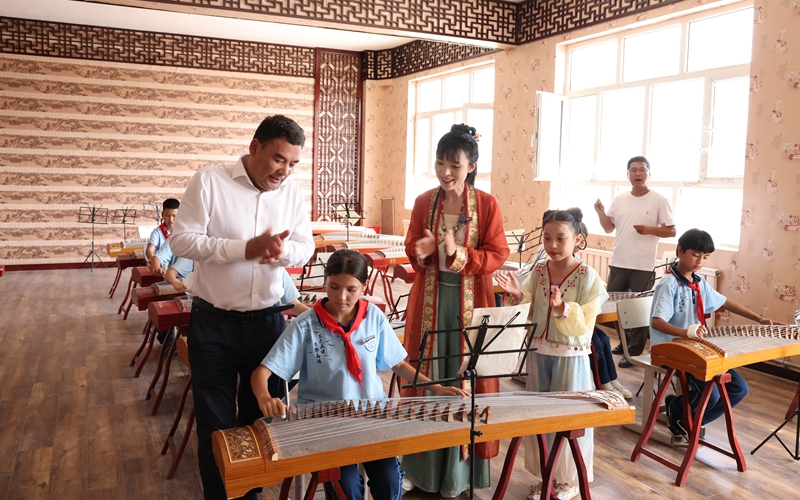
At Kurban’s school, traditional Chinese culture is woven into every aspect of campus life. Students recite classics such as The Analects of Confucius, learning lessons about integrity, respect and responsibility. Two to four times a week, they attend classes in music and art, mastering instruments like the erhu, or two-stringed fiddle, singing Peking Opera and painting in traditional Chinese styles.
Yet embracing Chinese culture does not mean erasing their own. Students wear school uniforms that blend Han-style jackets with traditional Uygur patterns, and their meals include both dumplings and traditional Uygur pilaf. They perform their folk songs and yangge, a folk dance popular in north China.
“They can choose what to eat or perform. All we want is for children to grow up in a multicultural environment, becoming open-minded individuals,” Kurban noted.
Addressing online criticism that he is undermining ethnic minority cultures, Kurban said, “That’s not true. I have helped develop ethnic minority cultures. Ethnic minority cultures are an integral part of Chinese culture. By learning from knowledge and ideas beyond our communities, we can better appreciate, share, preserve and develop our ethnic culture.”
“After mastering the standard spoken and written Chinese language and engaging with traditional Chinese culture, our children’s future is no longer confined to Xinjiang, but extends across the entire country,” he continued, adding that, as an educator, it is his responsibility to build a broader stage for students.
Village empowerment
Now, Kurban has turned his attention to adults aged 18 to 45 who never received a quality education or had the chance to learn the national common language. “Because I live in rural areas, I know farmers are also eager to learn,” he explained.
With Xinjiang’s industrial growth, national common language proficiency has become essential. “Without it, you cannot secure well-paying jobs and engage meaningfully in modern society. Learning the language well also makes it possible to take full advantage of AI and other new technologies,” Kurban said.
Identifying outdated teaching methods as a barrier, he has developed an approach focused on practice. “Speak out loud, and practice makes perfect,” he explained.
He also compiled Introduction to the 800 Most Common Chinese Characters, a workbook with QR codes linking to audio recordings. Tailored to rural and pastoral communities, it helps learners integrate modern vocabulary into daily life.
In the creation of an online learning and testing system for adult workers and farmers, a project led by Xinjiang University, Kurban played an important role. The platform is immersive and interactive, encouraging learners to speak aloud, sing and move in rhythm—turning the lessons into a blend of education, entertainment and assessment.
Kurban hopes to bring traditional Chinese culture into rural communities in Xinjiang, for example, health and wellness practices. “In Shanghai, the average life expectancy exceeds 84 years, while in Xinjiang it is 77. Many health issues, including diabetes and heart disease, are linked to diet and lifestyle,” he noted.
This year, as a deputy to the 14th National People’s Congress, China’s top legislature, Kurban proposed integrating vocational training with initiatives to improve local lifestyles and develop specialty industries in Xinjiang, building digital platforms to foster interethnic exchange, cultivating night school teachers to teach standard Chinese and traditional culture, and creating immersive cultural centers to advance ethnic unity and rural development.
“All efforts toward cultural-ethical progress in rural areas should be woven into daily village life in practical, accessible ways,” he said.



