
|
| Xinjiang Today |
| Development and daily life | |
|
|
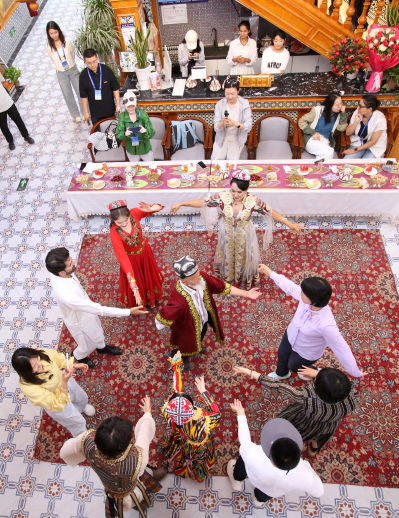 Tourists dance at a homestay in Kashi on September 10, 2025 (XINHUA)
Editor's Note: From the quiet rhythm of Kashi's old streets to the vast horizons of the Taklimakan, each scene reveals a Xinjiang shaped by both heritage and modern progress. As our contributors observe, development here is not just about infrastructure but about people—building communities and finding balance between culture and change. In their reflections, we find a portrait of a region that is dynamic, diverse and deeply human. 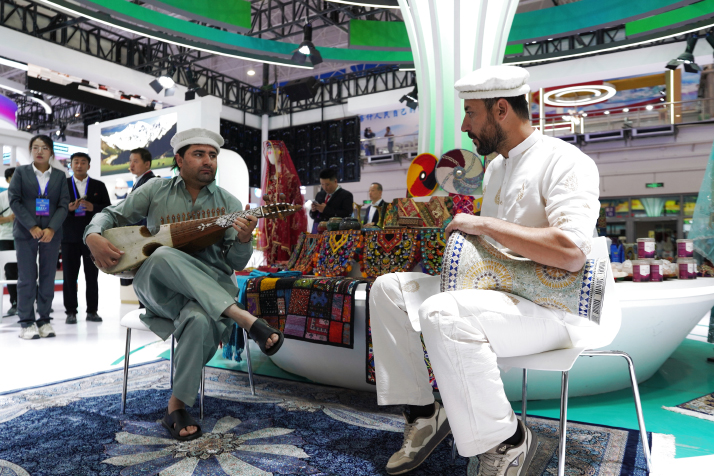 Pakistani exhibitors perform for visitors at the 15th Xinjiang Kashi-Central Asia and South Asia Commodity Fair in Kashi on August 15, 2025 (XINHUA)
Daniele Mattioli, an Italian photographer currently living in Shanghai The first thing that hit me in Kashi, better known to many as Kashgar, wasn't a headline or a talking point. It was the scent of fresh naan drifting out of a small bakery, the soft thud of bread slapped onto an oven wall, and the rhythm of daily life moving at a human pace. I had flown in from Shanghai, where glass towers and constant urgency can make a person forget what "slow" feels like. Here, slow didn't mean stagnant. It meant rooted. In the old city, history doesn't sit behind museum glass. It leans out from clay-colored walls and wooden doors, tucked into narrow alleys where courtyards hide behind modest entrances. Children darted past me, shopkeepers chatted across thresholds, and neighbors lingered in conversation as if time was something you could spend carefully. Kashi felt less like an "end of the road" and more like a doorway, one that opens onto the wider story of south Xinjiang. That story becomes clearer once you leave the city and travel by road. The landscape expands, and with it, your sense of how life here is negotiated, between water and wind, cultivation and desert. You start to notice the logic of survival etched into the terrain: irrigation channels tracing thin lines of possibility, fields clustered where the land can be persuaded to give, trees planted not for beauty but for defense. In the county of Markit, that defense becomes visible in a way no photograph quite captures. I visited what locals described with quiet pride: more than 66,600 hectares of windbreak and sand-control forest. Standing before it, I struggled to hold its scale in my mind, rows upon rows of trees stretching outward like an engineered horizon. "The desert doesn't negotiate, so we build our own protection," one worker told me, wiping dust from his hands. It wasn't a poetic line delivered for a visitor. It was a practical truth. Nearby, at the No.39 Desert Scenic Area, the world opens directly onto the Taklimakan, China's largest desert located inside the Tarim Basin in south Xinjiang. It's immense, almost muscular in its presence, spanning roughly 300,000 square km. Seeing even a small edge of it made the number feel less like trivia and more like physics. You understand, viscerally, why the Silk Road skirted these shifting seas of sand, threading trade and culture along fragile green belts fed by water from distant mountains. This is where outside perceptions often collapse under the weight of reality. From afar, Xinjiang is frequently reduced to a single narrative, either romanticized as an exotic frontier or flattened into something tense and unknowable. What I encountered was more complicated and more human: a region balancing heritage and modernization, security and openness, vulnerability and ambition. What struck me just as much during my trip was what those routines made possible: crowded markets, families out late, businesses operating with confidence, and long highways carrying goods across distances that once isolated communities. People didn't speak in slogans. They talked about work, weather, schools, harvests—ordinary concerns that sound the same in many places and are hard to sustain without a sense of safety. Along the route, signs of development kept appearing: better roads, logistics nodes, renewable energy projects on the horizon, environmental engineering embedded into daily life. The message wasn't "Look how modern we are." It was "we are building a future that can hold us." Tourism, too, felt more like an invitation: Share the culture, respect the landscape, and stay long enough to understand the pace of the place. My journey ended in Zepu County, where that future-focused thinking comes into sharp relief. Ecological projects there aim to restore and protect oasis environments through tree planting, water management, and soil recovery, work that treats nature as a partner rather than a backdrop. Zepu felt like a place where ancient ideas of the oasis are being reimagined with modern tools, not to erase the past, but to keep living on it. I came to south Xinjiang with curiosity and I left with a notebook full of scenes: clay walls warmed by sun, windbreak forests standing like patient guardians, desert horizons that humble you, and communities quietly stitching tradition and development together. The biggest contrast wasn't between old and new, it was between what people assume Xinjiang is, and how much of it is simply people living, building and belonging. 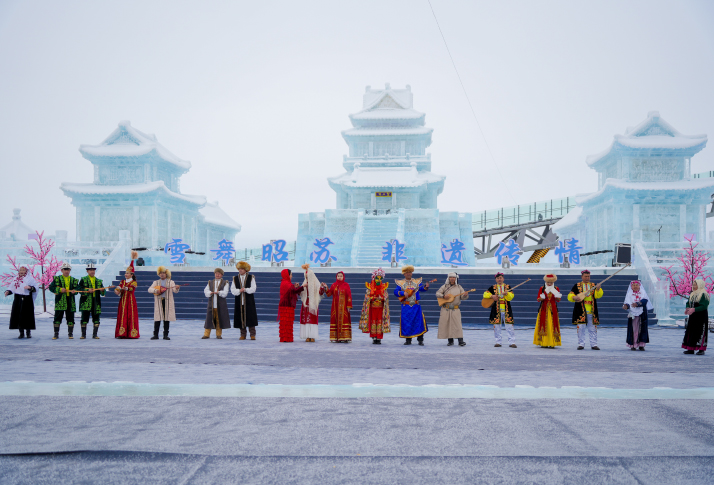 An intangible cultural heritage preservation program is launched in Zhaosu County, Yili (Ili) Kazak Autonomous Prefecture, on January 1 (XINHUA)
Muhammad Rehan Hashmi, a former member of Pakistan's parliament who was also mayor of Karachi Central District This was my second visit to Xinjiang, following a trip five or six years ago. Once again, I returned deeply impressed. My experience was profoundly positive: I encountered beautiful people, a pleasant atmosphere, and a really clean environment. There was also a disciplined feeling in daily life, shaped by dedicated authorities and paired with a rapidly growing economy. Taken together, it made my time there genuinely enjoyable. What struck me most on this visit was how visibly transformative the current development has become. Compared with my earlier trip, I saw clear signs of change: lots of new buildings, including noticeable vertical expansion. I also observed new housing schemes, expanded roads, and modern infrastructure. Even as a visitor, it felt obvious that Xinjiang is building at speed, and not only in one direction, but across multiple areas that touch everyday life. From my observation and understanding, policies are being implemented with a clear emphasis on key sectors such as energy. More importantly, the overall economic approach appears demonstrably focused on the betterment of the people. That focus felt even stronger this time. What I saw suggested that Xinjiang's policy direction as an autonomous region has shifted decisively toward improvement, specifically, a greater betterment in the lives of the people, while giving a clear priority to economic prosperity. The development looks designed to improve daily living conditions. This reality stands in stark contrast to my preconceptions before my first visit. Before I ever set foot in Xinjiang years ago, my image of the region was shaped mainly by distance and assumptions. Then I arrived and discovered something different, something more grounded and more human. People were very nice. The clothes were different. The culture felt unique and unusual. What could have felt unfamiliar instead became a point of fascination. It was surprising to discover such a rich tapestry of ethnic groups and cultures, all coexisting peacefully. That diversity is something you notice in ordinary moments. It shows up in the way communities live side by side, in the customs that remain visible, and in the sense that difference is not automatically treated as division. For an outsider like me, that coexistence carried its own quiet message: You don't need to erase variety to build unity. Xinjiang demonstrates that cultural diversity and social stability can exist together. Beyond what I saw internally, I also view Xinjiang's role on the global stage as pivotal. Xinjiang is very important for China, and it holds great significance for all neighboring countries. It serves as a gateway for international trade, cultural and economic exchange, and peace and harmony. It is also a hub for newly constructed corridors, while the Silk Road remains one of the most ancient routes. When you place Xinjiang in that larger geographic and historical context, it looks central, strategically and economically. Looking ahead, I believe Xinjiang will be crucial for the world, not only for China. The routes that lead toward Europe or other regions, the Silk Road and its modern incarnations, matter because connectivity shapes opportunity and opportunity shapes stability. In that sense, Xinjiang's development is not only a local story, it is linked to broader regional futures. As someone who has witnessed Xinjiang firsthand, I see a region that blends diverse cultural heritage with a forward-looking drive for unity and shared prosperity. It reflects an approach that places the collective wellbeing of all its people at the forefront, while also securing its place as a cornerstone of future global connectivity. This is the Xinjiang I have seen and it is a story of success worth recognizing. Comments to zhaowei@cicgamericas.com |
|
||||||||||||||||||||||||||||
|