|
| Xinjiang Today |
| Xinjiang charts a new course for high-quality development | |
| Xinjiang will focus on promoting high-quality development with steady and practical steps | |
|
|
|
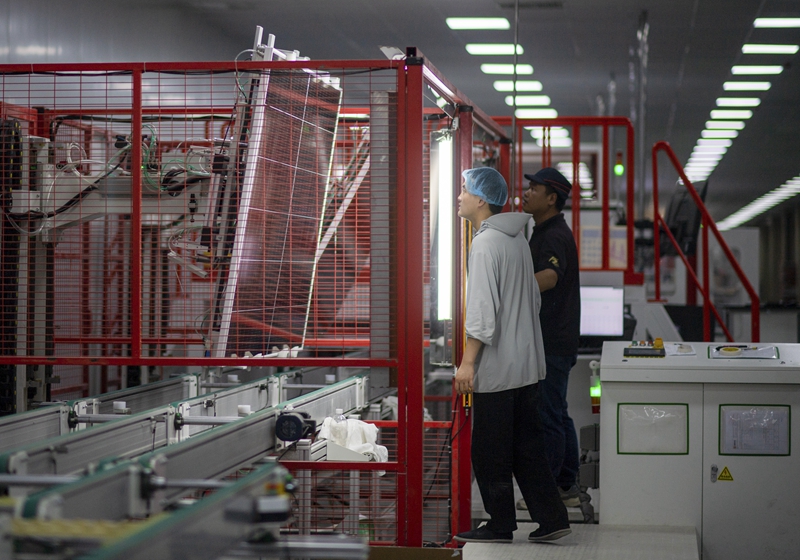
Workers conduct quality inspections on photovoltaic cells at a new energy enterprise in Ruoqiang County, Bayingolin Mongolian Autonomous Prefecture, Xinjiang, on September 22, 2025 (XINHUA) The annual Two Sessions, the gatherings of China’s top legislature, the National People’s Congress (NPC), and the top political advisory body, the National Committee of the Chinese People’s Political Consultative Conference (CPPCC), took place in Beijing from March 4 to 12. On March 6, the NPC delegation of Xinjiang Uygur Autonomous Region held an open-day event. During the deliberation, deputies engaged in in-depth discussions on the region’s economic and social development and shared their vision for the next stage of growth under the 15th Five-Year Plan (2026-30). Chen Xiaojiang, Secretary of the Xinjiang Uygur Autonomous Regional Committee of the Communist Party of China (CPC), emphasized that the 15th Five-Year Plan period is critical for consolidating foundations and advancement across the board. Xinjiang, he said, will focus on promoting high-quality development with steady and practical steps. Erkin Tuniyaz, Deputy Secretary of the CPC Xinjiang Uygur Autonomous Regional Committee and Chairman of the regional government, said during the 14th Five-Year Plan (2021-25) period, Xinjiang faced severe challenges rarely seen in decades. Despite the complex situation, the region achieved remarkable and hard-won progress (see chart).
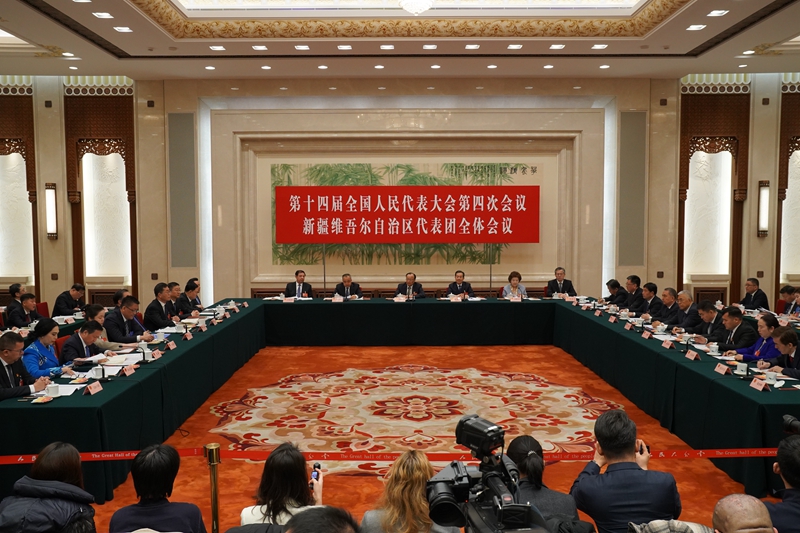
The delegation of Xinjiang Uygur Autonomous Region to the Fourth Session of the 14th National People’s Congress, China’s top legislature, hosts an open day event for international media on March 6 (ZHANG WEI) Sustained stability Today, across Xinjiang’s cities and rural areas alike, streets are brightly lit at night and bustling with activity. Shopping malls and markets bustle with activity, school surroundings are safe and orderly, and neighbors in rural communities live in harmony. Both north and south of the Tianshan Mountains, a new atmosphere of stability, unity and shared endeavor is taking shape, Wang Mingshan, Deputy Director of the Standing Committee of Xinjiang Uygur Autonomous Regional People’s Congress, said. Through sustained efforts, Xinjiang has gone several consecutive years without a single violent terrorist incident. Public order remains stable. A system of local regulations with distinctive regional characteristics has steadily taken shape, bringing counterterrorism, stability maintenance and de-radicalization firmly onto a law-based track, Wang added. He said Xinjiang will prioritize social stability above all else, continue advancing governance under the rule of law, consolidate its hard-won social harmony and ensure long-term peace. High-standard opening up From 2021 to 2025, Xinjiang’s total foreign trade surged from 156.9 billion yuan ($22.7 billion) to 520.37 billion yuan ($75.4 billion). Last year, its export and import volume recorded an increase of 15.9 percent year on year, the fastest in the country. Accounting for this acceleration, Zheng Jun, a counselor to the regional government, pointed to the combined effect of several factors: Xinjiang’s geographic advantage, the growing role of international transport corridors, the strengthening of industrial support and a range of favorable policy measures working in concert. Wang Kuiran, Secretary General of the regional government, said in recent years, certain countries have imposed unjustified sanctions on some enterprises and individuals related to the region. These actions are based on false allegations such as those of forced labor, undermining international law and global trade rules under the disguise of human rights while attempting to hinder China’s development, Wang said. "We firmly oppose and resolutely counter such actions," he said, adding that Xinjiang’s development has never been deterred by external pressure. During the 15th Five-Year Plan period, the goal is to achieve steady foreign trade growth, foster a more diverse range of foreign trade market entities and continue improving the export structure, advancing toward higher-quality development, Zheng said. Green development Erkin said in recent years Xinjiang’s new energy sector has expanded rapidly and maintained strong momentum. Netizens have even given the region a nickname: the “super green power bank.” He said Xinjiang is endowed with exceptional natural conditions for renewable energy, with its wind and sunshine being among the most abundant in China. At present, five major electricity transmission corridors have been built to deliver power from Xinjiang to other parts of the country. Since 2010, the region has transmitted more than 1 trillion kilowatt-hours (kwh) of electricity to 22 provinces, autonomous regions and municipalities. Nearly 1 out of every 3 kwh outbound electricity from Xinjiang is generated from renewable sources. The environmental impact is obvious. The outbound power transmission from Xinjiang has helped reduce carbon emissions by about 240 million tons, equivalent to adding at least 24 million hectares of forest coverage. These efforts have contributed to safeguarding national energy security and advancing China’s broader energy transition, Erkin said. China has pledged that by 2035 the combined installed capacity of wind and solar power will reach around 3.6 billion kilowatts. This national target provides vast new opportunities for Xinjiang’s renewable energy development, Erkin added.
A visitor interacts with an intelligent robot at the 2025 (China) Eurasia Commodity and Trade Expo in Urumqi, Xinjiang on June 26, 2025 (XINHUA) Hi-tech empowerment "Computing power is the foundation of AI and it runs on energy," said Shi Gang, Vice Chairman of the Xinjiang Uygur Autonomous Regional Committee of the Chinese People’s Political Consultative Conference. Beyond its reliable energy supply, Shi said Xinjiang has another distinctive advantage for AI infrastructure: its climate. The region’s dry and cool conditions function as a natural and cost-free cooling system, reducing the energy consumption required for large-scale computing facilities. As a major region for energy production, agriculture and tourism, Xinjiang also offers a wide range of AI application scenarios and its geographic advantage further amplifies its technological potential, he added. Xinjiang has made comprehensive arrangements to advance AI development in the next five years. The strategy includes strengthening the foundational infrastructure for AI by exploring direct connections between green power and computing facilities, promoting the clustered development of green-powered computing centers, and integrating AI technologies into key industries and public services, Shi said. Modern agriculture Xinjiang’s grain output has continued to rise year after year, with its yield per unit area ranking first in the country for two consecutive years. At the same time, the region now produces more than 90 percent of China’s cotton. Xue Bin, Vice Chairman of the regional government, said in recent years, both the quantity and quality of Xinjiang’s agricultural products have improved. The region’s distinctive varieties of fruit have become widely recognized by consumers in China and abroad. Among them are Korla fragrant pears, apples from Aksu and grapes from Turpan. Meanwhile, specialty agricultural sectors are expanding. Xinjiang now accounts for more than 90 percent of China’s tomato-processing capacity, with output ranking first in Asia. Aquaculture has also grown steadily, with annual aquatic production exceeding 200,000 tons. Salmon raised in Xinjiang, in particular, have become a sought-after fresh product in both domestic and international markets. Looking ahead, Xinjiang will develop grain and food processing industry clusters and build a strong “western granary” for the country, Xue said.
Tourists pose for photos in front of a graffiti wall on Liuxing Street in Yining, Ili Kazak Autonomous Prefecture, Xinjiang, on August 4, 2025 (XINHUA) Culture and tourism In 2025 Xinjiang received 323 million tourist visits, with total tourism spending reaching 370 billion yuan ($53.6 billion), increases of 8 percent and 8.4 percent, respectively, from the previous year. Both figures set new historical highs. "Without visiting Xinjiang, it is hard to grasp the vastness of China,” said Ainivar Tursun, Deputy Director of the Standing Committee of the regional people’s congress. “It’s a place people should visit at least once in their lifetime. And once you’ve been, you will remember it forever.” Xinjiang spans more than 1.66 million square km. Across this vast land are breathtaking landscapes that shift with the seasons, a large number of historic sites and communities where people of different ethnic groups live together. These resources, he noted, continue to elevate Xinjiang’s cultural and tourism appeal and expand its influence. During the deliberation, deputies introduced the unique features of their hometowns and extended sincere invitations to visitors from across the world. Looking ahead, Xinjiang will continue to build on its core attractions by exploring their deeper cultural value, innovating tourism products and cultivating distinctive service brands. Efforts will also focus on advancing the integration of culture and tourism and enhancing the overall visitor experience, Ainivar said. Chen said during the 15th Five-Year Plan period, Xinjiang will further consolidate its five strategic roles in national development, namely, a golden channel across the Eurasian continent and a gateway for opening up to the west, a strategic pivot for fostering a new development paradigm, a strategic base of China's energy resources, a national base for high-quality agricultural and livestock products, and a strategic barrier for safeguarding national geopolitical security. Xinjiang in Numbers 5.9% Average annual GDP growth rate from 2021 to 2025, surpassing 2.15 trillion yuan ($311.7 billion) in 2025 64% Share of new energy in Xinjiang’s total installed power capacity, with installed new energy capacity reaching 169 million kw 90% Share of Xinjiang’s cotton output in China’s total 74,000 Number of China-Europe and China-Central Asia freight trains that have originated in or passed through the region to date 228 Number of countries and regions maintaining trade relations with Xinjiang 70%+ Share of Xinjiang’s annual fiscal expenditure directed toward public wellbeing 99%+ Public satisfaction with safety, maintained for five consecutive years 1,911 Number of foreign delegations received over the past five years, along with 1,368 outbound exchange visits 323 mln Number of tourist visits in 2025, more than doubling within four years from 158 million in 2021 3,046 km Length of the world’s longest desert-encircling ecological shelterbelt, now fully complete Copyedited by G.P. Wilson Comments to zhangshsh@cicgamericas.com |
|
||||||||||||||||||||||||||||
|