
|
| Xinjiang Today |
| The chill factor | |
|
|
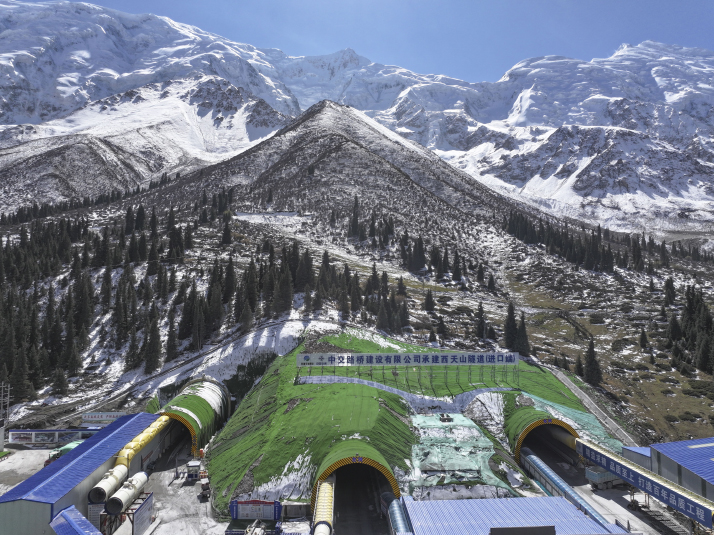 Tunnels under construction in Zhaosu County, Yili (Ili) Kazak Autonomous Prefecture, on October 5, 2025. Slated for completion in October 2027, the new highway across the Tianshan Mountains will significantly cut travel time between Yining City and Aksu City, adding new momentum to tourism (XINHUA)
The onset of winter draws Chinese travelers in two distinctly opposite directions. While many seek sunshine and warmth in destinations like Hainan Province, a growing number are purposefully heading toward the cold, chasing the thrill of ice sculptures, winter sports, and landscapes transformed by ice and snow.
Zhou Jianming and Li Shufang, a couple from Changsha, Hunan Province, belong to the latter group. Last winter, they took their family to Harbin in northeast China, captivated by its ice lantern festivals and sleigh rides. This year, their compass points further west. "The cold itself is a kind of landscape," Zhou told Xinjiang Today. "My wife and I are both from the southern parts of China, where there is no snow. We are excited every time we see snow. In recent years, the booming of snow sports and the improvement in the quality of winter tourism have led us to make more plans to visit north in winter." The enthusiasm of travelers like Zhou is far from an isolated case. A robust surge in winter tourism is sweeping across Xinjiang, solidifying its status as a premier cold-weather destination. The 2026 New Year holiday, January 1-3, offered a powerful snapshot of this growth. According to data released by Xinjiang's Department of Culture and Tourism, the region welcomed 1.68 million tourist trips over the three-day period, generating a total tourism spending of 1.53 billion yuan ($220 million). The upward trend is further evidenced by a 67-percent year-on-year increase in tourism bookings for Xinjiang's attractions during the holiday, as reported by the delivery platform Meituan, which last year began offering online travel booking services. "For the upcoming Spring Festival holiday, we did our homework on [social media platform] RedNote and plan to follow some of the hottest travel routines: riding down powdered slopes, witnessing ancient ice-fishing rituals on frozen lakes, getting a glimpse of snow-covered mountains, and watching some local ethnic performances," Zhou added. 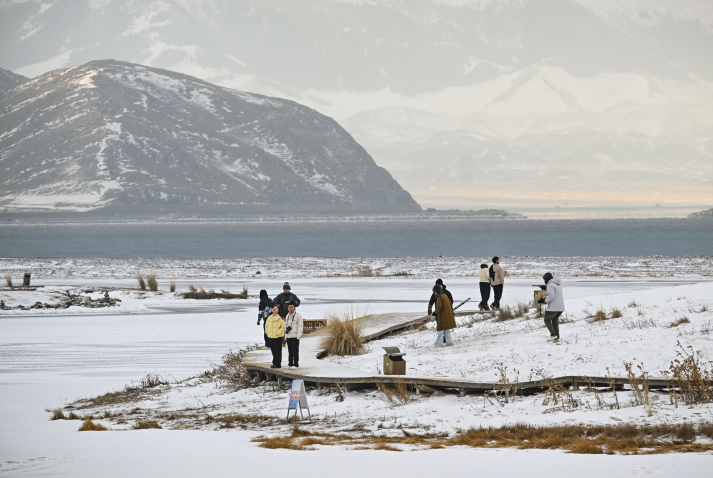 Tourists enjoy the scenery by Sayram Lake in Xinjiang's Bortala Mongolian Autonomous Prefecture on December 16, 2025. The lake is the highest and largest alpine lake in Xinjiang (XINHUA)
Natural arena Xinjiang's winter tourism boom is partly due to its geographic location. Spanning over 1.66 million square km, the region boasts some of China's most dramatic and diverse winter landscapes, from the deep powder snow of the Altay Mountains to the crystal-clear ice sheets of its alpine lakes. These conditions have created a paradise for winter sports, both traditional and modern. During the Bosten Lake Ice Sailing Competition, held in Bayingolin Mongolian Autonomous Prefecture in January 2026, athletes from eight provinces gathered to race wind-powered ice sleds. Bosten Lake is one of the few lakes in China where ice sailing competitions can be held. According to the event's organizing committee, iceboats can reach speeds three to five times the wind speed. During this competition, lake gusts reached 24-28 km per hour, with the measured top speed of the participating iceboats exceeding 120 km per hour. The event has reshaped many visitors' understanding of winter sports. "Sailing across the vast frozen lake, with the speed and the scenery, it's a thrill you can't find anywhere else," said Li, a competitor from Jiangsu Province, told newspaper Xinjiang Daily. The event, rare in China, highlights Xinjiang's growing role as a center of high-adrenaline winter activities. In addition to rare elite sports, Xinjiang's terrain supports everything from professional skiing to family-friendly ice festivals, giving rise to the development of sports with mass appeal. Altay Prefecture alone is home to four major ski resorts, Jiangjun Mountain, Koktokay, Jikepulin and Qinggeli Wolf Mountain, which have become social media hotspots for young travelers. "The ski resorts in Xinjiang are very junior-friendly," Zhu Tianqi, who visited Altay last winter, told Xinjiang Today. "I was a complete beginner, but I found it surprisingly easy to get started. I hired a local ski instructor and a photographer who rode alongside to record videos, and rented all the equipment right at the resort. The whole experience was fantastic." Xinjiang's natural advantages are being amplified by improving infrastructure. New highways like the Altay-Hemu highway have cut travel times by half, while expanded airports and high-speed rail links connect Xinjiang to major cities like Beijing, Shanghai and Guangzhou. The most transformative change comes from projects that dismantle historical barriers. The recent opening of the Urumqi-Yuli (or Wuyu) Expressway, which traverses through the towering Tianshan Mountains via the world's longest highway tunnel, is a prime example. It has slashed the travel time between the regional capital Urumqi and Korla in southern Xinjiang from seven hours to just three and a half. For tourists, iconic destinations like Bosten Lake are now within a comfortable half-day drive from Urumqi, further fueling a winter tourism boom. At the same time, upgraded regional airports, such as the expanded Altay Airport, provide more frequent and direct links, better integrating remote scenic areas into the broader travel network. Together, these advancements are turning Xinjiang's vastness from a logistical challenge into a tourism advantage. "The improvement of public transportation has been a significant boost to Xinjiang's winter tourism industry," a sales representative surnamed Chen from China CYTS Tours Xinjiang International Travel Service Co. Ltd., told Xinjiang Today. "During spring and summer, many tourists prefer self-driving tours. They believe it offers more flexibility to enjoy the scenery. However, winter weather and snowfall prompt many to switch to travel agencies or public transportation. The upgrades to expressways and airport facilities enable us to design better travel itineraries for our clients." 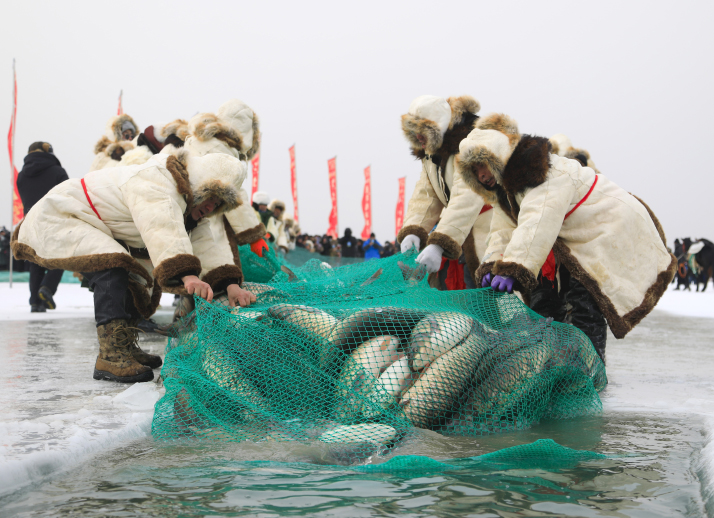 Fishers pull in a long net teeming with fish during the winter harvest season on Bosten Lake in Bayingolin Mongolian Autonomous Prefecture on January 19 (XINHUA)
Culture on ice What truly sets Xinjiang's winter apart is how it is blending sport with culture. Its winter tourism offers more than just skiing or sightseeing; it also offers opportunities to connect with the cultures, traditions and heritage of the region's ethnic minorities. The 19th Ulungur Lake Winter Fishing Festival in Fuhai County (also called Burultokay in Kazak language) is a prime example. In January, locals gathered to practice a centuries-old fishing method, drilling holes in thick ice, laying nets that stretch for over a kilometer, and hauling up fish including pike, carp, and catfish. The festival, which was listed as a form of intangible cultural heritage in 2025, drew nearly 100,000 visitors on its opening day alone. Fuhai County is home to a diverse population of about 65,000, with ethnic Kazaks making up the largest group at 48 percent, followed by Han at 46 percent and other ethnic groups. The centuries-old Ulungur Lake Winter Fishing Festival is a modern expression of the fishing and hunting traditions of Kazak people. Data from the Fuhai County cultural and tourism authorities showed that since January, the event received 97,755 visits and earned comprehensive tourism revenue of 37.15 million yuan ($5 million). Visitors came not only to witness the "ice lake leaping fish" spectacle but also to taste the communal "fish-and-lamb" stew simmering in giant pots set on the lake. "The soup warms you from the inside out, and is very unique in flavor," Pang Zijian, a tourist from Guangdong, told newspaper Guangming Daily. Around the lake, local vendors sold dried fish, snacks and handicrafts, while celebrations featured intangible cultural heritage performances like singing and dancing of Kazaks. This deep cultural connection to the seasons extends from the lively festival scene to the warmth of family homes. For the Kazak herders in the pastoral valleys of the Tianshan Mountains, winter is marked by the essential tradition of dongzai, or Winter Slaughter, featuring the butchering, cooking and sharing of meats. For local herders, sharing this festival with visitors is not only a way to increase income but also an opportunity to preserve traditions. "Having friends and tourists gather for this is like a reunion dinner. The guests, who are curious about the herding life and fascinated by our food and traditions, are most warmly welcomed," Yer'deli, a Kazak herder in Kuerdening Scenic Area in Gongliu County, Yili (Ili) Kazak Autonomous Prefecture, told local news portal Ylxw.com.cn. Policy empowerment Behind the region's tourism boom is a robust policy framework. Government initiatives at both regional and national levels have provided the strategic direction, financial support and regulatory guardrails needed to transform potential into long-term growth. In March 2025, China's State Council issued an action plan for boosting consumption, which specifically emphasized the integration of cultural, tourism, and sports sectors and encouraged innovative consumption scenarios, including boosting ice and snow consumption. Xinjiang has responded with precision. The region's implementation plan for stimulating the ice and snow economy through the high quality development of ice and snow sports outlines measures to improve infrastructure, promote event tourism, and support local businesses, with the aim of building a modern ice and snow industry system and turn the region into an internationally influential ice and snow economy leader in northern China by 2030. Funding has followed this vision. Statistics widely cited in industry reports indicate that as of mid-2025, the total investment in high-end hotel projects either signed or under construction had exceeded 12.6 billion yuan ($1.74 billion) across eight key cities. Policy has also prioritized cultural preservation and innovation. At the 2026 Xinjiang Regional People's Political Consultative Conference, a proposal for establishing a long-term incentive mechanism for the development of Xinjiang's ethnic cultures was submitted. Its core suggestions included establishing a Xinjiang Ethnic Culture Development Fund, supporting intangible cultural heritage revitalization, cultural creative products, and digital cultural projects. Tax incentives, intellectual property protection mechanisms, and innovation awards aim to encourage the transformation of traditional elements, such as Uygur embroidery, Kazak horseback games, and Mongolian throat singing into modern tourism products. "Establishing a sound innovation incentive mechanism is a key measure for inheriting the cultures of ethnic groups and promoting the integrated development of culture and tourism. Through systematic support, it is expected to cultivate a group of innovative projects, boost employment and income growth, and further highlight the charm and vitality of Xinjiang's culture," Sailike Wuhebay, one of the members making the joint proposal, told Xinjiang Daily. Comments to zhangyage@cicgamericas.com |
|
||||||||||||||||||||||||||||
|