|
| Xinjiang Today |
| Legislation for cohesion | |
|
|
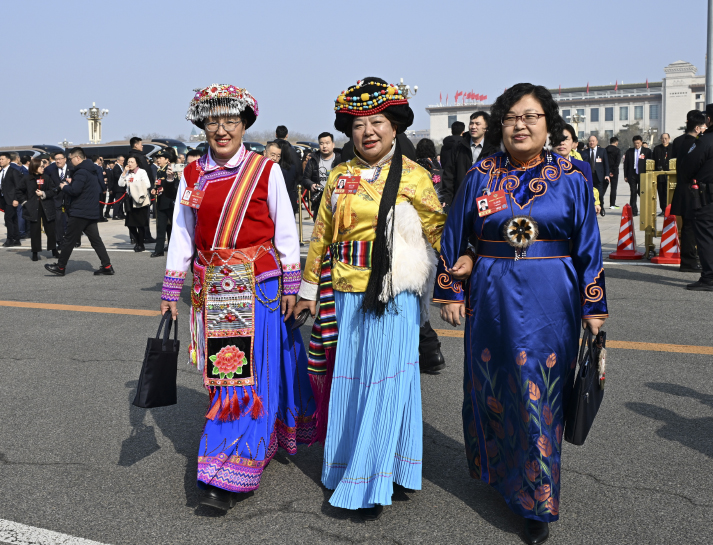 National political advisors attend the third plenary meeting of the Fourth Session of the 14th Chinese People's Political Consultative Conference National Committee in Beijing on March 8 (XINHUA)
On March 12, national lawmakers attending the Fourth Session of the 14th National People's Congress (NPC) voted to adopt the Ethnic Unity and Progress Promotion Law, a legislation dedicated to enhancing the legal foundation for advancing common prosperity and development among all 56 ethnic groups in China.
The draft law was submitted to the NPC session for a third reading on March 5, the opening day of the annual gathering of China's top legislature, following the first and second readings by the NPC Standing Committee in September and December of 2025, respectively. It had also been made available online to solicit public feedback and provided to all NPC deputies to collect their opinions. In China, laws are often adopted after three readings. Enacting the Ethnic Unity and Progress Promotion Law is essential to fostering a strong sense of community for the Chinese nation, Lou Qinjian, spokesperson for the Fourth session of the 14th NPC, said at a press conference in Beijing on March 4. "It will also ensure that ethnic regions are supported in integrating with the country's overall development at a faster pace, and that ethnic unity as well as the lawful rights and interests of people from all ethnic groups are better safeguarded," Lou added. 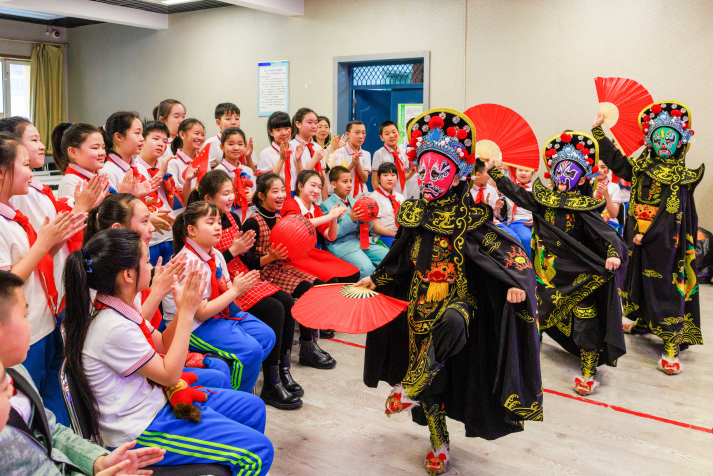 Students of a primary school in Xinjiang watch a Sichuan Opera face-changing performance on March 1 (CNSPHOTO)
Legislative foundation Formulation of the law, which began in 2023, has followed the principle of promoting common ground while respecting and accommodating differences, Li Hongzhong, Vice Chairman of the 14th NPC Standing Committee, said in his explanatory remarks on the draft on March 5. China's economic and social landscape has seen great changes over recent years, including through the progress of urbanization and improved population mobility. Exchanges and integration among all ethnic groups continue to deepen like never before, Zhang Shaochun, a researcher at the Institute of Ethnology and Anthropology of the Chinese Academy of Social Sciences, said in an interview with news portal Chinanews.com.cn. Formulating the Ethnic Unity and Progress Promotion Law is essential to advancing the governance of ethnic affairs within the framework of the rule of law, Zhang said. Lawmakers expect the law to inject fresh momentum into ethnic minority regions by offering legal guarantees for ethnic unity and progress. "For China, a unified multiethnic country, ethnic unity is the lifeblood for all ethnicities and the foundation of national development. Only ethnic unity can pave the way for collective efforts toward national development," Omarjan Kurban, a senior management professional at the Energy Research Institute of Xinjiang Energy Group, told Xinjiang Today. The law lays out measures to encourage interaction, exchange and integration among different ethnic groups. To advance shared prosperity and development, it emphasizes strengthening infrastructure, industries and public services, while conserving natural resources and protecting the environment. Specifically, it stipulates that schools and other educational institutions should use standard Chinese as the basic medium of instruction, as the promotion of standard Chinese is mandated by the Constitution and is also an important measure to foster a strong sense of community for the Chinese nation. Yu Feixia is an NPC deputy from Yunnan Province. In her hometown, more than 10 ethnic groups live in a deeply integrated fashion. In one village, local customs blend Tibetan, Lisu and Naxi ethnic traditions. "Their unique local language blends elements of all three, but alone, none of them would be comprehensible," she told Xinjiang Today. Jin Ruirui, another Yunnan deputy and general manager of a cultural company, is dedicated to preserving traditional embroidery skills of the Yi ethnic group. She has incorporated elements from other ethnic groups when creating Yi-style clothing. "Fusing multiethnic culture better showcases the richness of Chinese culture," Jin said. She also credited standard Chinese with creating opportunities. "My mother, a Yi embroiderer, received training and workshop support from the local government thanks to her ability to communicate in standard Chinese," she said. As the first college graduate in her village, Jin added, "Education in standard Chinese enabled me to take Yi embroidery to more advanced stages," she said. "My work has focused on using music to tell stories and build shared identity among ethnic groups. This law is a milestone—it strengthens the preservation of ethnic minority cultures and empowers us by directing us toward bringing people together through art," He Mailasu, an NPC deputy from Inner Mongolia Autonomous Region, told Xinjiang Today. 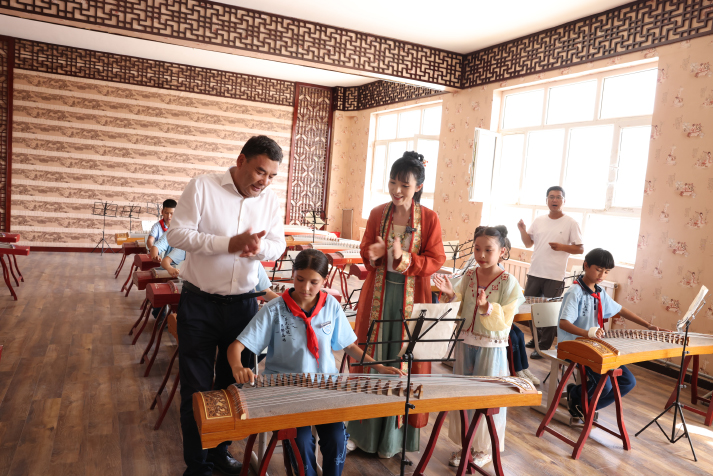 Kurban Niyaz and teachers watch students playing the guzheng during a music class at the Standard Spoken and Written Chinese Language Primary School in Yimamu Township, Wushi County, Aksu Prefecture, on August 28, 2025 (COURTESY PHOTO)
Bridging ethnicities According to deputies from Xinjiang Uygur Autonomous Region to the 14th NPC during an open-day event on March 6, ethnic unity across Xinjiang continues to strengthen, and the cultural bonds among its ethnic groups are growing deeper, fostering a stronger sense of shared identity. "The introduction of the law provides legal foundation for fostering a strong sense of community for the Chinese nation, which will promote exchange and integration among all ethnic groups," Min Xiaoqing, principal of the No.6 Middle School in Tacheng City, told Xinjiang Today, noting that leveraging laws and regulations to popularize education delivered in standard Chinese is crucial. Min herself is a member of the Russian ethnic group, one of the country's smallest ethnicities. According to her, the law offers a legal guarantee for the promotion of the teaching of both standard Chinese and ethnic minority languages. At the school where she works, activities are organized to bring together students of different ethnic groups for lively interaction. Kurban Niyaz shares similar views. In 2003, he founded a primary school in Wushi County, Aksu Prefecture, the first private school in the region dedicated to intensive instruction in standard Chinese. At this year's NPC session, he proposed building digital platforms to foster interethnic exchange and training night school teachers to teach standard Chinese and traditional culture. "Learning standard Chinese allows students from ethnic minority groups to pursue personal growth through study, broaden their horizons and improve their lives. Language is a key to a better future for them," Kurban told Xinjiang Today. He added that his school also provides education in minority languages. Three years ago, Niyaz participated in a project led by Xinjiang University to develop an online learning and testing system for standard Chinese, which allows immersive study. "We have filled a void by developing the intelligent language learning system, which now has more and more users," Kurban said. "We will continue to promote the learning of standard Chinese to foster interaction and integration among all ethnic groups. As language connects us, deeper exchanges follow," he said.  Tourists' vehicles in a roadside parking area in Zhaosu County on July 4, 2025 (XINHUA)
Conveying opinions and suggestions For the deputies, ethnic unity and progress transcend a mere legislative principle; it is a commitment practiced daily by listening to people's concerns, ideas and suggestions and promoting shared prosperity and development. Gulimila Dawulieti, Secretary of the Communist Party of China Branch of Xiaerhete Village in Jimunai (Jeminay) County in Altay Prefecture, has been fostering joint prosperity among villagers of diverse ethnic backgrounds through her day-to-day work. "The significance of grassroots work lies in the details. Whether helping villagers apply for subsidies or mediating conflicts over livestock grazing, each task has a direct bearing on their wellbeing," Gulimila told Xinjiang Today. She helped villagers diversify their incomes by industrializing livestock production and opening new markets for local farm goods. As a result, the revenue of the village collective increased from 80,000 yuan ($11,603) in 2019 to over 400,000 yuan ($58,019) in 2024, with per-capita income of villagers reaching 24,000 yuan ($3,481). After consulting local industrial parks and energy companies, Omarjan submitted a suggestion at the 2025 NPC session calling for national support to launch pilot programs for point-to-point green electricity supply in Xinjiang, connecting renewable energy power generation directly with load centers. In May 2025, the National Development and Reform Commission and the National Energy Administration jointly issued a circular on the development of green power direct connection systems. He said Xinjiang is endowed with abundant wind and sunshine, and advancing pilot projects for direct green power connection will transform these resources into economic gains and drive green upgrades across the industrial chain, allowing more local people to share in the benefits. (Zhang Shasha, Li Qing and Wang Jinxu contributed to this story) Comments to lixiaoyang@cicgamericas.com |
|
||||||||||||||||||||||||||||
|