|
| World |
| Forum discusses how to rebuild a new governance paradigm in a world of disorder | |
|
|
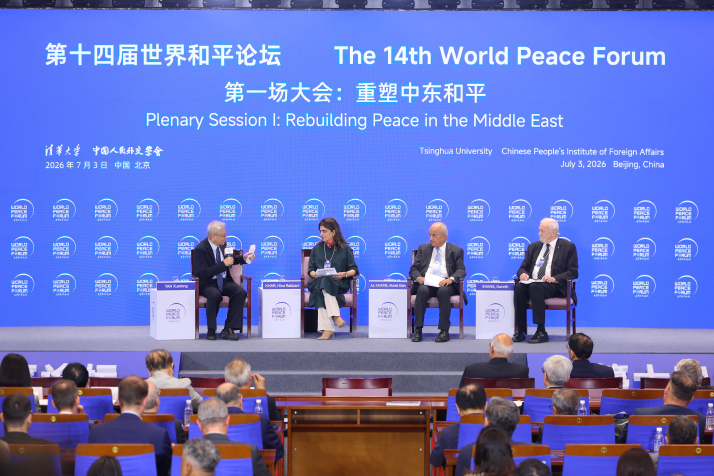 A plenary session of the 14th World Peace Forum in Beijing on July 3 (COURTESY PHOTO)
The 14th World Peace Forum (WPF) concluded in Beijing on July 4, immediately before a moment of breathtaking diplomatic whiplash. Merely four days later, the fragile U.S.-Iran interim agreement, brokered just weeks earlier to halt a devastating war, was declared "over" by U.S. President Donald Trump on the sidelines of the NATO summit in Ankara, Türkiye. The move abruptly ended the 60-day window for negotiating a permanent accord, casting a long shadow over discussions on Middle Eastern security. This sudden turn of events served as a powerful, real-world testament to the forum's central theme: the urgent need for a global governance system rooted in "integrity, innovation and inclusiveness," rather than the whims of a single power. In his opening address, Chinese Vice President Han Zheng called on nations to "safeguard the post-war international order and uphold international fairness and justice," a reaffirmation of China's longstanding commitment to a multilateral system centered on the United Nations. Over three days, the WPF, hosted by Tsinghua University and the Chinese People's Institute of Foreign Affairs, brought together diplomats, scholars and policymakers from across the world. What emerged was a sobering diagnosis of a world adrift, alongside a set of prescriptions for building a new equilibrium, one where the Global South takes center stage, regional solutions gain primacy, and a commitment to shared rules and mutual benefit replaces the politics of division and domination. Hollowing of the 'rules-based order' The forum was marked by a palpable sense that the post-Cold War international architecture is failing. Participants from the Global South, in particular, articulated a sharp critique of the current system, which they argued is characterized by double standards and the selective application of international law. "The so-called 'rules-based international order' is disintegrating," Mushahid Hussain Sayed, former Chairman of the Pakistani Senate's Defense Committee, said during a plenary session. He added that this Western-led framework was neither truly rules-based nor effective in maintaining order, instead being "rife with double standards." According to Sayed, the U.S.-Israeli attacks on Iran showed that "size is not strength, might is not right, and aggression ultimately does not succeed." This sentiment was echoed by former Chinese Special Envoy on the Middle East Issue Wu Sike, who said the conflict "demonstrated a state of international disorder where rules are flouted and some actors attempt to use force to achieve their political goals." Consensus reached at the forum pointed toward a need to move away from a system dominated by a few Western powers to one that is more genuinely multilateral and representative of the world's diverse interests. Russian Ambassador to China Igor Morgulov said the "potential of the Global South is growing" and that these nations "are fully capable of addressing some of the global problems," adding the creation of "new framework mechanisms for political and security cooperation is an urgent task." The challenge, as laid out by Australian former Foreign Minister Gareth Evans, is to move toward a more "civilized and responsible" form of global leadership that prioritizes dialogue and cooperation over confrontation. Vuk Jeremić, former President of the UN General Assembly and Serbian Minister of Foreign Affairs, offered a historical perspective that cut to the heart of the crisis. He recalled the 1999 NATO airstrikes on Serbia, which he described as an "illegal military intervention" that later became a precedent for selective rule application. "This was the precedent that came back to haunt the main champions of the so-called rules-based order. When other actors started behaving in that way, everybody realized that the world is a very unstable place if you apply rules selectively when you see fit." For Jeremić, the lesson is clear: International organizations can no longer be taken for granted. "In a geopolitical recession, there is no trust and no adequate cooperation, particularly not between the main actors," he said, while outlining three paths forward: reforming existing organizations, building new ones or acting unilaterally. He warned that unilateralism rarely goes to plan, as the U.S. in the Gulf has recently discovered. The rise of indigenous security Nowhere was the failure of the old order more evident than in the discussions on the Middle East. The devastating conflict between Iran and the U.S. and Israel that erupted on February 28 has fundamentally altered the strategic calculations of the region, particularly among Gulf states. The war exposed the vulnerability of Gulf states when their security guarantor proved ineffective. Reports of 228 U.S. military facilities in the Gulf being damaged in Iranian retaliatory strikes, including high-value radar and air defense systems, shattered the illusion of infallible American protection. A key takeaway from the WPF was the growing consensus that regional security can no longer be outsourced to extra-regional powers, especially the United States. Alireza Khoda Gholipour, Director General of the Institute for Political and International Studies of Iran, captured this new reality, saying that "establishing a new regional security mechanism is essential" and that the war's destruction has shown that regional countries must cooperate on a localized, inclusive security management model independent of external powers. The pragmatic turn, with nations like the United Arab Emirates pursuing dialogue with Iran, points to the emergence of alternative regional security frameworks. Alongside the necessity of the two-state solution to the Palestinian issue, which envisages independent Israeli and Palestinian states peacefully coexisting, experts called for a regional platform driven by states in the region to explore lasting peace, a model that fundamentally challenges the historical role of the U.S. as the region's sole security architect. Ramazan Erdaş, Chairman of the Center for Strategic Research at the Turkish Ministry of Foreign Affairs, introduced a concrete—yet to be formalized—initiative aligned with this trend. It is a new quadrilateral partnership between Egypt, Pakistan, Saudi Arabia and Türkiye, formed earlier this year. "Our main priority is to foster regional ownership of regional problems, seek solutions through regional initiatives, and mobilize international efforts toward resolving them," he explained. "It is not possible for any arrangement where countries in the region are not the main actors in meeting our regional needs. This initiative is inclusive, able to involve all regional actors in the new architecture." Three pillars The broader discussions at the WPF coalesced around the three pillars of its theme. The principle of "integrity," which underscores the need to uphold the UN Charter and international law as the cornerstone of global governance, was echoed across multiple sessions, with speakers from diverse regions calling for a return to the foundational norms of sovereignty, territorial integrity and non-interference in internal affairs. Participants considered "innovation" in governance structures a priority, particularly the creation of new institutions and mechanisms that reflect contemporary realities. Kim Sung-hwan, former Foreign Minister of the Republic of Korea, called for a broader understanding of security that goes beyond conventional military threats, citing AI as a compelling example. "AI possesses enormous potential to advance human wellbeing and economic growth," he said. "But at the same time, it introduces new risks related to autonomous weapons systems, cyber operations, disinformation and strategic instability. The international community has yet to establish comprehensive norms and governance mechanisms capable of addressing these challenges effectively." In his opening address, Han also underscored this dimension, noting that AI governance is a shared challenge that requires collective international action, a point that resonated with participants who see technology as both a driver of growth and a source of new vulnerabilities. Finally, "inclusiveness" was emphasized as a key to resolving global challenges. The forum highlighted that shared global goods, such as energy security and stable financial systems, require collaboration that transcends narrow geopolitical competition. (Print Edition Title: In Search of a New Equilibrium) Copyedited by G.P. Wilson Comments to mamm@cicgamericas.com |
|
||||||||||||||||||||||||||||
|