|
| China |
| Jiajin Mountain: Where the Long March spirit lives on | |
|
|
|
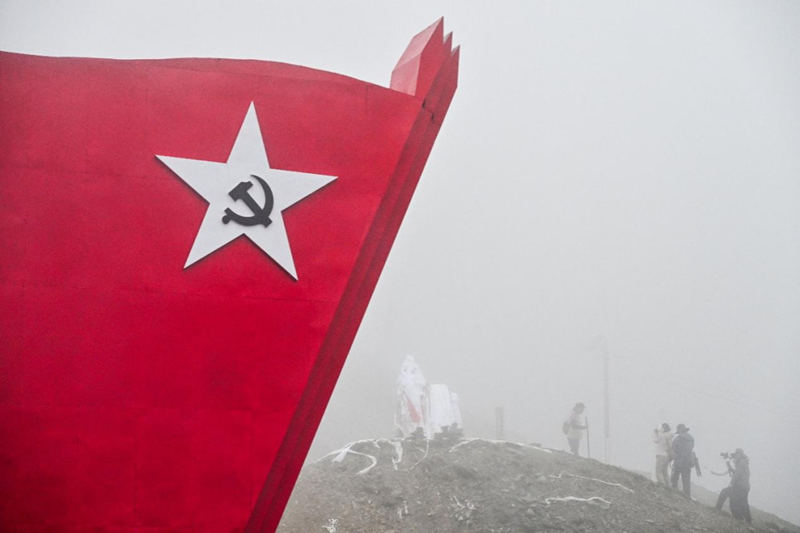
The Jiajin Mountain Pass on July 6 (WEI YAO) Jiajin Mountain, Jiajin Mountain. Birds cannot fly over it, Humans cannot climb it. If you wish to cross Jiajin Mountain, You must be god living among the people. “Jiajin” means “very high and very steep” in Tibetan and this local folk song describes the mountain’s formidable height. The weather on the mountain is extremely complex and unpredictable. On July 6, a group of journalists from the China International Communications Group (CICG)’s Together on the Long March project crossed the Jiajin Mountain Pass while travelling along the route taken by the Central Red Army during the Long March. The pass is located at an elevation of 4,114 meters sits the border between Baoxing County in Ya’an City and Xiaojin County in the Aba Tibetan and Qiang Autonomous Prefecture in Sichuan Province. Together on the Long March is a media initiative launched to commemorate the 90th anniversary of the completion of the Long March, a series of strategic relocations undertaken by the Red Army under the leadership of the Communist Party of China in order to break through the encirclement by the Kuomintang party’s repressive regime. Jiajin Mountain was also the first major snow-covered mountain that the Central Red Army crossed on foot during the Long March. Shalan, a Tibetan herder told Beijing Review that until a little more than a decade ago, the summit of Jiajin Mountain remained covered in snow throughout the year.
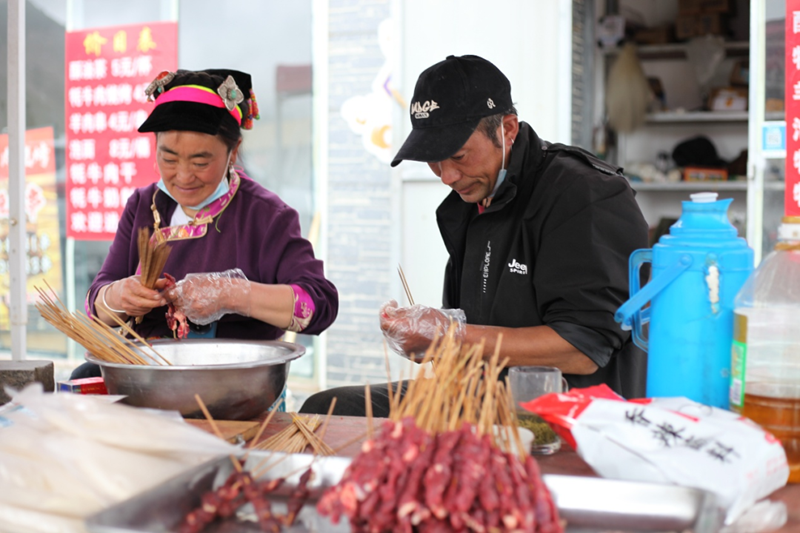
Shalan and her husband sell yak meat skewers at the Jiajin Mountain Pass on July 6 (LIANG XIAO) An immortal epic The Fourth Regiment of the Second Division of the First Army Corps, who were the advance troops of the Central Red Army, arrived at the foot of Jiajin Mountain on June 11, 1935. The unit had just completed a 120-kilometer forced march along the Dadu River in 24 hours and captured Luding Bridge, a strategic turning point in the journey, in a daring operation. Beginning at dawn the following day, they spent the entire day crossing the snow-covered Jiajin Mountain. Later, the Central Column, which included Mao Zedong and other Red Army leaders, also crossed mountain along the same route. Liu Linfeng, a senior lecturer at the Party School of the Xiaojin County Committee of the Communist Party of China, who has long studied the history of the Red Army’s Long March, told Beijing Review that this was also one of the sections of the Long March in which the Red Army suffered the most severe non-combat losses. Even fifty years later in the 1980s, when construction teams were building roads on Jiajin Mountain, they uncovered the remains of Red Army soldiers who had died there. More than 90 years ago, these young soldiers, dressed in inadequate clothing, conquered the snow mountain with faith and determination. Along the way, they forged the “Jiajin Mountain Spirit,” the spirit of firm conviction, unity and friendship, challenging the limits, and refusing to stop until victory. Today, a commemorative landscape has been built at the Jiajin Mountain Pass, attracting visitors from around the world. “Alongside Chinese visitors, many foreigners come here every year,” Shalan said. Shalan and her husband are native residents of the area. Their pasture is located near the Jiajin Mountain Pass, where they jointly graze more than 200 yaks with another local herding family. Ten years ago, the couple noticed that many tourists were coming specifically to visit the Red Army heritage sites in the area. They began generating good income from grilling fresh yak meat on skewers and selling dried yak meat, mushrooms, and other local specialties. Before the Jiajin Mountain Tunnel opened in October last year, Shalan had worried traffic between Baoxing County and Xiaojin County would no longer need to travel along the mountain road and her business would suffer. However, this year there have actually been even more visitors. “A few days ago, while chatting with tourists, they mentioned that this year is the 90th anniversary of the Red Army’s victory in the Long March. That was when I realized that this road is now attracting more and more people to revisit that history,” she said.
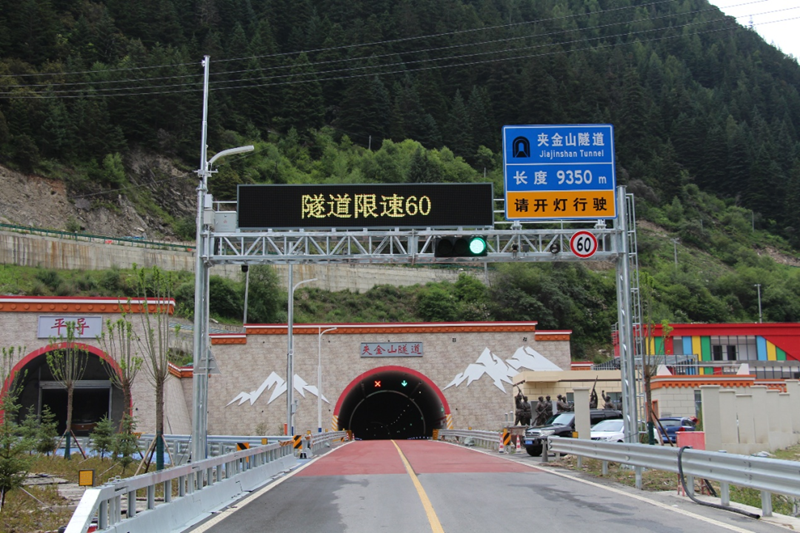
The entrance of the Jiajin Mountain Tunnel on July 6 (LIANG XIAO) The Jiajin Mountain Tunnel on National Highway 351, which began trial operation on October 1, 2025, is a key project under China’s 14th Five-Year Plan (2021-25). The toll-free tunnel, with a total length of 10.07 kilometers, has reduced the travel time needed to cross Jiajin Mountain from one hour to just ten minutes and has completely resolved the problem of winter road closures caused by snow and ice. Liu Shangping, Deputy Director of the Xiaojin county-level transportation bureau, said that Jiajin Mountain is covered with snow for much of the year and the mountain road used to be closed every winter. In some years, the closure could last as long as five months. Since the tunnel opened, it has largely solved the transportation difficulties for the 110,000 residents of Baoxing and Xiaojin counties. “The tunnel will help promote local red tourism and ecological tourism, while increasing local residents’ income,” he said. (Reporting from Sichuan Province) |
|
||||||||||||||||||||||||||||
|