
|
| Xinjiang Today |
| From archery to agriculture | |
|
|
 The Xibe Ancient City, a scenic area in Chabuchaer (Qapqal) Xibe Autonomous County (COURTESY PHOTO)
Chabuchaer (Qapqal), the only autonomous county of the Xibe ethnic minority in China, lies on the southern bank of the Yili (Ili) River in Yili Kazak Autonomous Prefecture in north Xinjiang. The Xibe, descendants of a nomadic tribe, migrated from northeast China more than 200 years ago, carrying with them their cultural roots and planting them deep in China's western frontier. Over the centuries, they absorbed the region's diverse local cultures and as history unfolded, nurtured a Chabuchaer Xibe culture that is classical, vibrant and resilient.  A performer in Xibe ethnic costume at the opening ceremony of the 31st summer edition of the FISU World University Games in Chengdu, Sichuan Province, on July 28, 2023 (COURTESY PHOTO)
Guarding the frontier In the mid-18th century, after the Qing Dynasty (1644-1911) quelled a rebellion launched by the Junggar separatist regime and restored control of the Yili River basin, the region remained sparsely populated and weakly defended. To consolidate the northwestern frontier and establish permanent garrisons, Emperor Qianlong, who reigned from 1735 to 1796, ordered the transfer of elite Xibe troops from Mukden (today's Shenyang in Liaoning Province in the northeast) and surrounding areas to the northwest. In 1764, a little over 1,000 Xibe officers and soldiers, accompanied by their families—more than 4,000 people in total—set out on a westward journey. Braving bitter cold, hunger and disease, they traveled over 5,000 km during a trek that lasted one year and three months, finally reaching the southern bank of the Yili River. A desolate landscape awaited them there. However, they dug canals, diverted water, reclaimed wasteland and turned arid sand into fertile farmland. After six years, they completed a waterway stretching more than 50 km, later known as the Chabuchaer Canal, from which the county takes its name. Chabuchaer means "granary" in the Xibe language. These harsh years forged a frontier spirit marked by patriotism, steadfastness and unity. This ethos has become deeply embedded in the collective identity of the Xibe residents in Chabuchaer and has been passed down from generation to generation. Each year, on the 18th day of the fourth lunar month, the local Xibe community holds commemorative events to honor their ancestors' achievements. The day is known as the Xiqian (Westward Migration) Festival. Today, the Xibe people in Chabuchaer live in harmony with the Han, Uygur, Kazak, Hui and other ethnic groups. With waves of modernization and urbanization reshaping local ways of life, increasing numbers of young Xibe adults are heading to big cities such as regional capital Urumqi to study and work, broadening their horizons. 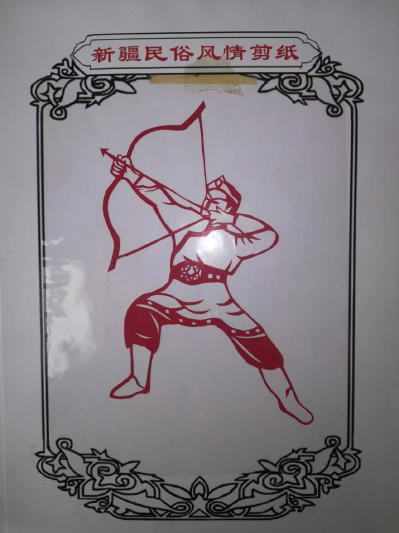 A paper-cut artwork depicts a Xibe man practicing archery (COURTESY PHOTO)
A 'living fossil' After their westward migration, the Xibe settled in Xinjiang's multilingual environment, where their language was preserved in a relatively complete form. In 1947, drawing on Qing Dynasty Manchu script and incorporating spoken usage, the Xibe script was reformed and standardized. Further state-led standardization in 1955 laid the foundation for modern written Xibe. Founded in 1946, the Chabuchaer News is the only newspaper in the country published entirely in the Xibe script. Documenting social transformation over decades, it has served as a living platform for Xibe-language writing, research and application. Following the fall of the Manchu-ruled Qing Dynasty in 1911, the Manchu language declined rapidly, and today only a handful of people nationwide can read and write it. The Xibe language preserved in Chabuchaer, highly compatible with Manchu, has thus become a "golden key" to decipher the vast archives of Qing Dynasty Manchu documents. Scholars and students from across China pursuing Manchu studies and Qing history travel great distances to Chabuchaer to learn from local Xibe experts, mastering Manchu "in reverse" through Xibe. Chabuchaer has thus earned a reputation as the most important stronghold for the living transmission of Manchu-Tungusic languages. 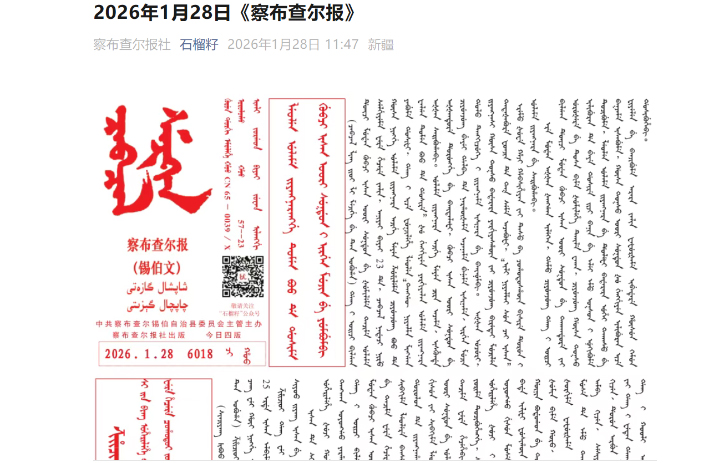 The Chabuchaer News published in Xibe script dated January 28 (COURTESY PHOTO)
The Xibe language also carries the essence of China's outstanding traditional culture. Zhulun is a form of oral literature circulating among the Xibe community, consisting of mainly translated Chinese classical novels. The most widely known are Romance of the Three Kingdoms, Journey to the West, Water Margin and Dream of the Red Chamber, the four great classics of China, as well as historical works. Adapted into colloquial Xibe, these translations are rhythmic and easy to recite, embodying a close fusion of Confucian tradition and Xibe culture. To safeguard this valuable folk heritage, Chabuchaer hosts an annual zhulun recitation competition. On August 26, 2021, a Xibe zhulun recitation group was established to study the art form. This is a grassroots "heritage preservation team"—without public funding or a fixed performance stage, driven solely by a deep love for Xibe culture. The oldest member of the group is 83, while the youngest is just 20, including farmers, retired teachers and former officials. These ordinary Xibe people are doing something extraordinary—guarding the intangible cultural heritage treasures of the Xibe people. They have held more than 20 public welfare performances across communities and villages. Xibe calligraphy, derived from Manchu calligraphy yet infused with distinct Xibe aesthetics, forms another cultural hallmark. Calligraphers pursue not only powerful strokes and rhythmic composition, but also creatively incorporate ethnic motifs such as bows and arrows, butterflies and lotus flowers, producing a style that balances strength and grace, text and image. 'Hometown of archery' The Xibe are renowned for their prowess in archery. Traditionally, archery was not only a means of survival but a core symbol of the Xibe martial spirit and devotion to family and country. Traditional Xibe archery requires a steady footing, an upright posture with the arms held straight and coordinated use of the whole body. For the Xibe, archery also has ethical significance as a means of self-cultivation and willpower training. In Chabuchaer, schools offer archery classes; daily exercise includes archery practice; and archery performances feature in festivals and family celebrations alike. Known nationwide as the "hometown of archery," Chabuchaer has produced numerous elite archers. The Beilun Dance epitomizes Xibe folk dance. Originating from shamanistic rituals and a fishing-hunting life in their northeastern homeland, it later absorbed rhythms and movements from various Xinjiang ethnic dances. Its movements are drawn directly from daily life—imitating horseback riding, hunting and archery, as well as natural imagery such as birds in flight, flowing water and butterflies. Their folk songs are the Xibe's "sonic history books." Passed down through generations, these melodies span themes of labor, love, heroic epics, festivals and customs, and the history of the westward migration. Food and clothing are among the most intimate expressions of culture. On the Xibe table and in their attire, one can clearly trace a journey across geographic and cultural boundaries. Xibe cuisine exemplifies "fusion through innovation." After migrating west, the Xibe's livelihood shifted from fishing and hunting to garrison farming, making wheat-based foods central to their diet. However, they retained their northeastern fondness for fish. Xinjiang's thriving pastoral economy also brought fresh beef and mutton into everyday cooking, resulting in uniquely distinct Xibe-style dishes that showcase their culinary heritage. The author is a retired teacher who has worked in Xinjiang and spent nine years researching Xinjiang-related issues Comments to taoxing@cicgamericas.com |
|
||||||||||||||||||||||||||||
|