
|
| China |
| China's latest animated hit brings ancient gods down from the clouds | |
|
|
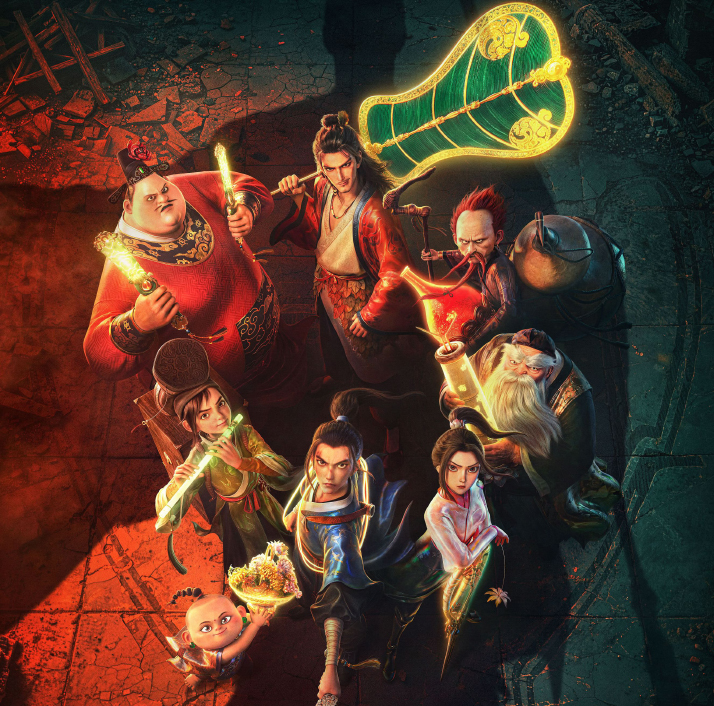 The Eight Immortals in All Wishes Come True (COURTESY PHOTO)
Every Chinese person knows the Eight Immortals—the eight legendary figures in Taoist mythology that represent male and female, old and young, rich and poor, noble and humble—and the fabled tale of how they crossed the East Sea together, each wielding a different divine power. If asked who those eight immortals actually are, however, most people are at a loss. It is in this curious paradox, something at once deeply familiar and strangely elusive, that All Wishes Come True, a new Chinese animated film, finds its creative space. Rather than retell the immortals' famous voyage across the sea, the film imagines how they earn their title as deities in the first place. Here, the Eight Immortals are recast as a motley crew of con artists who pose as deities in hopes of breaking into a celestial treasure vault. But the scam soon spirals into something far larger. The imposters find themselves obliged to do what real gods are supposed to do—answer the wishes of their worshipers, while becoming entangled in a conspiracy that threatens the balance between the mortal and immortal worlds. Released on July 18 into a generally lackluster summer movie season, with several Chinese films announcing their withdrawal from theatrical release, All Wishes Come True has emerged as a breakout hit. According to data from Chinese ticketing platform Maoyan, the film had grossed more than 1.5 billion yuan ($221 million) as of August 13, making it the summer's second-highest-grossing release, second only to Stephen Chow's Kung Fu Soccer, and placing it among the 10 highest-grossing animated films in Chinese box-office history. Much like its motley cast, who eventually rise to claim a place in the Chinese mythological pantheon, the film has pulled off an ascent of its own. The mysterious metropolis Clouds weave between mountains and celestial palaces, doubling as highways for fish-drawn carriages that shuttle across the sky. The immortals clock in at their assigned temples, their performance graded by an Immortals Management Bureau according to a single key performance indicator: how many wishes they fulfill. Towering leaderboards rank the gods by the incense offerings they receive from worshipers. This is Penglai, the fairyland at the center of All Wishes Come True. For centuries, it has occupied the Chinese imagination as a remote celestial paradise, a mythical island inhabited by immortals. The film turns it instead into a bustling modern metropolis, where gods and humans live peacefully side by side. "The world was designed in such a way that, at first glance, audiences feel they've stepped into a traditional Chinese fairyland. But once inside, it becomes much more like a giant amusement park," Mu Zhengyang, the film's director, said. In its imaginative scale, with playful exuberance and vision of different communities coexisting, Penglai may bring to mind the sprawling metropolis of Zootopia or Pandora in Avatar. But its building blocks are distinctly Chinese, pieced together from a vast trove of folklore and mythology. As producer Cao Linlin has shared in multiple interviews, the creative team went searching through ancient texts and arts for ways to give physical form to a place that has long existed largely in the realm of imagination. 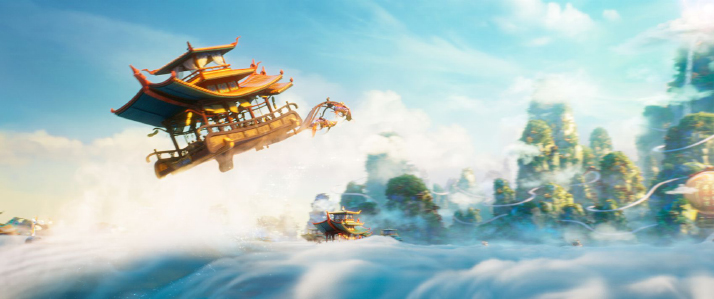 A scene from All Wishes Come True in which a fish-drawn carriage enters Penglai (COURTESY PHOTO)
Penglai itself is portrayed as a floating island carried on the backs of four giant mythical turtles, a conceit drawn from Xuanzhongji, a collection of strange tales compiled during the Jin Dynasty (265-420). Its elusive nature—a realm with no fixed location, accessible only to the fortunate few—takes its cue from Taiping Guangji, a Song-Dynasty (960-1279) anthology of supernatural events. The fish-drawn carriages, meanwhile, were inspired by motifs found in the Han Dynasty (206 B.C.-A.D. 220) murals. Even the cute, fluffy attendants at the celestial spa centers were inspired by Dijiang, a formidable mountain deity described in The Classic of Mountains and Seas, an ancient compilation of mythic geography and beasts. Taken together, these pieces create what American media scholar Henry Jenkins calls an "encyclopedic impulse": The sense that a fictional world extends far beyond the story at hand, inviting audiences to dig deeper into its histories and myths. The film has sparked an Easter-egg hunt across Chinese social media, with viewers enthusiastically scouring scenes for hidden details and tracing the film's cultural references back to their classical sources. "What makes Penglai so compelling is that it feels like an open map—one you are free to explore and, in doing so, you will only find yourself drawn ever deeper into the richness of Chinese mythology," wrote one reviewer on Zhihu, the Chinese equivalent of Quora. "Chinese culture is so vast and profound," Mu said in an interview with a film influencer on Chinese video-sharing platform Bilibili. "Everything you could want is already there, quietly waiting to be uncovered and woven into a world of your own." Between fidelity and freedom A new spin on an old myth can be an invitation to wonder—or to criticism. The breakout success of All Wishes Come True has reopened an age-old debate: Where does creative adaptation end, and betrayal of the original begin? Chinese gods, at least in the Taoist imagination, are serene, cloud-borne figures, far removed from the appetites and struggles of human society. The very idea of the xian—the class of immortals to which the Eight Immortals belong—suggests transcendence: beings who have risen above the dust and clamor of the mortal world. The characters in All Wishes Come True could hardly be further from that ideal. In this new Penglai, gods are less aloof celestial beings than divine civil servants, answering petitions and tending to their earthly followers. The Eight Immortals, meanwhile, start off not merely as mortals, but as people on the margins of society, brought low by a mixture of their own failings and forces beyond their control. Zhong Liquan and Lu Dongbin, the two leaders of the group, are men thwarted by fate. Cursed by their master and expelled from the school where they have been training to become immortals, they turn to theft after every conventional means of survival has failed them; Han Xiangzi is a teenager who dreams of becoming a thief himself; He Xiangu, the only woman in the group, is one already; Zhang Guolao, an elderly hustler; Lan Caihe, an abandoned baby; and Cao Guojiu, an aristocratic idler. While some have embraced the film's wild imagination, others have dismissed it as a travesty, arguing that it distorts the identities of the traditional figures beyond recognition. "The film merely wears the trappings of the Eight Immortals while remaining, at its core, a commercial heist movie," one viewer wrote on Chinese lifestyle app Xiaohongshu (RedNote). Mu, however, noted that the legend of the Eight Immortals has always been fluid—and that it was precisely this openness to reinvention that drew him to the story in the first place. Several of the figures now counted among the Eight Immortals were already circulating independently in historical records and popular lore during the Tang Dynasty (618-907), with little to connect them to one another. It was only in the Yuan Dynasty (1271-1368), as zaju, a popular form of Chinese opera at the time, brought the immortals together onstage, that the familiar ensemble began to take shape—though the lineup still varied widely from one play to the next. The cast did not largely settle into its present form until the Ming Dynasty (1368-1644), with the publication of writer Wu Yuantai's The Journey to the East, whose version of the Eight Immortals became the one that endured. "There was something remarkably avant-garde about the group in the way it came to encompass people from across the social spectrum," Mu told Shanghai-based news portal ThePaper.cn. "Each new addition or change to the story reflected what ordinary people of that era most yearned for." And it is ordinary people that the film ultimately brings into focus. Giving immortals recognizably human identities—and the flaws that come with them—has become increasingly common in recent Chinese animation. Monkey King: Hero Is Back (2015) reimagines the Monkey King as a washed-up hero, stripped of his powers and hobbled by self-doubt; the Ne Zha franchise turns the famous child god into a bratty preteen demon struggling to control his own powers. Yet those characters were still gods from the outset. What All Wishes Come True did differently is to reverse the question: not how gods can be made human, but how humans might become gods. "The film was an attempt at redefining divinity," one comment on Zhihu read. "Here, divinity is no longer an abstract state attained through centuries of Taoist practice, but a code of conduct—a moral choice that anyone can make in the here and now." That shift speaks to a broader change in how Chinese audiences approach mythology, according to Zhu Jingwen, a professor at Chengdu University's School of Film, Television and Animation. "Today's audiences are no longer content simply to look up to mythological figures; they want stories in which they can see their own struggles and growth," she wrote in Wenhui Daily, a Shanghai-based newspaper. That, perhaps, is how myths endure. Each generation leaves something of itself in the stories it inherits—its aspirations, its values, its idea of what a god, or a hero, should be. The versions that resonate become part of the tradition in turn. Seen that way, an animated film about eight misfits stumbling their way toward immortality may seem like a radical departure from the ancient texts. But it is also part of the way myths have always survived: by taking an old tale and making it speak to the present. (Print edition title: A Myth in the Making) Copyedited by Elsbeth van Paridon Comments to pengjiawei@cicgamericas.com |
|
||||||||||||||||||||||||||||||
|