
|
| China |
| Chinese cinema as a witness to the war of resistance against Japanese aggression | |
|
|
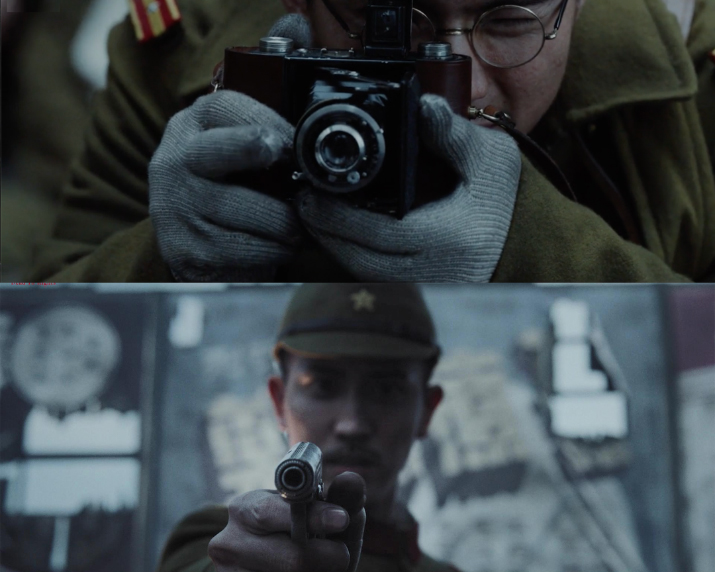 A scene in Dead to Rights showing a Japanese photographer taking pictures (COURTESY PHOTO)
'The verb 'shoot' can mean two very different things—the firing of weapons in war and the capturing of that violence on film," Shen Ao, director of Dead to Rights, said. If cinema has turned World War II (WWII) into a standalone genre, it is one largely defined through Western lenses. While Charlie Chaplin's The Great Dictator, Steven Spielberg's Schindler's List and Christopher Nolan's Dunkirk are featured in every WWII film list, the Chinese front, where the prolonged struggle against Japanese aggression continued for 14 years, from 1931 to 1945, is often missing from the roll call. A closer look at China's post-1949 film industry reveals that the war has been a theme woven throughout its history. From the peasant heroes in Tunnel Warfare (1966) to the corpse-strewn city wall in The Bloody Battle of Taierzhuang (1986), and from the sweeping epic City of Life and Death (2009) to the intimate portrayal of a small photo studio in Dead to Rights (2025), Chinese filmmakers have continued to build their own WWII canon—one that chronicles not only the growth of a young industry but also the broader shifts in aesthetics and how the country confronts its past. Screens of solidarity After the founding of the People's Republic of China in 1949, the domestic film industry found itself tasked with the mission of conveying a new national identity born out of the tumult of wars and revolutions. And the Chinese People's War of Resistance Against Japanese Aggression (1931-45) became the genre that most powerfully captured this narrative of national struggle. A prominent subgenre within this category focused on guerrilla warfare, a tactic of hit-and-run attacks, sabotage and ambushes that was extensively used in north China during the war. These films often feature a morally unwavering and larger-than-life protagonist. Yet, unlike their Western counterparts, they emphasize collective participation over individual heroism, underscoring the idea that the strength of the nation lay in its people and that victory comes not from lone heroes but from the solidarity of the many. 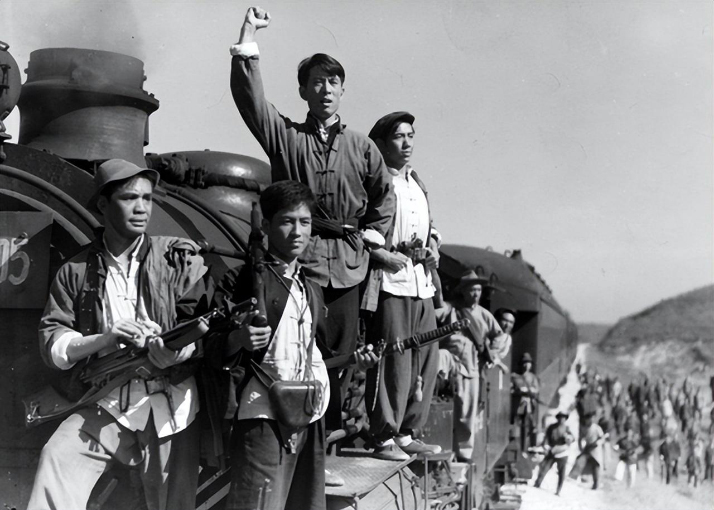 The guerrilla fighters in Railway Guerrilla (1956)
A standout example of this genre is Zhao Ming's Railway Guerrilla (1956), which follows a band of guerrilla fighters living alongside a railway line in Shandong Province. Led by the bold and decisive Liu Hong, the group uses their intimate knowledge of the local terrain to disrupt Japanese supply trains and launch strategic attacks. The film, on the one hand, is about heroes, who were portrayed as ghost-like figures capable of performing extraordinary feats in the face of overwhelming odds. Yet ultimately, it is about the power of the masses, as it creates a space in which local fishermen, railway workers and even children's brigade members all participate in passing on intelligence and sabotaging the enemy's operations. Another film that masterfully captures this ethos of collective strength is Tunnel Warfare, directed by Ren Xudong, which tells the story of how a small village in the heart of the North China Plain, under the leadership of a local militia sergeant, defended itself against Japanese troops by building an extensive network of tunnels. By painstakingly reconstructing the tunnel system on set, the film portrays tunnel warfare as a symbol for collective wisdom by bringing to life a historical period in which by 1944, the flatlands of Hebei Province and neighboring provinces had spawned more than 12,000 km of such tunnels. "The village in the film is not one place, but the distillation of countless villages and countless fighters who, through long years of war, invented and perfected the system," Ren said of the film. When heroes became human With the launch of China's reform and opening-up policy in 1978 came a marked shift in how China's wartime experience was portrayed on the big screen. The heroes were no longer flat embodiments of collective strength but fleshed-out individuals with their own desires, flaws and moral ambiguities. The exultant spirit of the earlier decades gave way to a more sobering portrayal of the cruelty of war and a fuller exploration of its emotional dimensions. Endings often carried a tragic note rather than a triumphant one, recasting the genre as a vehicle for reflection on trauma, memory and human complexity. The Bloody Battle of Taierzhuang, co-directed by Yang Guangyuan and Zhai Junjie, epitomizes this pivot. The film recounts China's first major victory in the war, fought in the spring of 1938 at the strategic town of Taierzhuang in Shandong. Rather than romanticizing the battle as a morale-boosting triumph, the film adopted a near-documentary style to press home the horror of war: charred bodies strewn along the canal banks, shattered bricks mingled with torn flesh, and soldiers using their own mutilated bodies to block the advance of Japanese tanks. The film's most haunting scene is its four-minute closing sequence, where a trembling camera moves through mountains of corpses stacked against a shattered city wall, above which a tattered Chinese flag flutters alone in the wind. "It is impossible for any viewer to feel joy at the final victory when confronted with so many corpses lying across the battlefield," a recent commenter on Chinese review platform Douban wrote. The reopening of the Beijing Film Academy in 1978 also ushered in a new breed of filmmakers—the fifth generation of Chinese directors—who sought to explore the themes of history and national psychology through more subjective, individualistic and visually rich modes of storytelling. For them, the years 1931 to 1945 provided a fertile ground for artistic experimentation. The most renowned example is Red Sorghum (1988), the directorial debut of Zhang Yimou, which put the young director on the map by winning the Golden Bear at the Berlin Film Festival. The film tells the story of a young peasant girl, who was sold into a pre-arranged marriage with a leprous winemaker and, after her husband's death, forced to run the winery while contending with the invading Japanese army. As Zhang stated in an interview, the film was "an attempt to fuse the harsh realities of death with the strength of life." By using the color red in the wine, the sorghum field, the wedding and the spilled blood of war, the film builds up a narrative that is at once about a young woman's rebellion against the old patriarchal order, the tragedies of war and the unbending grit and resolve of a nation. The power of perspective The release of Red Sorghum not only marked the first time a Chinese film won a top prize at an A-list film festival but also changed the life of a young man named Lu Chuan. "When the film ended, I found myself unable to rise, as if a giant hand were holding me down," he later wrote. "At that moment, I was struck by the power of film—a power that I, too, wished to possess." Two decades later, Lu's City of Life and Death landed as both a major box office hit and winner of the top prize at Spain's San Sebastian Film Festival. Shot in black and white, the film recounts the Nanjing Massacre, the mass murder of Chinese people by the Japanese army after its seizure of China's then capital, Nanjing, in the winter of 1937-38. 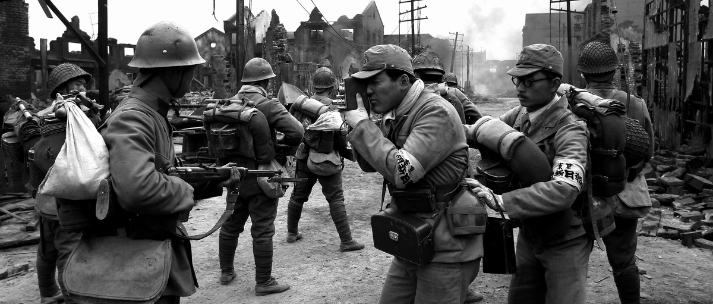 A scene in City of Life and Death shows a Japanese photographer capturing images of Japanese soldiers as they enter Nanjing, then capital of China, in late 1937 (COURTESY PHOTO)
Perhaps the film's most radical departure from earlier traditions is its incorporation of the perspective of a bewildered Japanese soldier, whose eyes constantly take in what his conscience cannot fully process and whose guilt eventually drives him to suicide. This insider's gaze not only exposes the sheer brutality of the Japanese forces but also foregrounds a broader theme: how war dehumanizes those caught within it. The film is part of a wider shift in China's film scene in the 21st century. On the one hand, the rapid modernization of the domestic film industry, together with advances in motion capture, computer animation and other filmmaking techniques, has pushed Chinese WWII films closer to the scale and spectacle of Hollywood blockbusters. On the other hand, as audiences grew increasingly wary of formulaic war narratives, Chinese filmmakers began seeking fresher angles and more diverse perspectives. One way to do that is to move beyond the conventional stories of soldiers to focus on ordinary people—figures usually kept in the margins of traditional war epics. With its unprecedented toll on life, the Nanjing Massacre opened a vast space for cinematic experimentation with this creative shift. 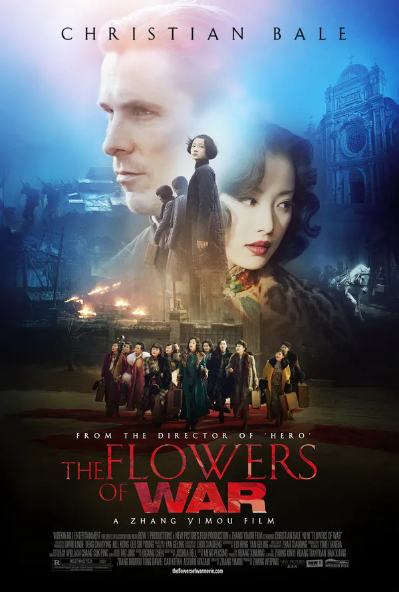 A poster for The Flowers of War (2011)
Two years after the release of City of Life and Death, Zhang Yimou offered his own take on the event with The Flowers of War (2011), which follows an American who seeks refuge in a Nanjing church alongside a group of women as Japanese troops ravage the city. The film has all the elements of a 21st-century commercial blockbuster. With a budget of 600 million yuan (approximately $100 million at the time), it was then the most expensive Chinese movie ever made, starred Christian Bale, one of Hollywood's most sought-after A-listers, and enlisted the special effects team behind American war epics such as Saving Private Ryan (1998) and Band of Brothers (2001). Beyond these trappings, what really sets the film apart from the rest is its perspective. While women's voices have always been present in Chinese war films, the encounter between two very different groups of women confined to the same space gives the film a new dimension, with one group composed of 13 teenage convent students and the other of 13 courtesans. By folding the narrative into a single space, the film traces how these seemingly irreconcilable groups set aside their prejudices to forge a bond, culminating in the courtesans' decision to offer themselves up to the Japanese soldiers to protect the students. If City of Life and Death is about how war can strip away humanity, The Flowers of War, with its focus on the sacred in the ordinary, suggests that humans possess an innate capacity for kindness and empathy. "In all of the movies in the past, everything is so big and massive, with so much violence and destruction," Zhang said in an interview with The New York Times about the film in December 2011. "Yet I love the art of making something small to show something big." A more recent film, which also chooses to distill a nation's trauma into the survival ordeals of a few civilians, is Shen's Dead to Rights, which follows a group of civilians as they seek refuge in a photo studio during the Nanjing Massacre and eventually risk their lives to smuggle photographs out of the city and expose the atrocities committed by the Japanese army. "After studying countless records of the massacre, we discovered many ordinary people who showed extraordinary courage, yet whose names were lost to history," Shen wrote in People's Daily newspaper. "Dead to Rights was made to tell their story." 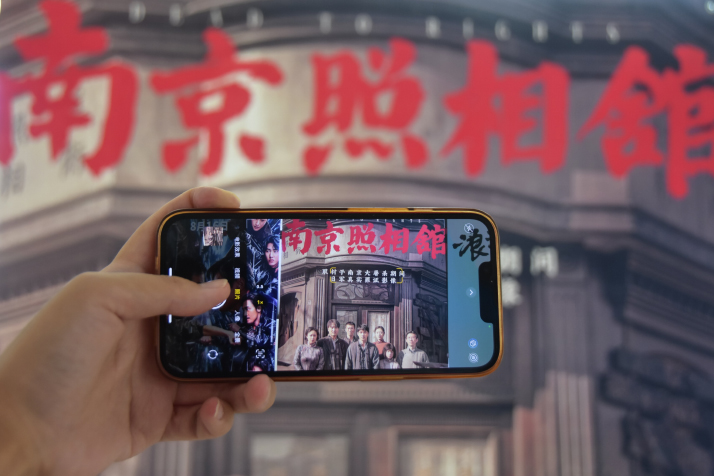 A moviegoer photographs a poster of Dead to Rights at a cinema in Mengzi, Yunnan Province, on August 9 (XINHUA)
Another widely noted aspect of the film is its meditation on the power of the camera. In one scene, the film interweaves portraits of the dead with the moments in which those pictures were captured. By the film's end, the photos documenting Japan's wartime atrocities become an important piece of evidence during the post-war tribunals—suggesting that, despite Japan's attempt to erase its deeds, truth lives on. On the surface, these scenes are about photography; more deeply, they reflect on cinema's own capacity to record and preserve. As Shen puts it, "film is the witness to an era." The "era" here refers not only to the years between 1931 and 1945, but also to the shifting decades in which these films were created. Over the past seven decades, the industry has undergone profound changes—marketization, technological innovation and a deepening humanitarian lens in the portrayal of war. What endures, however, is film's role as a reminder never to forget. (Print edition title: Reels of Remembrance) Copyedited by G.P. Wilson Comments to pengjiawei@cicgamericas.com |
|
||||||||||||||||||||||||||||||
|