

|
| Through Their Eyes |
| How Charlie Chaplin's granddaughter finds her own voice in the film world | |
|
|
|
|
|
For most people, the name Charlie Chaplin conjures an iconic image: a man with a bowler hat, a toothbrush mustache and a cane, stumbling through life with heartbreaking grace. But for British and Irish actress and film director Carmen Chaplin, Charlie Chaplin was first a grandfather, and later, a legacy she has had to learn to stand beside without feeling intimidated. From actress to director Carmen Chaplin has spent more than three decades forging her own path in cinema. Born in 1972, she entered the entertainment industry as an actress in the early 1990s. After performing in a dozen films and television series, she started writing scripts in her 30s and began aspiring to direct as well. "I wasn't very satisfied with my acting career," she told Beijing Review. For years, the weight of her lineage felt less like an inspiration and more like a shadow. "I was very intimidated for a long time to even think of the concept of directing," Carmen Chaplin said. "I thought, 'how can I compare with him?'" But as she grew older, something shifted. Carmen Chaplin said, "You feel like you have less time to waste. What you really want to do, you have to go for it." Also, she has fewer illusions of needing to measure up to her grandfather. "I can be inspired by him and enjoy being his granddaughter," she added. That freedom led her to direct a feature documentary: Charlie Chaplin: Spirit of the Tramp (2024). It was born from a letter—a piece of correspondence that sparked her father Michael Chaplin's research into his own Romani roots. The film traces the reconciliation between her father and his own father, Charlie Chaplin, through their shared love of Romani heritage and music. It's a story about connection found in the margins—between a father and son separated by fame. For her father, growing up as the son of one of the most celebrated filmmakers in the world was anything but easy. "People would always say, 'How lucky you are to have Charlie Chaplin as your father,'" Carmen Chaplin said. "It was very difficult for him as a young man to be an individual, to just be himself, to know what he wanted to do and who he was." "There was a lot of love on both sides, but they never could really connect at the right time. For me, this film was the connection," she added. There have been many documentaries about Charlie Chaplin, so it was important for his granddaughter to make hers distinctive. She and her team decided to show Charlie Chaplin from inside the family circle and allow people who are already familiar with his films to see him in a different light through the prism of his Romani heritage. "This was a deep dive into more of who he was as a man, but through the eyes of my father," Carmen Chaplin said. Editing was a challenge due to the extensive amount of footage. "We had an embarrassment of riches," Carmen Chaplin said. "Charlie Chaplin had such a rich career, and there was so much interesting material. But if it didn't serve the story, it had to go." 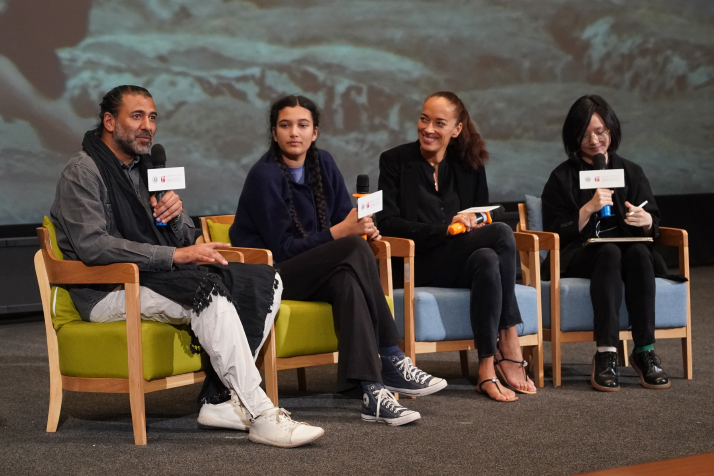 British and Irish actress and film director Carmen Chaplin (second right) at the China premiere of her documentary Charlie Chaplin: Spirit of the Tramp in Beijing on September 24, 2025
A granddaughter's view Carmen Chaplin didn't know Charlie Chaplin very well as he passed away when she was very little. She grew up in an era different from her father's, one in which the Chaplin name appeared mostly at film festivals or in interviews. "In my everyday life, it doesn't come up at all. It's much easier." What she has inherited is not the burden of comparison but a clear-eyed admiration for the craft. When she watches her grandfather's films now, she sees them not as family memorabilia but as works of art. "I see his work and his films and how brilliant they are. They inspire me. I love movies that move you and have humor in them. His are the ultimate in that sense." Her own favorite among his films shifts with time, though City Lights consistently moves her to tears. She also holds a special affection for A King in New York, in which her father appeared as a child actor opposite Charlie Chaplin. "Seeing them both on screen together in a film is quite magical," she said. She pointed to the enduring quality of his physical comedy—at once "very basic but also very elegant." She said she believes the mixture of sadness and laughter in his work is what makes his films timeless. Charlie Chaplin's childhood was one of extreme poverty in London. Yet from that hardship emerged an art form defined not by bitterness but by resilience, humor and an irrepressible celebration of life. "When you watch his films, you can relate to that struggle—whether you're rich or poor, you can relate to that human struggle. Those are human emotions that are essential. They never go out of fashion," she said. Chinese connection Carmen Chaplin's relationship with cinema extends beyond her grandfather's work. Her passion for film reaches across continents, with a particular affection for Chinese cinema. Hong Kong director Wong Kar-wai's In the Mood for Love (2000) is one of her all-time favorite films. She also holds a deep appreciation for Chen Kaige's Farewell My Concubine (1993). Growing up, she and her brothers watched Bruce Lee and Jackie Chan films on repeat. "Jackie Chan is a bit like Charlie—his physicality, his use of his body is like a ballet dancer. He has that added element of humor," she said. "Bruce Lee was so beautiful, an amazing martial artist. You could feel the nobility of his spirit in his films." That admiration has shaped her own ambitions. Her next project, a fiction feature she has written, centers on a woman painter who returns to Paris in her 40s to confront her past as a former supermodel. She has long hoped to collaborate with a young Chinese actress and has reserved a role for one in the film. She has yet to work with colleagues from China's film industry and has reserved a role in the film with the specific aim of doing so. "I hope to cast a young Chinese actress," she said. Perhaps the most moving moment in her recent visit to China was not about film at all, but about history repeating itself in unexpected ways. She learned that her grandfather had met Mei Lanfang, a legendary Peking Opera master, twice in the 1930s. At the 2025 Beijing Culture Forum held last September, Carmen Chaplin met Mei's great-grandson Mei Wei. "They met, and then we got to exchange gifts. It's interesting to think that Charlie was here in China, that he enjoyed the opera, that he was a fan," she said. Each of the two times Carmen Chaplin has come to China, it has been for work, so there has been a bit of frustration at not being able to see as much of the Chinese culture as she would like to. "But my impression is that the culture here is very deep, with so many layers. You would need to stay at least two weeks—minimum—to even get a sense of it," she said. For Carmen Chaplin, cultural shocks are interesting. She said if she was to make a film in China, it would be about a foreigner trying to integrate into the culture because there's always an element of comedy when two cultures meet. "I always find the misunderstandings quite funny. At the root, we are all very similar, but I love the cultural differences," she said. (Print title: Living With A Legendary Name) Copyedited by G.P. Wilson Comments to linan@cicgamericas.com |
|
||||||||||||||||||||||||||||
|