
|
| Business |
| Making openness tangible | |
|
|
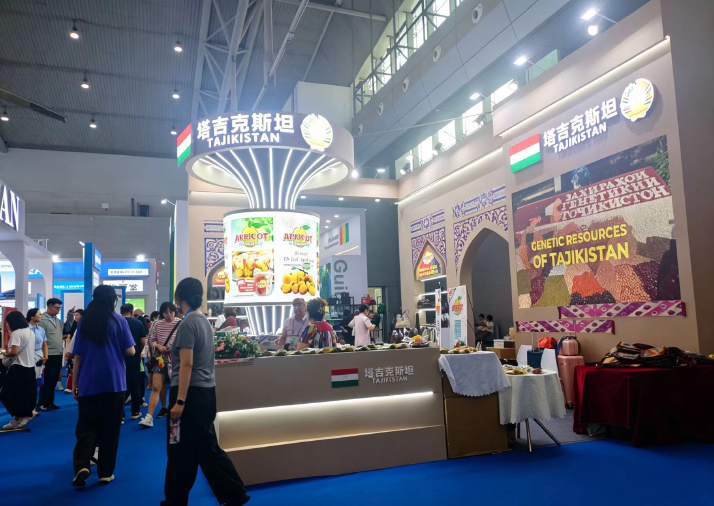 The Tajikistan Pavilion at the Ninth China-Eurasia Expo in Urumqi, Xinjiang Uygur Autonomous Region, on June 29 (XIANG YUTING)
Inside one of the international pavilions at the Ninth China-Eurasia Expo, glass display cases sparkled with jewelry. Green jade bracelets, colorful gemstone necklaces and loose stones for custom-made rings were neatly arranged under the lights. A Chinese customer selected a jade bracelet and paid for it via Alipay, a mobile payment app popular in China.
The expo was held from June 25 to 29 at the Xinjiang International Convention and Exhibition Center in Urumqi, capital of Xinjiang Uygur Autonomous Region. Themed New Opportunities of Silk Road, New Vitality for Eurasia Cooperation, this year's expo featured six major exhibition zones, covering investment cooperation, Silk Road cooperation, new quality productive forces, industries with distinctive strengths, green development and cultural tourism integration. According to Li Hongqi, Deputy Director of the Department of Commerce of Xinjiang Uygur Autonomous Region, both the scale and profile of this year's event reached record highs. Representatives from 49 countries, regions and international organizations participated in the expo, with 27 countries setting up national pavilions. The United Arab Emirates, the Republic of Korea, Russia and Thailand established national pavilions for the first time. More than 3,100 domestic and overseas institutions and enterprises took part, including over 300 central state-owned enterprises, Fortune Global 500 companies and specialized and innovative firms. The expo also attracted 25,700 professional buyers and business representatives from China and abroad. Regional cooperation and connectivity were promoted at the expo. Closer than before Xinjiang borders Central Asia and serves as an important gateway linking China with markets across Eurasia. As China's major opening-up window to the west, the region has long stood at the forefront of economic and trade cooperation between China and Central Asian countries, while increasingly attracting businesses and entrepreneurs from Russia and other Eurasian countries eager to tap into the opportunities of the Chinese market. At this year's expo, an Export to China event dedicated to Kazakhstan drew broad participation from businesses. From food products and consumer goods to specialty items, a growing number of Kazak companies are looking to use the platform to further expand their sales in China. During the expo, Kazakhstan's Deputy Prime Minister and Minister of National Economy Serik Zhumangarin described Xinjiang as "not only a close neighbor and partner, but also a very important gateway to China's vast market." He said Xinjiang has, for many years, been the principal hub for border trade, logistics and industrial cooperation between Kazakhstan and China. As a key logistics corridor connecting the two countries, it also helps facilitate transit transportation between Asia and Europe. "The China-Eurasia Expo provides a unique opportunity to establish new business ties, find reliable partners and launch promising projects," he said. Such connections are increasingly extending beyond official exchanges and taking shape in vivid, practical ways. At a matchmaking event for Chinese companies seeking opportunities in Central Asian markets, some Kazak buyers visited the expo remotely through livestreaming and cloud-based connections. They browsed products online, negotiated with suppliers and conducted business meetings in real time. Digital technologies are steadily breaking down geographical barriers and making trade and commercial exchanges across Eurasia more efficient and convenient. For Van Svetlana, head of the Russian National Pavilion and a first-time participant in the China-Eurasia Expo, the strongest impression came from person-to-person interactions. "The people of Xinjiang are incredibly warm and hospitable, and they have left me with wonderful memories," she said, adding that she hopes to return to Xinjiang every year and establish long-term partnerships here. Walking through the international pavilions, visitors could hardly miss another change taking place. More and more foreign exhibitors have become familiar with the shopping habits of Chinese consumers. Many of the business representatives used Chinese mobile payment systems, livestream promotions and online communication tools with ease. Meanwhile, Chinese consumers are getting to know products, traditions and lifestyles from different countries through every purchase and conversation. Relationships once defined simply by proximity on a map are gradually evolving into market connectivity and growing familiarity between peoples. 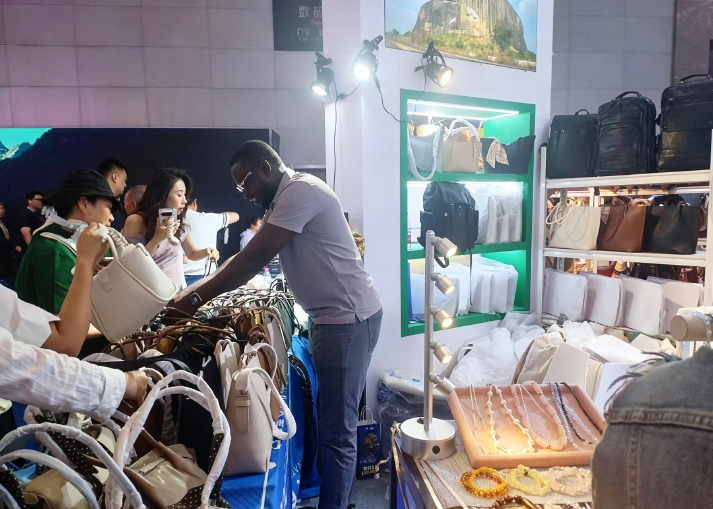 Visitors shop for products at the Nigeria Pavilion during the Ninth China-Eurasia Expo on June 29 (XIANG YUTING)
A glimpse of tomorrow If the international pavilions offered visitors a glimpse of increasingly close ties between China and countries across Eurasia, other sections of the expo presented a different vision—one that looks toward the future. For the first time, this year's China-Eurasia Expo established a dedicated zone for new quality productive forces, focusing on emerging industries such as AI, the digital economy, the low-altitude economy and biomanufacturing. Cutting-edge technologies, including intelligent biomimetic robots, large low-altitude aircraft and integrated computing infrastructure, drew crowds of visitors eager to watch demonstrations and experience new technologies firsthand. Application scenarios ranging from plateau transportation and energy inspection to emergency response, multilingual cross-border interaction and urban governance were recreated inside the exhibition halls. Presented through immersive themes and real-world scenarios, the exhibits illustrated how technological innovation is supporting industrial transformation. More importantly, they demonstrated a shift from displaying futuristic concepts to showcasing technologies already finding practical applications. According to Li, a number of technology enterprises from Jiangsu Province, Zhejiang Province, Shanghai and Guangdong Province made a concentrated appearance at the expo, offering comprehensive displays of achievements in smart manufacturing, smart cities, smart agriculture and smart logistics. Together, they delivered digital solutions powered by AI and demonstrated how AI is being applied across a wide range of industries in Eurasia. Yet the future on display was not only technological. It was also increasingly green and sustainable. The Green Development Zone and Green Services Zone brought together companies specializing in new energy, new materials, green building materials, green mining, green finance and high-efficiency energy-saving equipment manufacturing. Advanced environmental protection equipment, resource recycling technologies and ecological restoration solutions were among the products and technologies on display. Low-carbon development was not confined to exhibition booths. It was embedded in the very organization of the expo itself. The main venue was powered entirely by clean electricity, consuming approximately 1.5 million kilowatt-hours of green power during the event. Organizers promoted modular and recyclable exhibition structures, paperless conference services, waste sorting and recycling, and low-carbon transportation. A Green Booth Award was also introduced to encourage exhibitors to use recyclable and renewable materials. At the expo, innovation and sustainability were not abstract concepts. They became experiences that visitors could see and feel for themselves. Beyond the exhibition halls "We originally came here to attract business partners. We didn't expect our products to sell so well," said Liu Huanzhong. By noon on June 27, Liu, a member of the China Chamber of International Commerce and legal representative of Suifenhe Tianyou Zhonghua Economic and Trade Co. Ltd., had already sold out all the honey, candies, chocolates and biscuits he had brought to the expo and had to urgently contact distributors for additional supplies. For many residents of Urumqi, the China-Eurasia Expo is far from a distant international economic event. Instead, it has become a vibrant consumer festival taking place right on their doorstep. This year's expo featured a Quality Consumption Zone that brought together Xinjiang's specialty products, China's time-honored brands, smart home products and lifestyle goods. A series of citywide activities under the Premium Foreign Trade Products in China (Xinjiang Stop) initiative allowed residents to enjoy a diverse range of high-quality products without leaving the city. Among the most talked-about innovations was the booming "ticket economy." Expo tickets and exhibitor credentials were transformed into vouchers carrying various consumer benefits. Through digital service platforms, visitors could simply tap their mobile phones to receive coupons redeemable at shopping malls, restaurants, hotels and gas stations throughout the city. At the same time, more than 60 local specialty stores launched free giveaways and exclusive discounts, while public summer concerts and cultural performances enlivened the city's nighttime economy and added to the festive atmosphere. From cross-border transactions inside international pavilions to glimpses of future industries in technology exhibition zones, and from bustling consumer experiences in urban shopping districts to citywide cultural events, the China-Eurasia Expo is making openness and cooperation increasingly concrete, something that people can see, experience and actively participate in. (Reporting from Urumqi, Xinjiang Uygur Autonomous Region) Comments to xiangyuting@cicgamericas.com |
|
||||||||||||||||||||||||||||
|