
|
| China |
| Three Chinese cities revolutionize waste management through digital innovation and other circular economy solutions | |
|
|
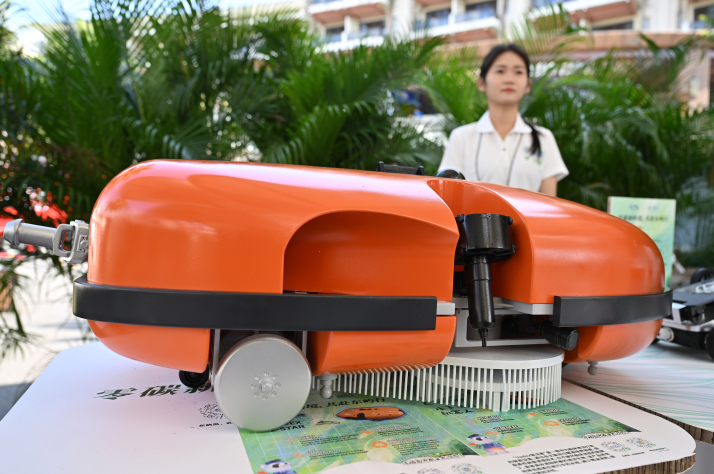 An underwater cleaning robot on display during the Boao Forum for Asia Annual Conference 2026, held from March 24 to 27 in Boao, Hainan Province, on March 25 (XINHUA)
Hangzhou in Zhejiang Province is pioneering a digital and intelligent approach to municipal waste governance, transforming how its residents manage recyclables and setting a global example for a zero-waste future. The term "zero waste" does not mean producing no waste at all, but rather promoting a material flow that is circular, using the same resources repeatedly within a system with the aim of minimizing the use of new resources and the waste of used ones. In the city's Gongshu District, Hu Yueying is taking advantage of this shift. By simply opening a recycling mini-program on super app Weixin (internationally known as WeChat), she can schedule on-demand collection for her accumulated cardboard boxes and plastic bottles. The process is seamless: After weighing and settlement, "environmental credits" are instantly credited to her account. "I used to have to track down waste collectors myself," Hu told People's Daily newspaper, displaying her phone with its substantial credit balance. "Now, it's just one click, and I can exchange these credits for daily necessities in the app's store. It's incredibly convenient." This digital empowerment extends to other communities like Dongxin in Hangzhou's Binjiang District. There, a 67-year-old resident surnamed Wang uses a smart recycling bin, automatically accessed by scanning a QR code with her phone. These smart facilities, coupled with an incentive program, have significantly increased the sorting of waste. Binjiang District has further incentivized waste sorting with a carbon credit system similar to that in Gongshu, awarding credits for redeeming goods or for offsetting community service fees. The recyclables are transported to sorting centers and transformed into valuable resources. At the heart of these everyday smart recycling practices lies Hangzhou's ambitious vision: a city-wide digital and intelligent management platform providing comprehensive, closed-loop supervision from sorting and collection to transportation and final disposal. On March 27, Hangzhou, Sanya in Hainan Province and Suzhou in Jiangsu Province were recognized by a UN advisory board for taking bold and ambitious steps to reduce waste and advance the circular economy. The advisory board selected the three cities, along with 17 others around the world, for the inaugural 20 Cities Toward Zero Waste initiative. The initiative is supported by the United Nations Human Settlements Program (UN-Habitat) and the United Nations Environment Programme (UNEP). The honor was granted ahead of the International Day of Zero Waste on March 30. The initiative, led by the UN Secretary General's Advisory Board on Zero Waste, aims to highlight cities demonstrating innovative approaches to waste reduction, promoting circular economy solutions, and building more sustainable, resilient and inclusive urban systems. The selected cities are actively engaged in areas such as food waste prevention, organic waste management, inclusive recycling models for informal workers and community advocacy to foster behavioral change. According to a statement jointly released by the UNEP and the UN-Habitat on March 30, humanity generates up to 2.3 billion tons of municipal solid waste each year, making cities a vital part of global efforts to tackle the waste crisis and its impacts on climate, biodiversity, public health and livelihoods. In Sanya, innovative solutions are emerging to address municipal solid waste, such as waste-eating robots that clean the beaches of Yalong Bay. As the robots traverse the beaches "eating sand," their rotating, spiral-toothed comb digs deep and plucks out buried debris like discarded bamboo skewers, before a vibrating screen separates the trash from the sand. "The entire process is like scooping cat litter," Zhao Guocheng, an assistant researcher at the Hainan Research Institute of Shanghai Jiao Tong University, told People's Daily. "The robot can clear over 3,000 square meters of beach per hour, working in tandem with sanitation workers to remove the garbage left behind by the tide." 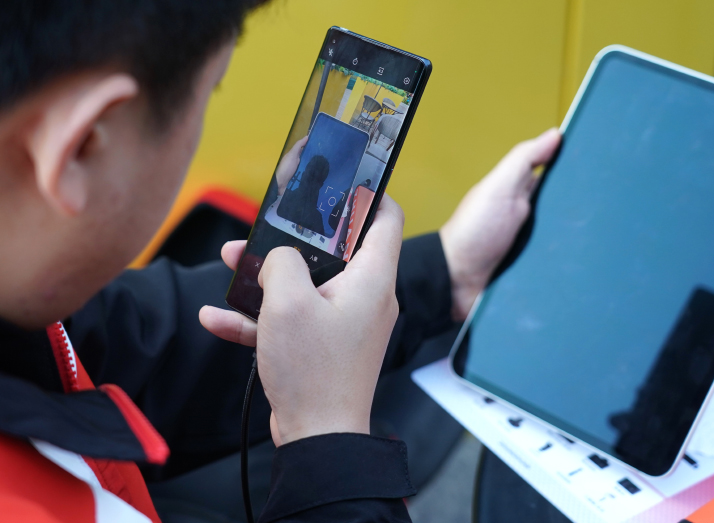 An engineer collecting idle electronic products for a second-hand trading platform takes photos of the electronic products to be sold second-hand on November 4, 2025 (XINHUA)
This robotic assistant is just one facet of Sanya's broader Zero-Waste City initiative. At the Sanya Household Waste Incineration Power Plant, a smart dispatch system monitors the city's waste treatment in real time. By leveraging big data to correlate waste generation with tourist foot traffic and hotel occupancy, the system dynamically optimizes collection routes. During peak tourist seasons, it increases collection frequency and extends processing hours, while shifting to equipment maintenance during quieter periods. The initiative extends to the city's tourist attractions as well. Jiang Xiangyu, manager of the Greening Department at Wuzhizhou Island, told People's Daily that the area implemented a strict plastic ban in 2020, replacing single-use items with biodegradable alternatives. Suzhou, like Sanya, is reducing waste by incorporating smart technologies into urban governance. The city boasts a comprehensive industrial system. Yet, this industrial power brings the immense challenge of managing complex waste streams, necessitating the transformation in its approach to urban governance. At the Suzhou Industrial Park (SIP), activity begins early. Forklifts shuttle between workshops and warehouses, loading barrels of waste emulsion onto trucks. Each barrel is tagged with a QR code and destination label, ensuring full traceability. "These liquids are headed for professional recycling," Guo Jun, a waste transfer operator, told People's Daily. Suzhou has focused on managing waste at the source. "We used to replace our emulsions every six months; now, they last for five years," Xu Qinfei, Director of Administrative Affairs at a local firm, told People's Daily. Through process upgrades, the company has reduced its hazardous emulsion waste by over 800 tons annually. Within the Circular Economy Industrial Park at the SIP, a sprawling network of interconnected pipes links multiple processing units. Here, industrial sludge, food waste and municipal sewage are systematically funneled into specialized treatment centers. In the sludge treatment workshop, pre-treated waste is dried using the heat from steam captured from a nearby thermal power plant. "The dried sludge is then cofired at the plant to generate electricity, which in turn powers the steam production for our system," Wu Jiang, President of the Zhongxin Suzhou Industrial Park Development Group Ltd., told People's Daily. Cofiring is the practice of introducing biomass as a partial substitute for coal in a high-efficiency coal-fired power plant. Nearby, a kitchen waste treatment facility is in operation, where biogas produced through anaerobic fermentation is purified and fed into the city's natural gas network; the remaining material enters the sludge treatment system for further processing; and the treated water flows into a wastewater treatment plant, where it is regenerated into reclaimed water for use in production cooling and flushing. This model turns industrial byproducts into valuable resources, creating a self-sustaining loop that defines Suzhou's circular economy. (Zero-Waste Pioneers) Copyedited by G.P. Wilson Comments to jijing@cicgamericas.com |
|
||||||||||||||||||||||||||||
|