
|
| China |
| How AI is rewriting the future of micro-dramas | |
|
|
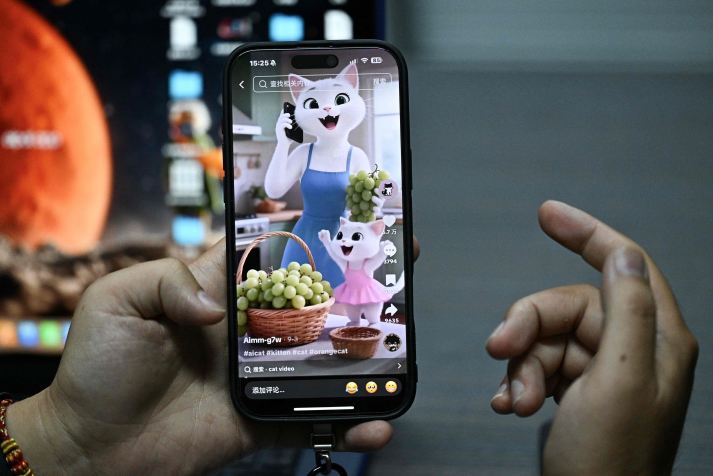 A user shows content generated by an AI video platform on a smartphone in Beijing in October 2025 (VCG)
For Chen Yuxi, a micro-drama actress, the professional landscape shifted overnight this past February. Returning to work after the Chinese New Year holiday, running from February 15 to 23, she found her usual casting group chats eerily silent. Her inquiries to industry peers and assistant directors revealed a chilling reality: Many had either pivoted to AI-generated short dramas or left the industry entirely. She didn't receive a single job offer in the entire month.
That same month, ByteDance, the China-based company that owns TikTok, launched a pre-release version of its next-generation AI video-production model, Seedance 2.0. With a sophisticated four-modality input system capable of processing text, images, video and audio, and handling up to 12 reference files simultaneously, the model is able to generate a multi-shot film sequence with sound in roughly 60 seconds. It is seen by industry insiders as a catalyst for restructuring the production logic of the micro-drama industry by drastically cutting costs. Redefining industry economics The economic allure of AI in short-form content is undeniable. At the 2026 China TV Drama Industry Conference, held on March 13-14 in Shenzhen, Guangdong Province, Gong Yu, founder and CEO of online entertainment platform iQIYI, declared that the film and television sector, historically plagued by exorbitant costs and sluggish production cycles, is finally entering a "springtime" of AI-driven innovation. The commercial viability of this shift was proven by this year's hit Zhanxiantai (Real Person AI Version). The project raked in over 100 million views within six days of its release. Produced by a lean team of 12 with a computing power cost of only 100,000 yuan ($14,480), the series took just one month to complete. Crucially, the audience response marked a turning point: Rather than focusing on "stiff expressions" and "lack of realism," viewers were captivated by the fluid visual spectacle and high-tension narrative pacing. Xiong Binghui, CEO of Kemeng Intelligence (Beijing) Technology Co. Ltd. (the platform behind the project), told news outlet CCTV.com that AI-simulated micro-dramas generally cost only a few thousand yuan (a few hundred U.S. dollars) per episode, constituting a staggering 70 to 80 percent reduction compared to traditional live-action shoots. The primary driver of these savings is the elimination of actor fees. While a lead actor in a successful live-action project might command over 1.5 million yuan ($217,193), AI-generated dramas have effectively reduced actor-related expenses to zero. Beyond costs, AI can dramatically cut production time. A full-length series can now be completed in less than two weeks, compared to the two months typically required for casting, location scouting, shooting and post-production. "It reconstructs the rhythm of content creation," Xiong said. "We can now respond to market trends in real time. If a theme becomes popular, we can launch a production immediately to capture the market window." With shorter production cycles, the core costs of AI-generated short dramas fall into two main categories, according to Xiong. On the technical side, the primary expense is AI computing power; on the production side, it is human labor—specifically creative design, prompt engineering and post-production. Xiong believes that the costs of AI-generated short dramas will continue to drop. "As AI models become more efficient, the computing power required per shot will decrease. Simultaneously, as tools become more intelligent and user-friendly, production teams will be able to handle multiple projects in the time it currently takes to complete one, further reducing human labor costs." The industry, he believes, is entering a long-term trajectory of continuously falling production costs. In addition to the reduced costs and shortened production cycles, Douyin Group, the division of ByteDance that operates the Chinese version of TikTok, in January introduced a guaranteed incentive policy for AI-generated short dramas, offering financial support based on the content's quality rating. Driven by cost-cutting and these new incentive policies, numerous short-drama production companies now focus on AI-generated content. As a result, a flood of low-cost, AI-generated short dramas has inundated the platform. 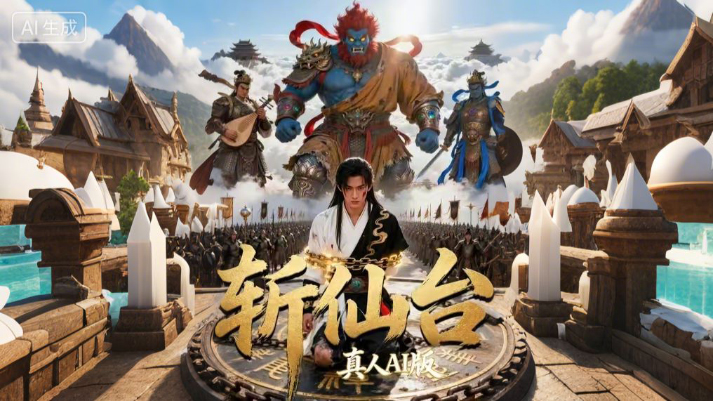 A poster for Zhanxiantai (Real Person AI Version)
The legal gray zone This rapid technological leap has outpaced the regulatory framework. In March, controversy erupted when the AI drama Reborn: I Became My Mother's Guardian was accused of using the likeness of popular Chinese television and film actress Yang Zi. Similar accusations followed for other productions featuring faces that bore striking resemblances to stars like actor Xiao Zhan. On March 18, production company Shanghai Youhug Media Co. Ltd. announced its new AI digital artists, Qin Lingyue and Lin Xiyan. Many netizens noted that the AI figures resembled several real-life actors, leading to the hashtag #NetizensBoycottAIActors trending on Chinese microblogging platform Weibo. Li Dengchuan, Executive Director of Shanghai Xinyi Law Firm, told news portal Chinastarmarket.cn that the core issue is "identifiability." Under China's Civil Code, the key test for whether an AI-generated image infringes portrait rights is whether the image can be recognized as a specific natural person. 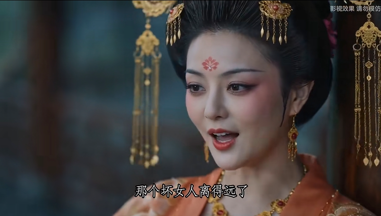 A user shows content generated by an AI video platform on a smartphone in Beijing in October 2025
The human touch dilemma As AI-simulated micro-dramas develop, the debate over whether they possess a "human touch" has also intensified. For actors like Chen, the soul of a drama lies in the spontaneous chemistry of human performance. "In professional projects, the director respects the actor's creative input," she said. "Some of the most impactful lines and expressions are born from the live, improvised sparks between actors on set." Lin Huan, a devoted micro-drama viewer, pointed out the lingering awkwardness in AI-generated dramas in an interview with CCTV.com: "The characters look realistic, but as soon as they move, you notice subtle glitches—unfocused eyes or unnatural expressions. That's where the AI trace reveals itself." There is also a paradox. While AI excels at "industrialized stability," much like pre-made meals that guarantee a consistent flavor, it often lacks the tang of human creativity. Zhao Hui, Director of the Audio-Visual Art Research Center at the Communication University of China, told CCTV.com that many current AI dramas have spectacles but no stories, visuals but no soul. She warns that if the industry solely chases technological efficiency, it risks losing the spiritual nourishment that defines great art. "Only when the dazzle of technology is deeply integrated with the truth of human nature can we create works that truly resonate with the public." Copyedited by Elsbeth van Paridon Comments to jijing@cicgamericas.com |
|
||||||||||||||||||||||||||||
|