|
| China |
| The art of the prompt | |
|
|
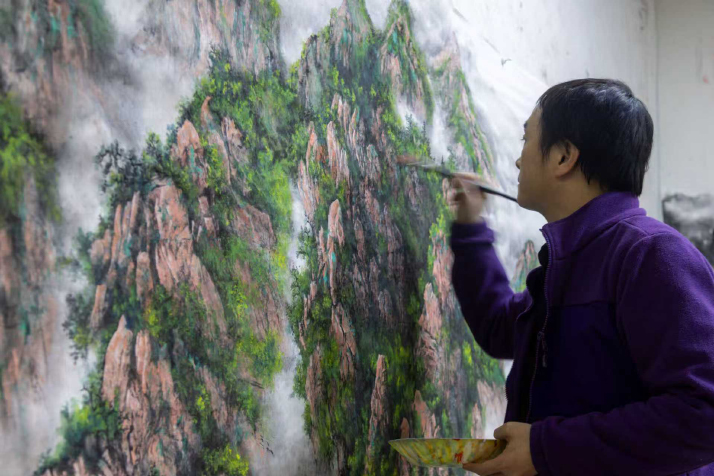 Shu Yong works on a large-scale landscape painting in February 2026 (COURTESY PHOTO)
For more than 1,000 days, Shu Yong, Vice President of the Kaiming Painting Institute in Beijing, has followed a strict routine: generating one image a day with AI. A scroll through the artist's social media feed, where he posts the full archive of these works, opens onto a world of wild invention. There are retro-futuristic cityscapes, where bubble-like tanks and blimps drift through the sky; galloping horses rendered in cubist, porcelain and traditional Chinese mural styles; and colossal creatures clad in mechanical exoskeletons, among other surreal scenes. These works seem a world apart from Shu's earlier works, which are more firmly grounded in social reality and often carry a more straightforward message. The Flowers of Life, a ceramic sculpture created a decade after the 2008 Wenchuan Earthquake that claimed roughly 70,000 lives, pays tribute to those who lost their lives in the disaster. Building Dreams, a large-scale architectural installation, celebrates the indispensable role migrant workers have played in China's urban development. His best-known work, Golden Bridge on Silk Road, is a monumental bridge-like structure inspired by the China-proposed Belt and Road Initiative, which aims to boost connectivity along and beyond the ancient Silk Road routes. For Shu, however, the point of keeping a daily AI workout regimen is not to create good, meaningful art. Rather, the exercise is very much like the fabled journey in the 16th-century Chinese novel Journey to the West—a long and uncertain quest marked by hardships, surprises and constant encounters with the unknown. "In a way, these past 1,000 days are my own digital pilgrimage," he told Beijing Review. "Each day is a new step, taken in an unknown direction, but little by little it brings me closer to a better understanding of the technology." Lost in translation Shu's daily AI practice was not his first foray into technology-driven art. Long before Midjourney, DALL-E, Sora and other generative AI tools turned machine-generated images into a global craze, he was already experimenting with a far cruder form of AI: Google Translate. In 2013, for the China Pavilion at the Venice Biennale, one of the world's most prestigious art events held every two years in Venice, Italy, he created an installation titled Google Bricks: a wall composed of 1,500 translucent bricks. Inside each is a Chinese phrase collected from netizens and carefully chosen to capture the mood of the times—Chinese popular culture, inherited traditions and shifting social currents. The phrases were then translated word by word into English by Google Translate and sealed inside cast-resin bricks modeled on the proportions of those used in the Great Wall of China in the Ming Dynasty (1368-1644). The result was witty yet disorienting, full of the awkwardness, distortion and accidental comedy that machine translation can sometimes produce. For instance, geili, an online slang term meaning "awesome," became "to the force"; beipiaolaoren, which describes the phenomenon of Chinese elderly leaving their hometowns for Beijing to work or help care for grandchildren, turned into "north drift elderly." For Shu, such mistranslations point to a larger truth: Technology does not so much erase cultural divides as make their distortions more visible. "It is easy to translate characters, but much harder to convey their broader social and cultural context," he said. "I created this work to show that, even in an age of instant communication, we may appear closer than ever, yet a wall still remains between us." 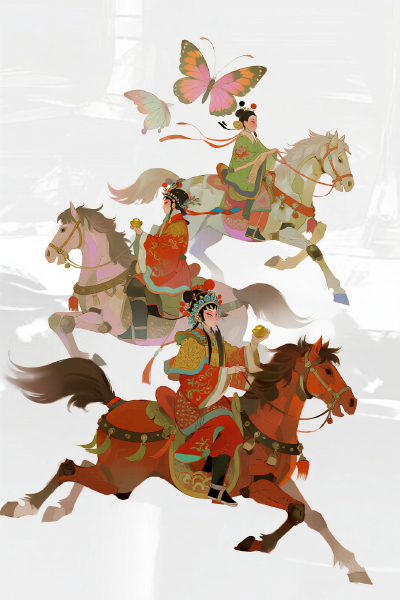 An AI-generated image by Shu Yong, created as part of his daily AI exercise (COURTESY PHOTO)
China-coded A decade on, that sense of distance has only grown more acute in Shu's AI experiments. Alongside his AI marathon, he also set to work on a large-scale non-AI landscape painting in the traditional Chinese style. The point, he said, was to make as direct a comparison between AI-generated content and traditional painting as possible: to see where the two converge, where they part company, and what, in the end, still distinguishes human creation. One problem he has become especially conscious of is that the underlying logic of many AI tools often carries a distorted reading of traditional Chinese culture, at times veering toward outright bias. Chinese written characters generated by such tools, he noted, often come out looking like meaningless scrawls. Enter a description, and the first images that appear typically feature Western faces, Western settings and Western aesthetics. Distinctively Chinese concepts, meanwhile, are sometimes rendered through negative or misleading lenses. "AI tools likely have a native tongue, and those who don't speak it are being left behind in ways that are subtle and consequential," Wesley Wu-Yi Koo, an assistant professor of management and organization at Johns Hopkins University, wrote in an article published on Chinese online publication Sixth Tone. For Shu, that native tongue is not merely linguistic but cultural. "If the way AI thinks is shaped mainly by other people's cultural vocabularies, China risks losing its own voice—and that is a very dangerous thing." That concern has also informed his role as a member of the 14th National Committee of the Chinese People's Political Consultative Conference (CPPCC), China's top political advisory body. At this year's CPPCC National Committee session, held from March 4 to 11, he proposed the creation of state-level laboratories to build homegrown models grounded in China's own knowledge systems and informed by its own values, aesthetics and cultural traditions. "If the future is to be one of human-machine collaboration, that collaboration will work best only when the machine speaks from the same cultural system and shares the same values as the people using it," he said. 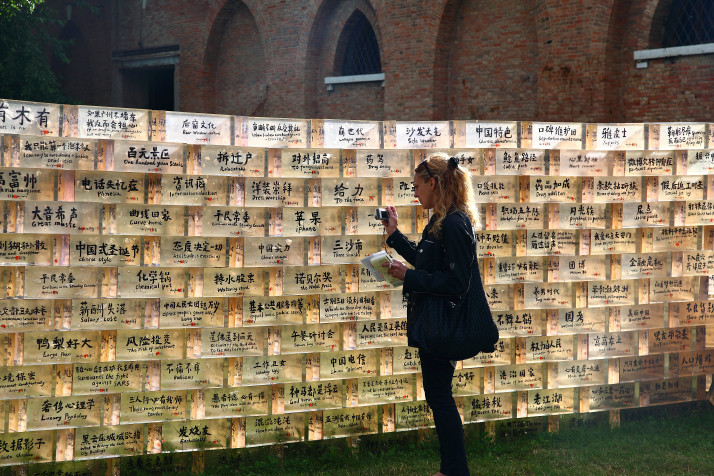 Google Bricks on display at the Venice Biennale in Venice, Italy, in 2013 (COURTESY PHOTO)
Creator commons Among the questions put to Shu at this year's CPPCC National Committee session, none came up more often than whether AI would one day replace artists. His short answer was no: If anything, the more capable AI becomes, the more valuable human creativity will be. That, however, does not mean artists can afford to sit back and relax. "In the AI era, the most essential skill will be the ability to ask good questions," he observed. "And that, in turn, requires artists to broaden their intellectual range—to understand art history, technology and all the other fields that help them write better prompts." In his view, AI will not just alter existing creative work; it will create entirely new art forms, along with the occupations needed to sustain them. That shift is already visible. AI webtoons, a nascent sector that uses AI to turn web novels or comic series into short videos, are beginning to carve out a space of their own on Chinese streaming platforms. In May 2025, "generative AI animation producer" was included among 42 new job categories recognized by China's Ministry of Human Resources and Social Security. But for all the promise of these new opportunities, Shu also sees a growing danger in the widening divide between those who can speak the language of AI and those who cannot. The creative power unlocked by AI tools, he argues, should not remain the preserve of professional artists or a narrow, tech-savvy crowd, but be opened to everyone. To that end, he has used the Shu Yong Museum of Modern Art, which he founded in Huangcun Town on the southern outskirts of Beijing, as the setting for dozens of exhibitions devoted to AI-generated art. Many of those invited to participate had no artistic background whatsoever: an elderly woman, a child, a farmer... someone with little to no connection to the art world. The idea was to give them direct exposure to the technology, so that its influence can radiate outward through the communities around them. For Shu, the world's encounter with AI is still at an early and very limited stage, which he likens to the old parable of the blind men and the elephant. "One touches only its tail, another its leg, another its ear—each of us is grasping only one small part of something much larger," he said. The task, then, is to allow more people to reach out to it, to experience more of it for themselves and, through these fragments of partial contact, piece together a broader understanding of what AI is and what it may become, he concluded. BR (Xu Bei and Shang Zhouhao contributed to this report) Copyedited by G.P. Wilson Comments to pengjiawei@cicgamericas.com |
|
||||||||||||||||||||||||||||
|