|
| China |
| Chinese modernization and the changing face of global opportunity | |
|
|
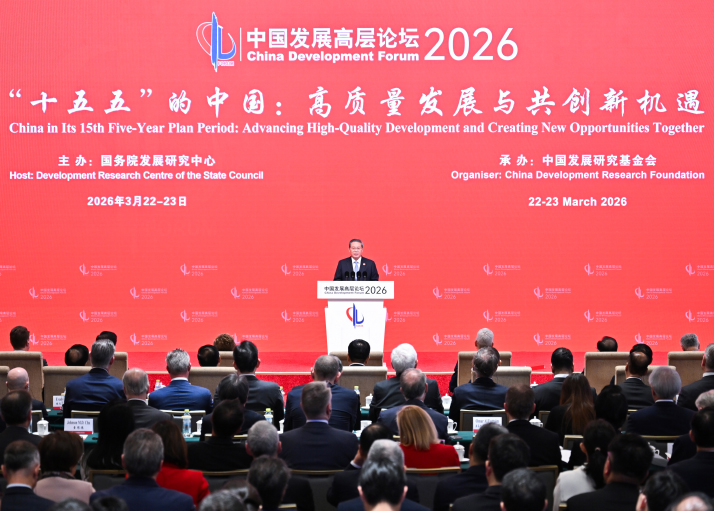 Chinese Premier Li Qiang attends the opening ceremony of the China Development Forum 2026 and delivers a keynote speech in Beijing on March 22 (XINHUA)
"A single tree does not make a forest, and a single note does not make a melody." With these words at the China Development Forum (CDF) 2026, Apple CEO Tim Cook on March 22 set the tone for an annual gathering that serves as a barometer of China's economic direction. He was co-chair of the event. Cook, who has witnessed China's transformation over nearly three decades of visiting the country, stood before an audience of global business leaders, policymakers and economists to deliver a message that transcended corporate interests. "During that time, the progress I have witnessed is nothing short of extraordinary. Today, China is home to some of the world's most dynamic cities," he said. As China embarks on its 15th Five-Year Plan (2026-30), the message is clear: The path forward requires collective effort, mutual trust and a shared understanding that China's pursuit of modernization is an invitation to grow together. "We have common goals, a common vision," Cook told the forum. "We hope to cooperate, trust each other and achieve shared objectives. That is precisely the significance of this forum." As Chinese Premier Li Qiang said at the forum's opening ceremony, the outline of the 15th Five-Year Plan for National Economic and Social Development, adopted in early March, serves not only as a new blueprint for China's development but also as a new opportunity for global progress. China will focus on promoting high-quality development, strive to sustain stable economic growth, continue to foster a sound business environment, fully implement national treatment for foreign-funded enterprises and enable businesses from all countries to operate in China with confidence and realize their full potential, Li said. Held in Beijing on March 22-23, the forum was hosted by the Development Research Center of the State Council, China's highest state administrative organ. Some 750 participants—entrepreneurs, officials, experts, and international representatives—attended the event, themed China in Its 15th Five-Year Plan Period: Advancing High-Quality Development and Creating New Opportunities Together. Certainty in an uncertain world Against a global backdrop of geopolitical fragmentation, supply chain disruptions and shifting trade policies, "certainty" has become a scarce commodity. The consensus at CDF 2026, echoed by Chinese officials and foreign executives alike, was that China is positioning itself as the "antidote" to global instability. "China is using its own certainty to address external uncertainties," Zheng Yongnian, Dean of the School of Public Policy at the Chinese University of Hong Kong, Shenzhen, told Beijing Review. "The 15th Five-Year Plan itself is a plan of certainty—it not only provides direction for national development but also sends a signal of stability to the world." John Quelch, Executive Vice Chancellor and American President of Duke Kunshan University in China, pointed out that China's long-term planning is both reliable and forward-looking. "I believe this makes China a source of innovation and a stabilizing force in the global economy," he told Beijing Review. This sentiment was more than rhetorical. For multinationals operating in China, certainty translates into strategic confidence. Saravoot Yoovidhya, CEO of Thailand's TCP Group—maker of the Red Bull energy drink—said, "Investing in China means investing in the future." He described the Chinese market as the "most important cornerstone" of his company's global strategy, a "ballast stone" that provides stability amid global demand fluctuations. Oliver Blume, Chairman of German Volkswagen Group, emphasized that China is not merely a market but a "leader in technological development." Volkswagen's "In China, For China" strategy, launched three years ago, is delivering results with locally developed intelligent connected vehicles—a model that the company is replicating in Europe. The message from China reinforced this narrative. Han Wenxiu, Executive Deputy Director of the Office of the Central Commission for Financial and Economic Affairs, delivered a keynote address underscoring that China's innovation capacity has "passed a certain inflection point" and that external forces cannot reverse the country's development trajectory. "China has a long-term, stable and safe development environment," Han said. "It is the finest safe harbor for international capital." Innovation as the engine Yet certainty alone, while necessary, is not enough to define a market's long-term appeal. What transforms a stable economy into a dynamic frontier is innovation. Here, China is rapidly shifting from merely a manufacturing powerhouse to a global source of advanced technologies. "In terms of automation and intelligent manufacturing, China has made remarkable progress, achieving precision and efficiency that were unimaginable not long ago," Cook said. As an example, he pointed to companies using AI for real-time product defect detection—a level of sophistication that places China at the forefront of the Fourth Industrial Revolution. China's renewable energy capacity is another example. The country has built the world's largest and most complete new-energy industrial chain and now accounts for over 40 percent of global patents in the new-energy sector. Its solar conversion efficiency, offshore wind turbine capacity and energy storage scale have all set world records. But the innovation story extends beyond green tech. At the forum, Joe Tsai, Chairman of Alibaba Group, outlined four factors behind China's success in AI: strategic investments in power infrastructure, an open-source ethos that breaks down barriers, vast data from the world's largest manufacturing sector and immense potential for AI applications across industries. What these factors suggest is a shift in the nature of opportunity, from accessing low-cost labor to co-developing AI-driven solutions that can be scaled across both China and global markets. Around the world, manufacturing is undergoing a profound shift. Digital technologies are not simply improving efficiency, they are changing how products are designed, built, operated and supported over their entire lifecycle, Judy Marks, Chair, CEO and President of U.S. elevator maker Otis, said at the forum. According to her, China's broader emphasis on integrating digital technologies with industrial development creates opportunities to improve transparency, coordination and long-term equipment performance. "We have a clear view that our innovation strategy in China is a two-way street. We bring to China the technologies we develop, and we try to learn and take advantage from many different fronts of progress in manufacturing, robotics, AI and mechanization," Beto Abreu, Global CEO of Brazilian pulp producer Suzano, told Beijing Review. Investing in China 2.0 If innovation defines the "how" of China's next phase, the "what" is equally transformative. The 15th Five-Year Plan signals a shift toward new growth drivers: domestic consumption, high-end services and the green economy. Han was explicit about this rebalancing and acknowledged that expanding consumption—especially services consumption—remains a massive untapped opportunity. He said China will implement an income growth plan for urban and rural residents to boost household consumption's contribution to GDP growth. This shift has profound implications for foreign investors. As China's manufacturing sector matures, the new frontiers are in services, including telecommunications, the Internet, education, culture and medical care. Han confirmed that China will "expand market access and opening up in services as a priority," following the complete removal of foreign investment restrictions in manufacturing in 2024. The financial sector is also opening up further. Pan Gongsheng, Governor of the People's Bank of China, the central bank, told the forum that China will "steadily promote the high-level opening up of the financial sector," facilitating cross-border payment systems to make it easier for foreign investors to participate in China's stock and bond markets—the world's second largest. Meanwhile, the green transition is creating investment opportunities on a scale rarely seen. Under the 15th Five-Year Plan, the target is to raise the share of non-fossil energy in total consumption to 25 percent while reducing carbon dioxide emissions per unit of GDP by 17 percent. For companies with expertise in renewable energy, carbon reduction technologies and sustainable infrastructure, China represents the world's largest laboratory for green growth. According to CEO of Danish manufacturing company Danfoss Kim Fausing, "China offers long-term policy clarity, particularly regarding green transition and high-quality development. Such stability makes China a strategic priority for Danfoss." In consumer-facing sectors, growth remains robust. Chris Kempczinski, CEO of McDonald's, said the company is building about 1,000 restaurants annually in China—a sign of sustained confidence in the country's domestic market. KPMG China Chairman Justin Zou captured the moment succinctly: "China's economy is demonstrating rare stability and leadership. Its steady progress, super-large domestic market potential, and resilient industrial system inject a force of certainty into global economic growth." Cook's metaphor of the forest lingered in the corridors—a reminder that China's vision for the 15th Five-Year Plan is not a solitary endeavor, but an invitation to global partners to co-create, co-invest and grow together. As Sean Stein, President of the U.S.-China Business Council, put it, "Companies realize it's a whole lot easier to be successful in China if they know the direction the river is going to flow." (Print Edition Title: An Invitation to Grow Together) (Xu Bei contributed to this report) Copyedited by Elsbeth van Paridon Comments to mamm@cicgamericas.com |
|
||||||||||||||||||||||||||||
|