
|
| China |
| Humanities graduates and AI: Promise or mirage? | |
|
|
 LI SHIGONG
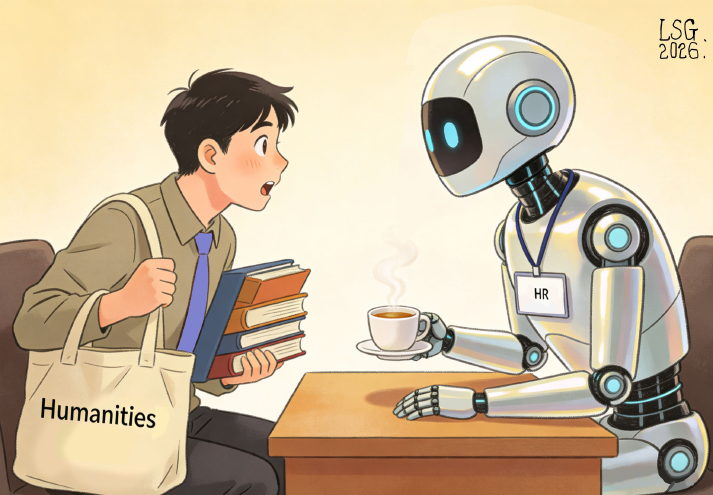
Recently, Chinese tech giants including Alibaba and ByteDance have launched well-paying AI-related recruitment drives targeting humanities graduates—positions ranging from model training to ethical evaluation and prompt design. The announcement ignited widespread discussion. Many interpret it as a long-awaited "spring" for liberal arts students in the age of AI, where language, ethics and creativity appear newly valued. Others, however, question whether this is genuine integration or simply a pragmatic response to labor gaps and public relations needs. Gao Lu (Zhejiang Daily): The so-called "spring for humanities graduates" is not an accident but a return of humanistic thinking to the technological sphere. This convergence is not a token gesture; it is an acknowledgment that machine learning cannot exist without meaning. In the age of large language models, the power of algorithms depends on the depth of language, culture and empathy they contain. Humanities scholars are not bystanders—they are interpreters of values, translators of culture and curators of nuance in a field too often obsessed with precision alone. When literature majors help shape prompts, philosophers join AI ethics teams and sociologists evaluate bias in data sets, technology regains its human face. Their contributions may seem subtle, but they influence how intelligence itself is defined. Science and the humanities should walk hand in hand, allowing empathy to flow into code and culture to breathe through data. What truly deserves to be called a "spring" is not the paycheck but the moment when technology learns to serve humanity with conscience and creativity. Li Yaxin (Rednet.com): The sudden enthusiasm of big tech companies for liberal arts graduates feels warm on the surface but carries the chill of expediency. Behind every idealistic narrative lies the practical need for low-cost, high-volume labor. Many of these so-called AI positions are repetitive and mechanical: emotion labeling, cultural proofreading and rewriting model outputs. The pay may seem attractive, yet the work seldom requires the true spirit of humanities. Calling this moment a "spring" oversimplifies a complex reality. When these roles remain marginal, temporary and easily replaced by future automation, the gesture of inclusion may turn into a form of disguised exclusion. Real respect for humanities talent should mean sustained participation in decisionmaking—ethics boards, content direction and product design—not simply short-term contracts in the name of accountability. If the industry cannot provide long-term growth paths for these recruits, the "humanities AI spring" may wilt faster than it bloomed. Tan Min (Guangzhou Daily): The excitement surrounding the "AI recruiting humanities graduates" phenomenon reveals both optimism and unease. It demonstrates that society has awakened to the importance of cultural literacy in AI, but it also exposes deep structural problems. Encouraging as it is to see literature, sociology and philosophy appear beside computer science, universities remain slow to adapt. Many liberal arts curricula still train for traditional scholarship, not interdisciplinary applications. True collaboration requires transformation on both sides. Humanities students must learn the grammar of data and algorithms, while engineers must acquire moral imagination and communication skills. Only when each side understands the other's logic can genuine co-creation happen. The inclusion of humanities voices is therefore not just about jobs; it's an attempt to humanize technology before technology defines humanity. The future of AI should not be measured merely by efficiency or scale, but by how deeply it understands the people it serves. BR Copyedited by Elsbeth van Paridon Comments to yanwei@cicgamericas.com |
|
||||||||||||||||||||||||||||
|