|
| Governance |
| Driving high-quality growth | |
|
|
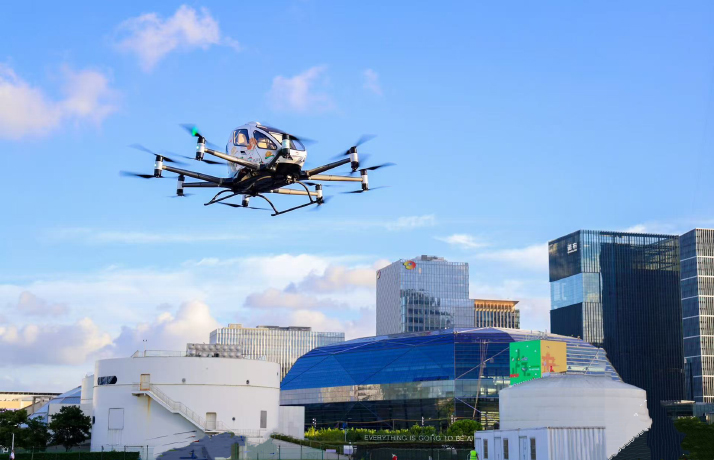 An electric vertical takeoff and landing aircraft flies over Shanghai on July 23, 2025 (XINHUA)
Over the past five decades, China has steadily strengthened its technological and economic capabilities. A key turning point came in December 1978, during the Third Plenum of the 11th Central Committee of the Communist Party of China, when reform guidelines introduced by then leader Deng Xiaoping were adopted. These reforms were implemented through the Four Modernizations—agriculture, industry, defense and science and technology, and through the broader policy of reform and opening up, which was considered a viable path for China to become a major global economic power. Through these efforts, China expanded domestic consumption and redirected technological development toward improving product quality. More recently, China's technological and development strategy has been shaped by the 14th Five-Year Plan (2021-25), which identified key areas for progress, including industry, enterprises, foreign trade, population development and advancements in science, technology and education. Building on this foundation, China has developed a framework centered on maintaining stability and advancing development. At the same time, China has been advancing a form of digital diplomacy that integrates infrastructure, telecommunications, finance and technology. This approach also stresses the need to reduce inequality and promote sustainable development, as part of a broader effort to support economic recovery. Central to this process are two guiding pillars: the dual circulation strategy and the development of new quality productive forces. A new development model With the launch of the 15th Five-Year Plan (2026-30), China aims to further boost domestic consumption while continuing to upgrade its technological capabilities. A central element of this strategy is the development of new quality productive forces, which are intended to transform the economy toward higher value-added production and innovation-driven growth. The emergence of this new development philosophy signals a shift away from traditional growth models toward one that integrates advanced factors of production, including digital technologies, data and innovation ecosystems. The goal is to promote high-quality development, improve people's wellbeing and modernize systems of social governance. This approach, emphasized during the 2026 Two Sessions—the meetings of the National People's Congress (NPC), China's top legislature, and the Chinese People's Political Consultative Conference (CPPCC) National Committee, the top political advisory body—reflects China's long-term objective of achieving sustainable and inclusive growth. In practical terms, the immediate task of developing new quality productive forces is to modernize the industrial system by fostering high-quality production processes. This involves expanding domestic demand to stabilize growth expectations, while increasing productivity through technological innovation and data-driven development. At the same time, China seeks to accelerate the growth of future-oriented industries, while carefully avoiding the risks of industrial overcapacity and speculative bubbles. China has identified several priority sectors that will play a critical role in this transformation. These include next-generation information technology, high-end machinery and robotics, aerospace and aviation equipment, advanced maritime engineering and shipbuilding, railway systems, energy-saving and new-energy vehicles, electrical equipment, new materials, biomedicine and advanced medical devices, as well as agricultural machinery. Together, these sectors account for a large share of China's industrial added value and are expected to drive future economic growth. In addition, a wide range of strategic emerging industries is being developed to support new quality productive forces. These span cutting-edge fields such as quantum science, digital manufacturing, fintech, high-speed transportation, renewable energy, electric vehicles, next-generation communications including 5G and 6G, advanced materials, biomanufacturing and commercial space technologies. Innovations in areas such as drones, robotics, post-quantum cryptography, hydrogen energy and additive manufacturing are also expected to play a key role. The Artificial Intelligence Plus initiative, launched by China last year, further underscores China's ambition to integrate AI across industries and enhance technological self-sufficiency. Looking ahead, China is positioning itself at the forefront of technological innovation by investing in future industries. At the same time, it is promoting the transformation and upgrading of traditional industries, refining policy support for emerging sectors and encouraging region-specific approaches to developing new quality productive forces. These efforts are expected to provide strong momentum for China's continued economic recovery and long-term development. Global implications China's new development philosophy is not only reshaping its domestic economy but also influencing its role in the global system. The 15th Five-Year Plan represents a pivotal step toward achieving the goal of basic socialist modernization by 2035, and represents China's economic resilience and its potential to contribute to global growth. China has increasingly positioned itself as a builder of world peace, a contributor to global development and a defender of the international order. Through its commitment to multilateralism, China seeks to play an active role in reforming and improving global governance. This includes expanding its participation in international forums, agreements and initiatives, thereby increasing its influence within the global system. A key dimension of this strategy is China's engagement with Global South countries. Through a range of globally-oriented initiatives launched in recent years, China has sought to address international challenges. These initiatives focus on areas such as infrastructure development, energy and food security, public health and cultural exchange, while promoting cooperation based on mutual benefit. The Global Development Initiative, in particular, emphasizes support for developing countries through mechanisms such as the Global Development and South-South Cooperation Fund. Meanwhile, the Global Security Initiative underscores the importance of resolving conflicts through dialogue and cooperation, and the Global Civilizations Initiative promotes mutual understanding and peaceful coexistence among nations. In parallel, China has advanced green diplomacy to address climate change, reaffirming its commitments under the Paris Agreement and promoting global cooperation on digital governance and sustainable development. These efforts reflect China's broader vision of inclusive multilateralism and its aspiration to contribute to a more balanced and multipolar world order. At the same time, geopolitical tensions and economic uncertainties continue to shape the global environment. China has emphasized that rising unilateralism and protectionism pose challenges to global trade and economic stability. In this context, the 15th Five-Year Plan stresses the importance of strengthening domestic demand, deepening the integration of technology and industry, consolidating foreign trade and expanding high-level opening up. Ultimately, China's new development model—centered on innovation, new quality productive forces and sustainable growth—aims to enhance both domestic resilience and global engagement. As China moves forward, its development trajectory will not only shape its own future but also influence the broader evolution of the global economic and geopolitical landscape. BR The author is a professor at the Center for International Relations, the National Autonomous University of Mexico Copyedited by Elsbeth van Paridon Comments to dingying@cicgamericas.com |
|
||||||||||||||||||||||||||||
|