The past year saw a complicated relationship between China and the European Union (EU), with the emergence of elements of conflict against the background of generally favorable interaction.
Basically, bilateral relations have developed in a positive direction. In the political area, high-level exchange of visits were frequent. From May to December, German Chancellor Angela Merkel, European Parliament President Josep Borrell Fontelles, Italian Prime Minister Romano Prodi, French President Jacques Chirac, EU Trade Commissioner Peter Mandelson and Cyprus President Tassos Papadopoulos paid consecutive visits to China.
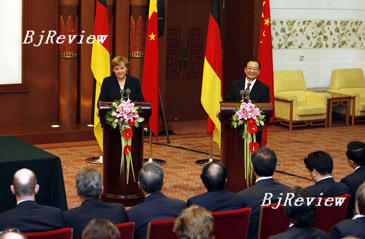
In September, Chinese Prime Minister Wen Jiabao visited Finland, Britain and Germany, and attended the Ninth EU-China Summit held in Helsinki. The two sides also held a series of broader, high-level strategic dialogues, such as the dialogue between foreign ministers of China and EU countries, bilateral talks on government purchases and a Sino-EU business summit. These visits, consultations and dialogues have consolidated the political basis of the relationship between the two sides.
In the economic field, the momentum of cooperation maintained. According to statistics from the Chinese Ministry of Commerce, the bilateral trade volume in 2005 totaled $217.3 billion, and it amounted to $246.1 billion in the first 11 months of 2006, up 25.1 percent year on year. By the end of June 2006, China had introduced 22,855 technological items from the EU with a contractual value of $95.62 billion. The EU has invested in 24,033 projects in China, with a contractual value of $92.8 billion and paid-in capital of $50.56 billion.
In the field of science and technology, bilateral cooperation has been intensified, injecting vigor into the two sides' trade and economic relations. In February last year, the Sixth China-EU Energy Conference was held in Shanghai. In September, the annual conference of the EU-China Information Society Project took place in Beijing at which experts from China and the EU exchanged views on the information development strategy. This cooperative project, which will last for three and a half years, involves around 220 million yuan provided by both sides. In October, a seminar on China-EU scientific and technological cooperation was held in Brussels. The seminar, touching on a broad array of topics, such as renewable energy, the environment, biotechnology, agriculture, food, animal health and the exchange of research personnel, discussed ways of bilateral cooperation within related R&D framework. On October 11, the China-EU Science and Technology Year was launched in Brussels under the theme of Cooperation for Sustainable Mutual Benefit.
Unfavorable elements
Preceding this progress, China and the EU established a comprehensive strategic partnership in 2003, and in 2005 the two sides carried out diplomatic activities to commemorate the 30th anniversary of the establishment of bilateral relations. All these phenomena make people feel that China and the EU have entered a mature and deeper relationship. But, in fact, the strong political relations have often covered up conflicts and contradictions in the economic field.
As time wore on to 2006, the complexity and uncertainty in China-EU relations emerged prominently. Europeans worry that a rapidly rising China will be a challenge or threat to Europe, and the huge trade deficit with China is also a headache for European leaders. Against this backdrop, such fallacies as a "China threat" and "vigilance toward China" emerged, which has greatly affected European governments' policy-making toward China.
Although quite a number of Europeans hold that China's rise will not threaten the basic interests of Europe--former German Chancellor Helmut Schmidt said that Europeans have no need to fear China, and former British Foreign Secretary Douglas Hurd maintained that the "China threat" theory is groundless--the biased opinion has indeed affected the stance and attitude of the EU toward China.
|