|
 |
|
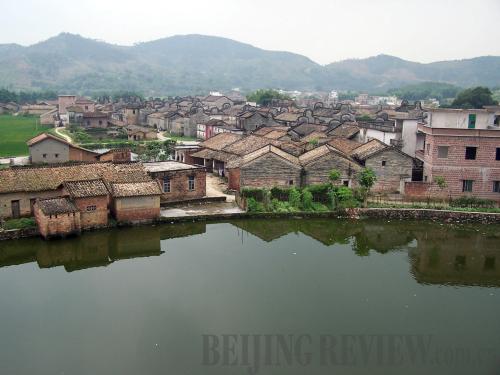
DWELLINGS IN PEACE: Shangyue Village of Fogang County in north Guangdong is famous for panhandle-shaped decorations on gables of houses (COURTESY OF FOGANG COUNTY) |
The Chen Clan Ancestral Temple, completed in 1894, for instance, is a representative work of Lingnan architecture. Sponsored by the Chen families across the province, it was originally built as a temporary residence for their children taking part in imperial examinations and activities in the capital.
It's a typical Lignan-style ancestral hall with a shrine for Chen descendants to worship their ancestors. It comprises a comprehensive and exquisite expression of Guangdong folk arts and crafts. All its buildings have been decorated inside and outside with wood, brick and stone carvings, ceramic and clay sculptures, iron and bronze castings as well as colorful paintings. The ancestral hall became the Guangdong Folk Arts Museum in 1959.
While numerous museums and cultural relics house the city's splendid history, civilization and folk traditions, modern buildings, such as the Guangzhou Opera House and the Guangzhou TV and Sightseeing Tower, in the city's new towns are landmarks of contemporary arts.
The province has also won a reputation for its fine cuisine. If idling with friends at a street-side, open air eatery is the main course of Cantonese nightlife, then going to a concert at the Guangzhou Opera House is becoming the dessert choice for many.
The opera house, designed by Iraqi-British architect Zaha Hadid, is known for its avant-garde twin-boulder design and challenging angles. Efforts to conquer technical difficulties in construction have been rewarded: the opera house evokes poetic associations with two boulders washed ashore from the river.
In its web-like exoskeleton, the opera house includes a 1,800-seat theater as well as a multipurpose hall and support facilities. It was inaugurated by a lavish production of Giacomo Puccini's Turandot directed by American Shahar Stroh on May 6 this year.
Countryside
An hour's ride from Guangzhou takes travelers to villages nearby, where people will have a different experience from city life. Ancient buildings, such as ancestral temples and old-style private schools, stand in their entirety in thousands of ancient villages in the province.
As part of the national project of folk cultural heritage presentation of the China Federation of Literary and Art Circles (CFLAC), 64 ancient villages in Guangdong have been entitled to be protected since 2007.
"We are lucky to have those ancient villages retaining their natural states," said Feng Jicai, a prominent writer and CFLAC Vice President. "With the innumerable intangible cultural heritage they house, these villages provide the Chinese with a spiritual home and are evidence of the nation's cultural diversity."
Kaiping diaolou and nearby villages were inscribed on the World Heritage List of the UN Educational, Scientific and Cultural Organization (UNESCO) in 2007.
The diaolou are multi-storeyed defensive village houses in Kaiping, a city about two hours' driving southward from Guangzhou. Built by Chinese emigrants who had returned from North America, South Asia and Australasia during the late 19th and early 20th centuries, the diaolou buildings "represent a complex and confident fusion of Chinese and Western architectural styles" and "testify to the final flowering of local building traditions that started in the Ming Dynasty (1368-1644) in response to local banditry," said the UNESCO description.
The location selection and layout pattern of these ancient villages reflect the influence of fengshui, knowledge revealing how to balance the energies of any given space to assure the health and good fortune of inhabitants. Fengshui is based on a Taoist vision and understanding of nature, particularly that the land is alive and filled with energy.
Many ancient villages have been built in forms of the Eight Diagrams (an eight-sided diagram derived from The Book of Changes. Each side represents a different aspect of life, such as wealth, career and marriage.), the Wain, or a chessboard. Such an architectural concept sprang from the desire of the ancient Chinese to communicate with nature.
For instance, Xiangang Village and Licha Village in Gaoyao under the jurisdiction of Zhaoqing in west Guangdong are examples of the Eight Diagram-shaped village layout. Encompassed by moats and country roads, houses in the two villages have been arranged in the form of the Eight Diagrams of Taoist cosmology.
Qingang Village in north Guangdong's Lianzhou, which enjoys a history of at least 700 years, was planned in the shape of the Wain, where every lane symbolizes the orbit of its seven stars. Folk traditions are well preserved in many villages. In Qingang Village, there was a custom in the past that any piece of paper with characters was not supposed to be thrown away and should be burned in a special kiln. Now villagers in the village still observe the tradition of valuing education and showing respect for knowledge and literacy.
In Shangyue Village of Fogang County in north Guangdong, women who have children collaborate with mother-in-laws in a quilt dance during the Spring Festival. It's an event only for women, unlike the popular Cantonese lion dance which is only for men of dexterity. The village, with a history of more than 720 years, is also famous for panhandle-shaped decorations on gables.
Lingnan-style architecture
Lingnan literally means the five mountain ranges running eastward across the region south of the Yangzte River and usually refers to Guangdong Province in south China and Guangxi Zhuang Autonomous Region in the southwest.
Lingnan-style architecture refers to a typical architectural style widespread in this region known for its gorgeous and heavy decorations, such as carvings and sculptures of varied materials, its emphasis on location for harmony with the surroundings, as well as its compact layout and design which suits the humid local climate. |