|
 |
|
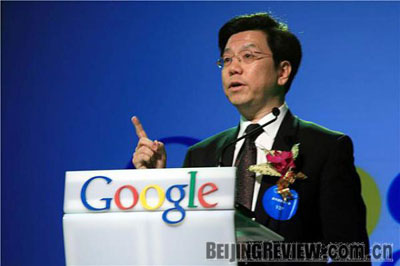
Dr. Lee Kaifu, President of Google China, delivers a speech at the launching ceremony on March 30 (COURTESY OF GOOGLE CHINA) |
Since joining Taiwan-based Enjoy Music in 2002, Jonas Chiu has had to deal with two opposing forces: music companies protecting their products versus Internet users downloading them for free. In 2008, Chiu moved into his new office in downtown Beijing as the branch officially began operations on the Chinese mainland, ranging from album production to market promotion.
"It was embarrassing to admit that we were in a dilemma. We badly needed a platform, like the Internet, to promote our music; but unfortunately, most of the songs that appeared on the Internet were unauthorized by music companies," Chiu, chief operation officer of the Beijing branch, told Beijing Review. "It was a headache to choose which side we stood on--marketing or copyright protection."
Fortunately, the legal music search launched by Google China in cooperation with Top100.cn on March 30 seems to be a remedy for Chiu's confusion.
"Authorized and high quality music that is free to download is what sets our music search apart," Dr. Lee Kaifu, President of Google China, said at the launching ceremony. According to Lee, Top100.cn has signed contracts with more than 140 music companies including Warner Music, Sony BMG, Universal Music and EMI. The number of authorized songs has reached 1.1 million, with 350,000 already posted online. Revenue for the music companies will come from online advertisements posted on the download page.
"The foundation for our music search creativity and sustainable development is to stifle piracy in the cradle. The revenue model we introduced respects the music industry and offers a win-win solution. Only by combining Google's top technology, Top100.cn's expertise and resources from the music industry can the Chinese Internet industry create a healthy and lasting business environment," Lee said.
Although Lee said pure business interest was not and never will be Google's top consideration, he is confident that more users will choose Google's music service.
 |
|
Representatives from Google China, Top100.cn and music companies attend the launching ceremony on March 30 in Beijing (COURTESY OF GOOGLE CHINA) |
Chiu said that Google's new service is a good start for music authorization on the Chinese mainland. "The search and downloads are free for users; at the same time, music providers can share in the revenue. On the company side, it is good to see that Google's solution works. In the era of the Internet, music companies need a platform for closer cooperation with technologies, which is totally different from those unauthorized music websites," he said.
What's more, on the marketing side, the Google music search provides companies a larger platform to promote new artists. According to Chiu, the revenue that a music company gains mainly comes from artists' commercial advertisements, including soft drinks and 3C products (communication, computers and consumer electronics products), rather than album buyers. More popular artists will get more advertisements. Hence, the biggest challenge in promoting a new artist stems from the uncertainty of his or her marketing budget.
"That is probably the reason why few music companies on the Chinese mainland manage to promote new artists successfully. Most singers now come from the TV singing competitions," Chiu said. "In 2005, we signed Xian-zi, who was born on the Chinese mainland, and managed to promote her in both the Taiwan and mainland markets. The marketing in her case was attributed to many factors, which is an exception and difficult to copy.
"Currently, most music we listen to comes from Taiwan and Hong Kong. The pop stars that truly belong to or symbolize the mainland only account for a small part. Hence, we are looking forward to seeing more platforms like the Google music search that help marketing and at the same time make money for music companies. This is the only way a music company can invest in a new artist. What's more, it provides more options for marketing our new artists," Chiu said. |