|
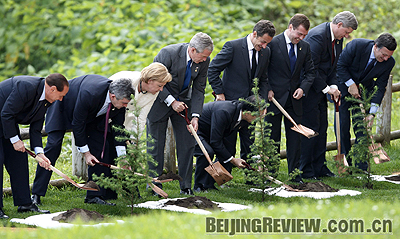
PHOTO OPPORTUNITY: G8 leaders plant trees in the northern Japanese resort of Toyako, Hokkaido, on the sidelines of their annual meeting
The global economy. Food security. Climate change. These were some of the critical issues haunting the leaders from Group of Eight (G8) developed countries and developing countries from across the world when they met in Hokkaido, Japan, on July 7-9.
After the G8 nations--Britain, Canada, France, Germany, Italy, Japan, Russia and the United State--convened their annual summit, they held an outreach session with five major developing countries, namely China, Brazil, India, South Africa and Mexico. All these countries, as well as South Korea, Australia, Indonesia and the European Union, also had a working session on energy security and climate change.
Chinese President Hu Jintao attended the outreach session of the G8 Summit and the major economies' meeting on energy security and climate change, spelling out China's principled positions on a number of pressing issues.
China's views and proposals are so compelling and relevant that the international community cannot afford to ignore them, experts say. But China should not be expected to shoulder responsibilities beyond its capabilities, they argue.
Facing the facts
Jin Canrong, Deputy Dean of the School of International Studies, Renmin University of China, said this year's G8 Summit was held against a special backdrop: The world economy is plagued with many problems, the international influence of the United States is on the decline, and uncertain factors in international relations are increasing.
Although the G8's authority in setting the agenda for the world has declined, efforts to use this forum to make China's voice heard are conducive to the country's development, he said.
Hu put forward a four-point proposal [see sidebar] on promoting the balanced, coordinated and sustainable development of world economy at the outreach session of the G8 Summit.
"As one of the biggest beneficiaries of economic globalization, China does not want to overthrow the existing international economic system; instead, it tries to make it better," Jin said.
Although the international community welcomes the rapidly emerging country to play a greater role on the world stage, it should act within its own capabilities, because it is still a developing country and its economy is far from large on a per-capita basis, he added.
In recent years, the dialogues and exchanges between China and the G8 have been increasing, said Assistant Foreign Minister Liu Jieyi at a press briefing shortly before the G8 Summit. In the long run, strengthening dialogues and cooperation between them will not only serve the interests of both sides, but also benefit the peace, stability and development of the world, he said.
A world of challenges
This year marks the midpoint to achieve the UN Millennium Development Goals (MDGs) by 2015. Hu called on the international community to take this opportunity to further demonstrate political will and mobilize all resources to achieve the goals.
The MDGs are eight goals officially established at the UN Millennium Summit in 2000, ranging from eradicating extreme poverty to halting the spread of HIV/AIDS and providing universal primary education.
African leaders attending the summit urged rich nations to keep their promises to assist the continent. Heads of state from seven African countries were invited to the Hokkaido summit.
In regard to the surging food prices, Hu said they are the combined result of many factors. To blame the development of developing countries for world food price hikes "does not tally with the facts," he said. The top priority now is "to scale up assistance, support the UN in playing its coordinating role, work to stabilize food prices and help the developing countries to tide over the difficulties," Hu said.
|