|
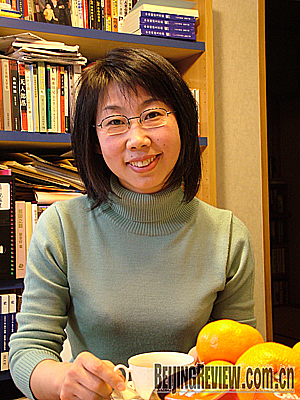
"It is my destiny to take the road to become a translator," said Qin Lan, a Japanese-language translator and researcher with the Institute of Foreign Literature, Chinese Academy of Social Sciences. She is also an editor for the reputed journal World Literature, which came into being in 1953.
Back in high school, Qin wished to be a judge. In her college application, she signed for China University of Political Science and Law. However, her teacher suggested she pursue literature and helped to shape Qin's future.
"That might have been a turning point for me," she said. She ended up as a student in the Department of Chinese Language and Literature in Northeast Normal University.
After college graduation in 1985, she found a job as an editor for the Higher Education Publishing House in Beijing. In 1992 she took a three-month leave to accompany her husband to Japan where he was studying Japanese history after winning a scholarship from the Japanese Government.
"Unexpectedly, I had stayed in Japan for almost 12 years: quitting my job in China, obtaining a master's and doctoral degree from two universities and working as a university teacher for Chinese literature for five years until returning to China in 2004," Qin told Beijing Review.
New Career
"My career as a literature translator began with the launch of a new Chinese-Japanese literature magazine The Blue," Qin recalled. It was autumn 1999 in Japan when a friend of her husband came to visit them. Both Li and her husband were literature fans and became good friends at the university.
After a long night of talking they decided to start a literature magazine publishing original and translated works both in Chinese and Japanese, serving as a bridge connecting the literature of the two countries. The first issue came out in July 2000, launching Qin's translation career as one of the main editors.
"I found great enjoyment in the process of solving the translation difficulties," said Qin. So far she has translated works by a dozen Japanese writers, including Kenzaburo Oe and Yukio Mishima.
The process of translating different books is similar, Qin explained. The translator has to read through the book to get a general idea of what it is about. Then, she must find the sense and feeling of the language that fit the original work. The actual translation work is a long process of checking and re-checking, sometimes asking friends for help. The translator also has to take notes to make the book easier for readers to understand. Most of the time, the first draft is followed by re-edits.
Qin recalled that once she was given the task of translating a collection of novels by the female Japanese writer Matsuura Rieko. The collection consisted of three novels featuring stories about lesbians. The subject and the language were both unfamiliar to Qin, who found the work difficult to translate. She had to ask one of her female Japanese friends for help, who explained some of the body language described in the book. When it came to some embarrassing descriptions, they just laughed it off and kept going.
Qin believes there is a bad trend in the translation business: that is hurrying the translation of award-winning books. Though it helps Chinese readers to keep up with literature from other countries, it also leads to some poorly translated works, she said, turning first-class books into poor copies. "It is like turning a horse into a lame donkey, which is a misfortune for both the writers and readers," Qin said.
In 2004 Qin became translator and editor for World Literature. It was the best-selling literature journal in 1970s and 1980s when its peak circulation hit 300,000 copies. Now its circulation has declined to around 10,000.
"Despite this our 12 editors chose to hold on to it. We picks up good literature according to our own standards instead of following the trends," Qin noted. She is one of the earnest editors who disputes even the smallest marks of punctuation.
"Thanks to its sober editors and excellent translators with remarkable dedication, I still have faith that World Literature will become a classic again in the future," Qin added. |