|
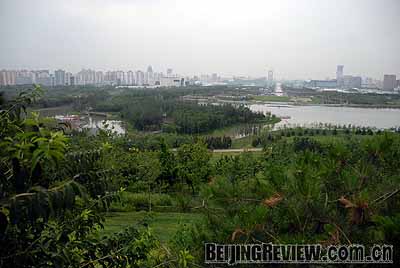
CITY OASIS: The Olympic Forest Park, the largest artificial green area of Beijing, is ready to welcome guests from all over the world (JIANG XIAOYING)
"We've already fulfilled our commitment for the green Olympics," said Cao Qingyao, Spokesman of the State Forestry Administration at a press conference on June 17. The meeting was held in Yanqing County, a county in the surburbs of Beijing that is 78 km northwest to the urban area. It used to be a place with inclement natural conditions and barren mountains.
Since 2000, a forestation project has been launched to re-green Yanqing. Beishan Hill, which stretches for 20 km, used to be a bald mountain. After six years of forestation it was transformed into beautiful scenery.
The barren beach of Longqing Valley, 8 km north to Yanqing County, which occupies 1,067 hectares, used to be a source of sand storms blowing through Beijing due to its low plant cover. Starting from 2002, the local government began to conduct a comprehensive transformation project of the area. The whole project was divided into four phases. Now it is a forest corridor that attracts tourists from the urban areas of Beijing.
Meanwhile, the government of Yanqing County has also employed forest rangers to protect the environment. In their fatigues and red safety helmets the rangers themselves have become an attraction.
Olympic Commitment
When Beijing won its bid for the 2008 Olympic Games, the city made a commitment of fulfilling seven greening targets. By the end of 2007, it had achieved all of them. Green cover in Beijing, in mountainous areas, and in urban areas has reached 51.6, 70.49 and 43 percent, respectively, all exceeding the targets of 50, 70 and 40 percent set out in the Olympic bid.
Three green ecological barriers have been formed, forming a circle around the city; a green belt of 25,000 hectares has been planted along the city's main rivers and highways, beating the original goal of 23,000 hectares; 12,600 hectares of forest has been established in total, exceeding the promised 12,000; and nature reserve areas 8.18 percent larger than the land area of Beijing have been established, in excess of the original 8-percent target. Meanwhile, the urban green land area and public green land area per capita in Beijing have reached 48 square meters and 12.6 square meters, respectively.
A total of 160 greening projects for 31 stadiums, 45 gymnasiums and connecting lines for roads have proceeded well in the run up to the Olympic Games. The green landscape development project covering 680 hectares in the Olympic Forest Park, the core area of the Olympic Park and National Avenue has almost come to an end. The Olympic Forest Park, which will be put into trial use on July 1-5, is the largest artificial afforested land area of Beijing. It sits near to the Bird's Nest and Water Cube and is regarded as an "axis to nature."
"We have planted 530,000 trees of 180 different breeds, and it will surely become a shining spot for the Olympics," said Yang Tong, Vice General Manager of the Olympic Forest Park Development Co. Ltd.
In recent years, the Beijing Municipal Government has taken into consideration the living environment of residents and required that each district of the city should develop one or two large-scale green areas annually. Meanwhile open space has been fully utilized to develop small green parks in accordance with the reality of residential districts so that residents have access to parks and green areas within 500 meters of their homes. In addition, various approaches have been adopted to create a greener environment for downtown areas. These include greening on roofs and developing green-covered parking lots, so that residents can enjoy a green lifestyle despite living in a city.
During the period 2001-07, the green land area in Beijing rose by 10,000 hectares, trees increased by 22.71 million and lawn areas grew by 46.53 million square meters, which greatly improved the environment in the city by sequestrating 211,000 tons of carbon dioxide. Now, Beijing has weeping willow trees along Changpuhe River, towering old trees in the Temple of Heaven, green city walls along the Second Ring Road and Landscape Avenue along the Fourth Ring Road. A large open green area covering 10,000 square meters has been developed along the Financial Street.
To help combat sandstorms, the Standing Committee of the National People's Congress, China's top legislature, promulgated laws and regulations to combat desertification. In recent years, the Central Government has invested 14 billion yuan ($2.04 billion) annually to implement land control in key areas.
A total of 463 institutions in the city have worked together with 277 villages in carrying out the "Joint Efforts for Building a New Countryside" activity. They have helped each other in greening endeavors so as to make the suburban area greener and more beautiful.
Future Goals
Last year, the Communist Party of China and the Chinese Government proposed a strategic goal of building an ecological culture by 2020. According to the plan, national forest cover shall reach 20 percent by 2010, and 26 percent by 2050. By 2030, over 90 percent of natural wetlands shall be effectively protected, and a quite complete wetland conservation and management system shall be established. By 2050, nature reserves will account for 16 percent of the total land area.
"I would like to mention that the greening undertaking has received not only support from all walks of life in Beijing, but also assistance from the international community," said Dong Ruilong, Director of the Beijing Municipal Gardens Bureau at a press conference. Seventeen forestry cooperation projects have been implemented jointly with 11 countries and three international organizations, which helped facilitate the greening campaign in Beijing. Meanwhile, the Chinese Government has actively taken part in global planting to fulfill its responsibility as a big country. It attaches great importance to and actively takes part in the1- Billion Plantations Campaign and 6.7-Billion Plantations Campaign that were initiated by the United Nations Environment Program. The Chinese Government implements international conventions, proactively participates in combating the illegal timber trade, and has issued Chinese Enterprises Guidelines for Sustainable Management of Forests Abroad to promote global forest resource rehabilitation and sustainable development.
"The pursuit of a green life is a symbol of modern civilization and our ultimate goal as well. We are confident and determined to make new achievements in the future," said Liu Tuo, General Director of the Desertification Combating Office of the State Forestry Administration. |