|
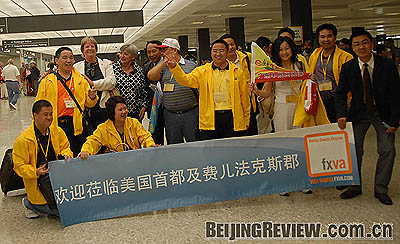
WELCOME TO THE STATES: Helen N. Marano, Director of the Office of Travel and Tourism Industries under the U.S. Department of Commerce (third from left), greets the first organized group of Chinese tourists to visit the United States at Washington Dulles International Airport in northern Virginia on June 17 (CHEN WEN)
When Americans in the manufacturing sector cried out, "The Chinese are coming," some years ago, they expressed a restless concern and warning about a possible loss of job opportunities. Now Americans in the tourism industry issued the same cry on June 17-but this time, it was a welcome call to greet the first organized group of Chinese tourists to the United States. U.S. tourism officials have high expectations that well-off Chinese visitors, who are ready and willing to spend loads of yuan, will give a big boost to their industry.
"We're very excited," said Helen N. Marano, Director of the Office of Travel and Tourism Industries under the U.S. Department of Commerce. Before she talked to Beijing Review on June 17, Marano and her colleagues had been waiting for more than two hours at the international arrivals terminal at Washington Dulles International Airport to give a warm welcome to the first organized group of Chinese tourists to visit the United States.
The first group consisted of 250 tourists, who left from Beijing, Shanghai and Guangdong on June 17, the day when newly appointed Chinese Vice Premier Wang Qishan and U.S. Treasury Secretary Henry Paulson started the fourth round of the China-U.S. Strategic Economic Dialogue (SED) in Annapolis, Maryland. Each was backed by a big delegation of heavyweight ministerial officials.
Coincidence could not provide a satisfactory explanation to the two events taking place on the same day. As a perfect example of one of the concrete results of the bilateral high-level dialogue started by Chinese President Hu Jintao and U.S. President George W. Bush in 2006, the first Chinese tourist group's arrival in the United States was widely reported by the Chinese media as adding zest to the two-day semiannual forum.
At the previous SED meeting last December, Chairman of the Chinese National Tourism Administration Shao Qiwei and U.S. Commerce Secretary Carlos Gutierrez signed a memorandum of understanding between China and the United States to facilitate outbound tourist group travel from China to the United States. Under this agreement, China granted an "approved destination status" to the United States, allowing Chinese travel agencies to market tourist packages to American destinations and permitting U.S. destinations to advertise directly to the Chinese public.
The agreement "is estimated to bring up to 100 million Chinese travelers to the United States over the next 15 years," Paulson said at the SED meeting in Annapolis.
But what people in the U.S. tourism industry care more about is how they can get a big slice of the pie.
"I'm getting calls already from people saying things like, ‘How do we get to do this?' and ‘How do we attract Chinese tourists to our area?'" Marano told Beijing Review. Marano said she had been waiting for this market to be open for more than five years and that she was so excited now to see it finally happen.
As a show of hospitality, Marano and the visitors' bureau of Fairfax County, Virginia, with which her office has joint partnership, threw a celebration for the long-awaited group of Chinese tourists at the airport. There was a jazz band and greeters holding banners in Chinese that said, "Welcome to the capital and Fairfax County."
"Everybody here is trying to be as hospitable as they can for the Chinese to see the very best of America," Marano said. She noted that Gutierrez was planning to greet the visitors on a grand welcome cruise in Washington on June 19.
One visitor, who identified herself as Ms. Miao from Beijing, was one of the 250 lucky travelers to be included in the inaugural group.
"As soon as I saw the notice of the first leisure group to the United States, I went with my husband to apply for this special tour group," said the professional accountant, who also has traveled to Europe and Japan. "We were so lucky to be chosen from so many applicants. I started to get excited when I stepped out of the airplane."
Miao told reporters that she planned to spend another $4,000 in the United States during the 11-day trip, which costs around $3,500. Besides Washington, other stops include New York, Los Angeles and Hawaii.
According to Charlie Shao, President of the Los Angeles-based Galaxy Tour, which is hosting the initial Chinese tourist groups to the United States, shopping is one of the activities included in the tour package, but it was only scheduled for the tour's last day. But "we can adjust these activities according to the requirements of our tourists," Shao said.
Shao told Beijing Review that he had been waiting for Chinese tourists for many years and that he now expects a large increase of Chinese visitors in the near future. To prepare for this, his agency has recruited and trained more than 130 Chinese-speaking tourist guides.
(Reporting from Washington D.C.) |