|
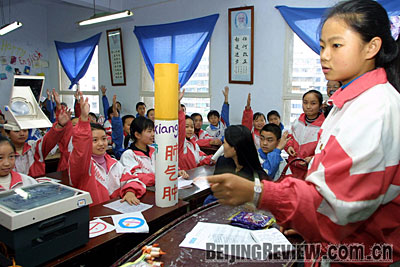
On the eve of the national publicity week for tumor prevention and control starting on April 14, Wu Yilong, Deputy Principal of Guangdong Provincial People's Hospital, revealed an inconvenient truth to the media: children and adolescents are increasingly becoming the victims of smoking induced cancers.
Wu told Guangzhou Daily that his hospital received three young lung cancer patients of around 20 in 2007, all diagnosed with senior stage cancer. Each of them was a non-smoker, but had been subject to an environment of frequent passive smoking. "Studies exhibit that it usually takes 15 years of being exposed to the pollution of smoke to developing cancer," Wu was quoted as saying. He said children were particularly sensitive to the cancer-causing agents in cigarette smoke as their bodies are still growing.
Beijing issued new rules in March to expand smoking restrictions from schools, sports arenas and movie theaters to bars, Internet cafes, hotels, offices, holiday resorts and all indoor areas of medical facilities from May 1. Besides being a move to meet China's pledge of a smoke-free Olympics, this new measure will hopefully reduce the kind of tragedies Wu has seen.
Secondhand smoke
China has 350 million smokers, the largest national smoker population in the world. Meanwhile, 540 million Chinese are victims of secondhand smoke, of who 180 million are children under 15 years of age, according to the annual tobacco control report of the Ministry of Health for 2007.
Professor Li Yan of the Tumor Surgery Department of Zhongnan Hospital of Wuhan University said during an interview in April that tobacco smoke out of smokers' mouth with moisture was like an aerosol, more penetrating than smoke from lit tobacco. As an aerosol it attacks all the respiratory organs, including windpipes, bronchi and lung air sacs. Children's lungs have weaker mucous membrane, which makes them more vulnerable to poisoning from secondhand smoke.
According to figures on the occurrence of cancer in 2006 released by the Ministry of Health recently, lung cancer was the most deadly cancer for both Chinese men and women.
Zhou Huaqing, Principal of Tianjin Medical University General Hospital and a renowned lung cancer expert, said it is common knowledge within the international medical community that smoking is the most important cause of lung cancer and over 80 percent of lung cancer cases are related to smoking or passive smoking.
He said of the more than 5,000 chemicals in tobacco smoke, over 50 are cancer-causing agents, which could do more harm to passive smokers than to smokers themselves. He said the intensity of some cancer-causing agents in the smoke in the air from a lit cigarette is higher than that of smoke inhaled by smokers, such as nitrosamines.
The report also revealed that according to the national prevalence surveys on smoking from 1984, 1996 and 2002, although the numbers of smokers among the population was declining, there was no progress in passive smoking.
|