|
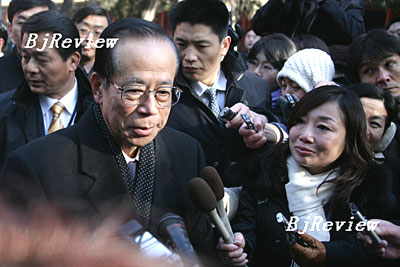
Japanese Prime Minister Yasuo Fukuda paid his first state visit to China on December 27-30, 2007, with a packed schedule of meetings that he had hoped would cement his country's official bonds with China and help him establish personal trust with the Chinese.
During their talks in Beijing, Fukuda and Chinese President Hu Jintao, Premier Wen Jiabao and Chairman of the National People's Congress Standing Committee Wu Bangguo reached a broad consensus on constructing and developing "strategic and mutually beneficial" relations between China and Japan and charted the future course for their relations.
Fukada's four-day tour also took him to the port city of Tianjin, where he visited a factory operated by a joint venture between Toyota Motor Corp. and China's First Automobile Works, and Qufu, Shandong Province, the birthplace of Confucius.
Chinese international affairs experts hailed the success of Fukuda's visit, saying it ushered an early spring into China-Japan relations, which have just been put back on track after years of stagnation. But the two Asian neighbors still face major challenges while embracing new opportunities to warm their relations, they said.
Fukuda's visit heralded the advent of spring for China-Japan relations, said Liu Jiangyong, a research fellow specializing in Japanese studies at the Institute of International Studies at Tsinghua University. Fukada focused on political topics when he held talks with Chinese leaders in Beijing. In Tianjin, home to many enterprises funded by Japanese investment, he encouraged Japanese investors and professed support for China's reform and opening up to try to boost economic ties between the two countries. Later in Qufu, Fukada underlined the two nations' shared cultural traditions. Liu said.
During Hu's meeting with Fukuda, the Chinese president said that political leaders on both sides had a duty to develop long-term, stable and neighborly relations. He said they should make concrete efforts to enhance their dialogues and consultations, strengthen mutual understanding and trust and appropriately handle major sensitive matters in their bilateral relations.
In what he called "a heart-to-heart dialogue," Fukuda promised Wen that he was determined to treat bilateral relations earnestly in the year to come. In turn, Wen proposed that China and Japan should maintain the momentum of their good relations through mutual visits and meetings by the two countries' state leaders and conduct high-level coordination on issues of common concern to enhance political mutual trust. He also suggested that China and Japan should cooperate in areas such as energy, the environment, finance, high technology, telecommunications and intellectual property protection. The countries also should carry out further personnel exchanges to strengthen their friendship, Wen said.
After their talks, Wen and Fukuda signed three cooperation documents in the fields of youth exchange, climate change and energy research. According to the agreements, Japan will help China train 10,000 young people on energy-saving and environmental protection technologies in three years. In addition, about 50 young Chinese researchers on climate change will be invited to visit Japan annually in the following four years.
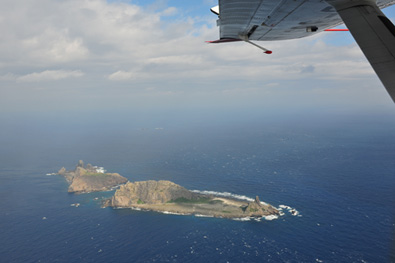
Wen and Fukuda also reached a new consensus on the demarcation of the East China Sea, which has long been a point of contention in the two countries' relations. They agreed to elevate consultations to the vice ministerial-level and strive for an early solution to the issue.
Addressing the two countries' long-time disagreement on wartime history, Fukuda said Japan would "very earnestly" reflect on the agonizing part of history and continue to follow the path of peaceful development so as to establish "forward-looking China-Japan relations."
Fukuda also said Japan would give no support to the claims of "one China, one Taiwan," "Taiwan independence" or the Taiwan authorities' attempts to join the UN and seek UN membership through a referendum, a position highly appreciated by the Chinese side.
|