|
Since China and Japan established diplomatic relations 35 years ago, especially during the past 20-plus years since China initiated its reform and opening-up policy, trade and economic relations between China and Japan have developed quite quickly.
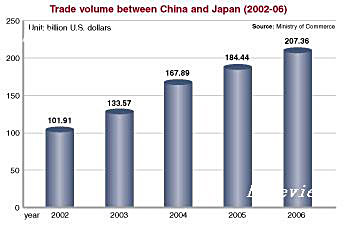
In 2006, Sino-Japanese trade volume reached $207.36 billion, increasing 12.5 percent from a year earlier. China exported $91.64 billion to Japan, up 9.1 percent from the previous year, while China imported $115.72 billion from Japan, for a yearly growth rate of 15.2 percent. China is Japan's second biggest importer and Japan is China's third biggest importer.
Japan is now China's second biggest investor, but its total investment in China in 2006, $4.598 billion, was 29.6 percent lower than that in 2005. Japan has been China's main technology exporter in recent years: one fifth of China's imported technologies and one sixth of China's imported high technologies are from Japan. Trade and economic relations between the two countries are formed on the basis of a strong complementarity.
This is an outstanding characteristic of their trade and economic ties. But, as economic globalization expands and China's economy develops steadily, the content of that complementary relationship is being gradually altered.
First, the trade structure between the two is changing. In the 1980s, China exported crude oil, coal and agricultural byproducts in return for Japan's mechanical equipment, automobiles, home electrical appliances and steel. In the 1990s, industrial products took up a greater proportion of China's export structure and primary products were no longer the main export products to Japan.
Last year, China's exports to Japan centered on mechanical and electrical equipment and spare parts, textile raw materials and products, non-precious metals and related products, foods and beverages, and cigarettes and alcohol. Meanwhile, China imported mechanical, electrical, audio and video equipment and spare parts, non-precious metals and related products, chemical industrial products, and optical and medical equipment from Japan. What China imports from Japan are capital- and technology-intensive products, including IT products and mechanical equipment, while Japan imports relatively labor-intensive products from China.
Second, direct investment complements the bilateral trade ties. In recent years, as China's economy has developed, its industrial structure has been upgraded, with an enlargement of the market scale. Japan's domestic industrial structure has made adjustments as well, as Japanese enterprises focus on setting up a global labor division system. Thus, the complementary nature of Sino-Japanese ties in the investment field has become more obvious, and the investment standard is higher. Evidence shows that Japanese enterprises' direct investment in China favors the development of Sino-Japanese trade. The growth of China's exports to Japan on some level is a benefit of Japanese direct investment, which is also the inevitable result of a complementary advantage and cooperation mutually beneficial to China and Japan.
Although bilateral trade ties have developed to a certain scale, these ties have degraded in recent years.
Trade was the first field to be influenced. In 2006, Sino-Japanese trade volume grew 12.5 percent on a year-on-year basis, which was lower than the average growth rate of such trade during the previous 12 years. Meanwhile, the Sino-Japanese trade volume was only 11.8 percent of China's total trade volume last year, while in 1994 the proportion was 24 percent.
Recently, Sino-Japanese political relations have encountered some problems, which have influenced the development of bilateral trade and economic relations. However, the degraded trade and economic ties cannot be regarded as the direct result of changed political relations.
|