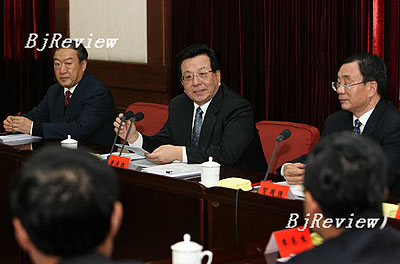
Forty-six-year-old Su Hongyou is the head of the county government in the province of Jiangxi. Su considers himself a local civil servant, so when the opportunity of receiving training organized by the Central Government came up in December, he was pleasantly surprised.
Managing a county populated of around 670,000 people, Su's day-to-day work involves association with people from all walks of life and a tight agenda. For the past seven years of his tenure, Su has attended training courses organized by provincial and prefecture governments, but never one from the Central Government, until December.
Lecturers at Su's training course told him and his classmates, 5,300 county heads from all over China, "President Hu Jintao said at the beginning of 2006 at a training course for provincial government officials, 'Training for civil servants should not stop at the provincial level since county-level officials are the front-line commanders for building a socialist countryside.'" That message is the background for Su's training.
"I had thought this training program would be no different from previous ones--dry and boring--but it turned out to be beyond my expectations. I should say that its influence on me is huge," said Su. He added that during the training course, many high ranking government officials and experts imported to the students the urgency and necessity of building a socialist countryside.
"There were no political slogans in the class. Instead, lecturers illustrated their points with facts and figures, totally facing the music," said Su. He added that he used to believe that "building a new socialist countryside" was no more than a political slogan, but at the training, for the first time, felt like the cause was his own.
According to a training compendium issued by the State Council, China's cabinet, at the end of February, China plans to put all of its 6 million civil servants through training courses in the next five years. This would build on 5,000 county officials and 500 provincial officials who already participated in training programs during 2006. According to the circulated training plan, this new initiative is intended to "enhance the political quality and governance capacity of civil servants and enable them to steer comprehensive and sustainable social development."
|