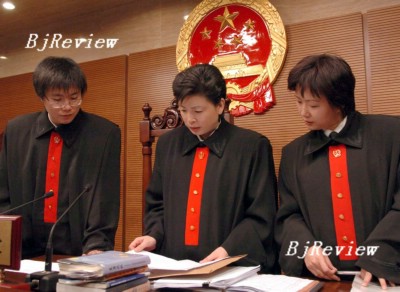
Starting on January 1, the power to review death penalty decisions reverted from local higher courts to the highest trial organ in China, the Supreme People's Court.
At present, there are two methods for reviewing death penalty decisions in China: holding a trial of the accused and reading the case files. Though the latter procedure, being in written form, secret and unilateral, is good at saving time and improving efficiency, it has come under serious question.
The current primary review procedure is a behind-the-scene check of the written materials related to a case. It doesn't require a trial of the defendant, nor does it need the participation of defense counsel. Such a procedure is too administrative, however, said Chen Guangzhong, Honorary President of the Institute of Evidence Law and Forensic Science of the China University of Political Science and Law.
Though in some cases the Supreme Court tries a defendant, this is just an internal check as it is done without the involvement of the prosecuting or defense attorneys, which is unfair to the defendant, said Chen Ruihua, a professor at the Law School of the Peking University.
In addition, it's hard to find flaws in a case just by reviewing the files. And such an administrative procedure goes against modern judicial concepts, given its lack of transparency.
"Such a decision on capital punishment is too risky as well as slapdash," said Chen.
In his opinion, it is impractical to hold a trial for every death penalty review case. But as long as one of the three sides-prosecutor, defendant and defense attorney-requests a trial, it should be held. That means the defendant also enjoys the right to choose certain judicial procedures.
Many legal experts hold that the legal system should be further perfected, and the key is to make the review a legal proceeding. At the very least, the defense attorney should be allowed to participate in the review to defend the accused.
But conditions are not ripe for such a transformation, said Zhao Bingzhi, President of China's Criminal Law Society and professor at the Renmin University of China. Zhao reasoned that the transformation would lead to a profound adjustment of criminal law, which is more difficult and costly than the revision of the death penalty review procedure.
"The biggest issue for now is how to guarantee the real participation of the counselors for both parties, instead of a formality," Xu Yingrong, a legal researcher with the Jiangxi Provincial High People's Court, told Beijing Review.
The death penalty review procedure is not a legal proceeding but a remedy procedure, Jiang Xingchang, Vice President of the Supreme People's Court, told the press. But Jiang also emphasized that judges must listen to the attorneys for the accused while reviewing a death penalty case. "In principle, the defendant needs to be tried in the review of a death penalty," he said.
The second challenge facing the Supreme Court comes from the question of what should be reviewed.
In international practice, supreme courts do not have a fact-checking function. But in China the Supreme Court had been checking both the facts of a case and the legal process. Chen of Peking University thinks it's a disadvantage for the Supreme Court to look into the details of a case as it is far from the location where the case took place. The main responsibility for the court when reviewing the death penalty is to provide judicial explanations and establish precedents.
According to a Chinese jurist Chen Xingliang , the Supreme Court should focus on the application of the law.
|