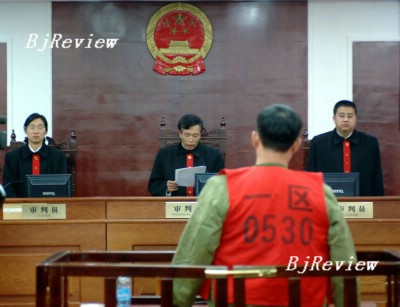
For the last five years, 54-year-old attorney Zhu Zhanping has doggedly monitored every inch of progress made by the nation's capital punishment trial reform. His hope was that one day the highest court in the land would once again preside over death sentence cases. Zhu finally heard the news he had been waiting for on October 31, when the regular meeting of the Standing Committee of National People's Congress (NPC) adopted an amendment to the country's Organic Law of People's Courts to retrieve the power of death penalty review from the provincial high courts. The new amendment, which requires all death sentences to be approved by the Supreme People's Court, took effect on January 1, 2007.
Even before the new law was adopted, Xiao Yang, President of the Supreme People's Court, said the new policy was aimed at allowing each death sentence to withstand any scrutiny and prevent any wrongful conviction and execution. Media see the new move as the latest initiative by the judicial system to exert stricter controls over the application of the death penalty.
Zhu's name has become synonymous with the death penalty reform after he represented a young man sentenced to death in court. In April 2001, Zhu's persistent efforts forced the Supreme People's Court to deliver a last-minute stay of execution for a young man named Dong Wei. What makes this case dramatic is that the order was passed to the executioners only four minutes before the preset execution time. The case caused a sensation throughout the country. Dong was, however, executed four months later.
The failure to defend the young man caused Zhu to suffer great bouts of depression, and he even flirted with the idea of quitting his career. He dropped out of society for a month, and refused to accept any new lawsuits. Yet during this period, the frustrated Zhu received countless letters of support. Meanwhile, a group of renowned jurists began to openly discuss and review the ruling of this lawsuit, which was widely reported in the media, creating unprecedented public interest.
Zhu, who claims he knows what is ailing China's death penalty system, has become an active criminal attorney since 2003. He has, since this time, focused his energy largely on lawsuits related to the death penalty. So far, he has successfully defended six criminals sentenced to death.
"As lawyers, what we can do is to eliminate the abuse of execution in every case," said Zhu. He regards the return of the power of death penalty review to the Supreme People's Court as a mark of government's changed attitude towards the death penalty. The change emphasizes the respect for life and the prudent ruling of the judicial system. "This is a goal that many people with a career in the legal justice system have been working for," he said.
Decentralization
According to international human rights criteria relating to the death penalty, in countries practicing capital punishment, the final say rests with the country's supreme court of justice. China had stuck to this principle until reform in 1980.
In the country's first Criminal Law and the Criminal Procedure Law, which went into effect on January 1, 1980, it was stipulated that the rulings of death sentences should be either delivered or reviewed by the Supreme People's Court.
At that time, China's reform and opening up had been underway for only two years and government's lack of administrative experience had bred a deterioration of public security. Under such circumstances, the Supreme People's Court found itself short of resources to conduct re-examination for the surging death penalty cases handed out by local courts. To guarantee the normal operation of the Supreme People's Court, the NPC Standing Committee adopted a new legislation to temporarily and partly put the power of death penalty review into the hands of provincial high courts.
|